
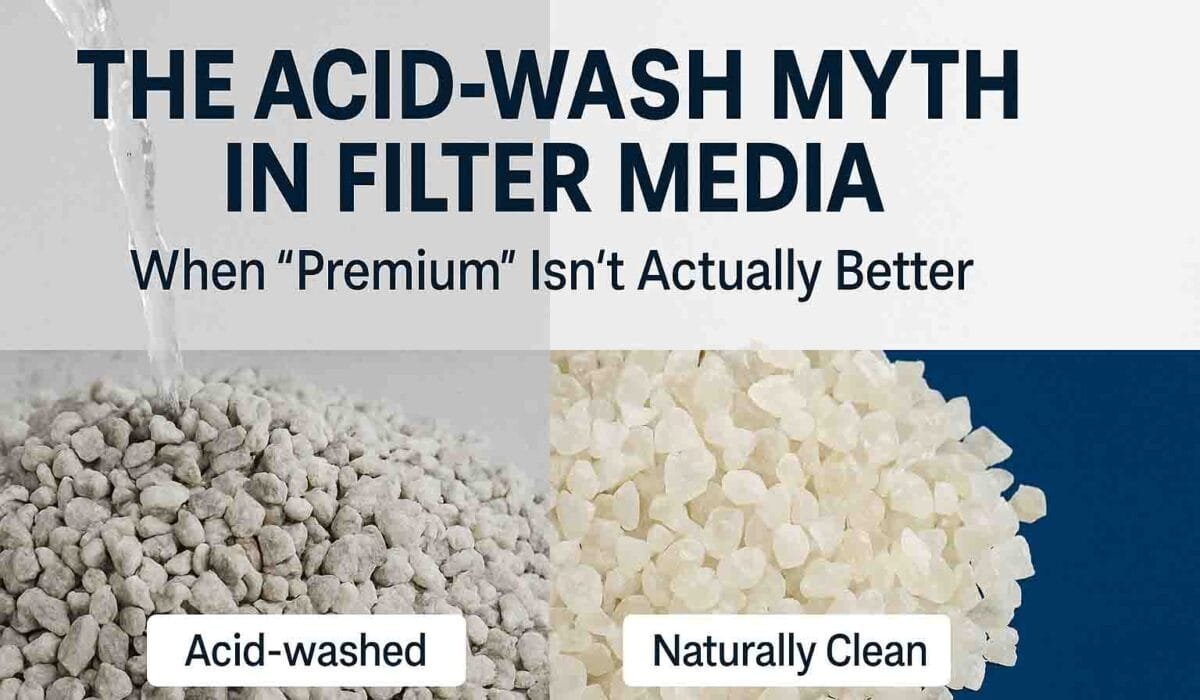
The Acid-Wash Myth in Filter Media: When “Premium” Isn’t Actually Better
In water treatment, terms like high purity, acid-washed, and premium-grade often catch attention. They sound scientific and trustworthy. But not everything that sounds refined actually performs better in the field.
One of the most persistent misconceptions in the filtration industry is that acid-washed filter media are always superior. Many assume that acid-washing improves filtration efficiency, removes impurities, and extends media life. But is that really true?
In this article, we break down the science, reality, and marketing myth surrounding acid-washed filter media and show you how Starke Aquacare Technologies helps customers make decisions based on data, not hype.
What Does “Acid Washing” Mean?
Acid washing is a chemical cleaning process in which a dilute acid solution (often hydrochloric acid or sulfuric acid) is used to remove impurities like iron oxide, carbonates, or surface stains from a media’s outer surface.
It is commonly performed on:
Activated Carbon
Silica Sand
Gravel
Anthracite
Zeolite (in some cases)
The idea is simple: the acid reacts with certain impurities, dissolving or loosening them, leaving behind a supposedly “cleaner” media. But while this may sound beneficial, the effect depends entirely on what type of impurity and what type of media you’re treating.
The Common Misconception
Many buyers, integrators, and even consultants believe that acid-washed media are automatically higher in quality. They assume:
The acid removes invisible impurities.
The filtration performance increases.
It guarantees longer life and clearer output water.
However, this assumption doesn’t hold up under laboratory or field testing. Acid washing is not a universal improvement; in many cases, it is unnecessary or even harmful.
When Acid Washing Does Help
There are only a few cases where acid washing makes a measurable difference. One example is activated carbon used in food, pharmaceutical, or ultrapure water applications.
During carbon activation, trace minerals and ash residues can remain embedded in the pores. Acid washing removes these residuals, improving surface area and adsorption performance.
In such cases:
It reduces metal leaching into the treated water.
It improves chemical reactivity for chlorine or organics.
It helps meet NSF/ANSI 61 or food-grade purity standards.
So yes in the right context, acid washing has real purpose. But for many other filtration materials, it’s mostly a cosmetic process.
When Acid Washing Adds No Value
1. Silica Sand & Quartz Filter Media
If your raw silica sand already comes from a high-purity deposit (≥95% SiO₂) with low iron and no carbonate impurities, acid washing does almost nothing.
Instead, it can:
Damage the grain’s crystalline surface structure
Increase micro-cracking, causing dust formation during backwash
Alter the pH neutrality of the media if acid residues remain
The result? You might pay more for a media that performs the same or worse.
2. Gravel and Support Bed Media
Support gravels are naturally inert and mechanically filtered. Acid washing them only adds cost without changing particle integrity or porosity. What truly matters is the uniformity coefficient (UC) and correct layering, not acid treatment.
3. Anthracite Coal Media
Anthracite is already chemically resistant and physically robust. Acid-washing can weaken its sharp edges, reducing its ability to trap suspended solids. Worse, it can slightly dissolve carbon structure at micro levels, affecting its strength over time.
The Real Problem: Marketing vs. Science
Some suppliers promote acid-washed filter media as a “premium upgrade”, hoping to justify higher prices. While the surface may look brighter or “cleaner,” that visual appeal does not reflect real-world performance improvements.
In fact, acid washing can hide deeper issues:
Poor source quality: low-grade sand from clay-rich quarries
Improper washing: leftover fines and silt residues
Inconsistent particle sizing: irregular flow and head loss
Acid may remove stains, but it cannot correct grain shape, size uniformity, or mechanical strength—the true factors that define high filtration performance.
What Actually Defines Filter Media Quality
The best-performing filter media aren’t defined by chemical treatment but by physical and chemical precision. The parameters that matter most are:
| Quality Parameter | Ideal Value / Range | Importance |
|---|---|---|
| Effective Size (D10) | 0.45–0.55 mm (for sand) | Controls filtration rate |
| Uniformity Coefficient (UC) | ≤ 1.5 | Ensures even flow and backwash |
| Bulk Density | 1500–1600 kg/m³ (sand) | Affects bed stability |
| Silica Purity (SiO₂) | ≥ 95% | Ensures chemical inertness |
| Turbidity (NTU after rinse) | ≤ 1 NTU | Indicates clean, dust-free media |
When these parameters are optimized and verified as per AWWA B100 and EN-12904, acid washing becomes unnecessary.
That’s exactly where Starke Aquacare Technologies stands out.
Starke’s Approach: Purity Starts at the Source
At Starke, we believe quality begins at the quarry not in the acid tank.
Our filtration media undergo a multi-stage process that ensures consistent results without unnecessary chemical treatment:
Raw Material Selection:
Only high-silica, low-iron sand deposits are approved after XRF purity testing.Mechanical Washing & Grading:
Multiple rinse and screening stages remove clay, silt, and undersized fines achieving <1 NTU wash water clarity.Drying & Sieving (ASTM / IS-8419):
Controlled drying prevents micro-fracture and ensures stable effective size (ES) and UC values.Quality Testing:
Each batch is tested for D10, D60, UC, specific gravity, turbidity, and pH neutrality.Compliance Documentation:
Starke media are supplied with complete Inspection & Test Packages (ITP) including sieve analysis, lab reports, and MSDS ensuring traceability and confidence for project consultants.
Comparing Acid-Washed vs. Naturally Clean Media
| Feature | Acid-Washed Media | Starke Natural Media |
|---|---|---|
| Source Material | Often lower purity | High-purity quartz deposits |
| Cleaning Method | Chemical (acidic) | Mechanical + multiple rinses |
| Residual Risk | Acid traces, corrosion | pH neutral, inert |
| Surface Integrity | Can weaken | Maintained crystalline structure |
| Performance | Same or reduced | Consistent long-term flow |
| Compliance | Often unverified | AWWA B100 / EN 12904 / ISO 9001 |
The takeaway is simple natural purity beats artificial polish.
The Science Behind Why Acid Washing Isn’t Always Better
1. Acid Doesn’t Improve Particle Geometry
Filtration depends heavily on grain shape and angularity. Acid washing smoothens edges, reducing the interstitial voids that trap suspended solids. Over time, this lowers turbidity removal efficiency.
2. Chemical Stress Weakens Structure
The acid etching process can make silica more brittle, leading to fine generation during backwash increasing turbidity instead of reducing it.
3. Residual Acidity Alters System Chemistry
If neutralization isn’t complete, traces of acid can lower pH in the filter bed, corroding metallic components or altering downstream chemical dosing.
4. No Effect on Uniformity Coefficient
Acid cannot improve grading. Uniformity is controlled by precision sieving something Starke performs through automated ASTM mesh calibration.
Environmental and Safety Impact
Acid washing is also environmentally taxing. The effluent from this process contains dissolved metals, chlorides, and low pH water that must be neutralized before disposal.
At Starke, we promote eco-responsible manufacturing focusing on closed-loop washing systems, mechanical cleaning, and zero-chemical discharge. Our goal is simple: performance without pollution.
Standards and Certification Perspective
Global standards like AWWA B100, NSF/ANSI 61, and EN 12904 emphasize physical characteristics — not acid treatment — as the foundation of quality.
They specify:
Effective size, UC, hardness, and density
Absence of organic matter and clay
Cleanliness (turbidity of rinse water)
pH neutrality
Nowhere do these standards require acid-washing as a qualification. That’s because it’s not essential to performance.
Real-World Example
A Middle Eastern desalination plant once replaced acid-washed sand with Starke’s high-purity silica media. The results:
Reduced backwash frequency by 25%
Lower head loss across cycles
Zero pH drift in treated water
Longer media life (3+ years stable performance)
No acid, no additives just consistent grading and quality control.
Common Customer Questions
“Can acid washing make low-grade sand usable?”
Not sustainably. It might remove stains, but structural issues like high fines, irregular sizes, or weak grains remain.
“Does acid washing remove iron contamination?”
Only surface iron, not structural or embedded oxides. Proper source selection is a better long-term solution.
“Is acid washing mandatory for drinking-water media?”
No. For silica and gravel, compliance depends on purity, not acid treatment. For activated carbon, it’s application-specific.
Key Takeaway
The myth that acid-washed filter media are superior is rooted in perception, not performance. In modern filtration design, what truly defines quality is:
Source purity
Consistent grain size
Low turbidity
Neutral pH
Compliance with AWWA, EN, and ISO standards
Acid-washing cannot substitute these fundamentals.
Starke’s Knowledge-Driven Philosophy
At Starke Aquacare Technologies, we believe informed customers build better systems. That’s why we invest in research, field data, and education not marketing gimmicks.
Our filtration media, from Purozite™ Zeolite to Starmnox™ MnO₂, are designed for real-world performance validated by testing and global references.
Whether it’s municipal filtration, desalination pre-treatment, or industrial process water, Starke ensures that each batch you receive is backed by measurable data not myths.
Conclusion
In filtration, “acid-washed” isn’t a badge of honor it’s a process that only fits specific use cases. For most applications, it’s unnecessary, costly, and environmentally burdensome.
Choose Starke for what really matters:
✅ Consistent grading
✅ Proven purity
✅ Scientific validation
✅ Global compliance
When performance speaks for itself, marketing myths fade away.