
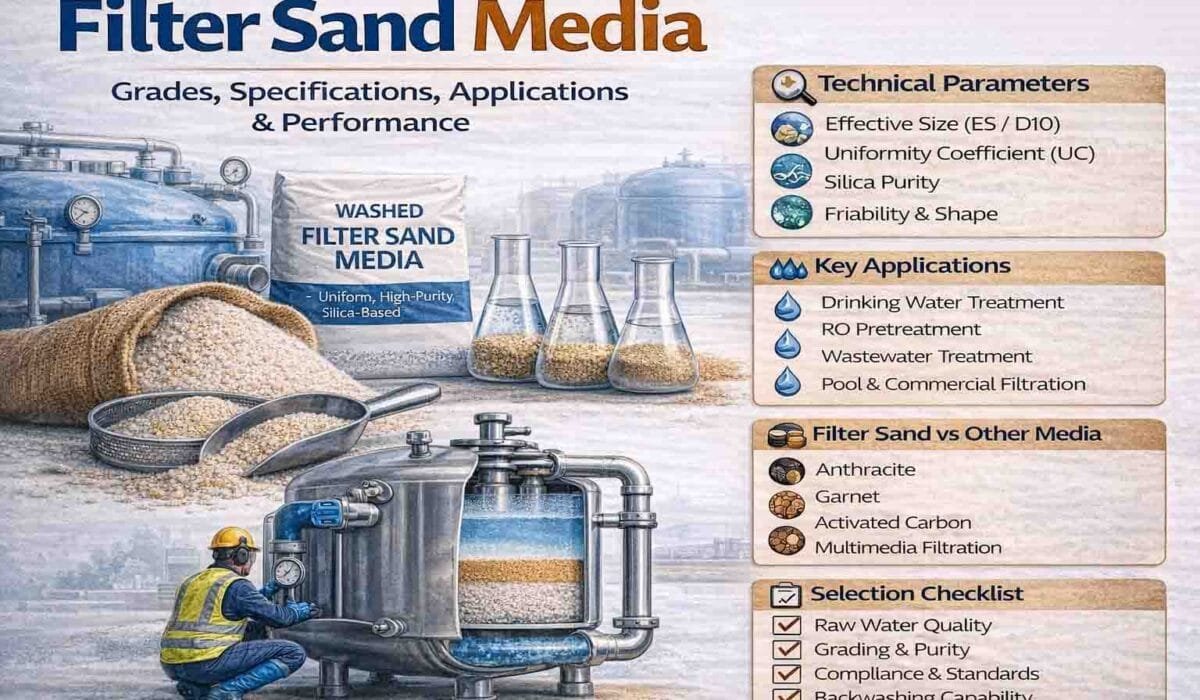
Filter sand media is one of the most widely used filtration materials in water and wastewater treatment systems. Despite the availability of advanced filter media, properly selected and graded filter sand remains the foundation of reliable filtration across municipal, industrial, and commercial applications.
However, not all sand is suitable for filtration. Performance depends heavily on particle size distribution, effective size (ES), uniformity coefficient (UC), purity, and operating conditions. Incorrect selection or poor-quality sand media often leads to filter failure, channeling, excessive pressure drop, or frequent backwashing.
This guide explains what filter sand media is, how it works, how it is specified, and how to select the right sand media for long-term filtration performance.
What Is Filter Sand Media?
Filter sand media is a processed, graded, and washed silica-based material used in filtration systems to remove suspended solids from water.
Unlike natural or construction sand, filter sand is:
Carefully graded
Free from clay, silt, and organic matter
Mechanically strong
Chemically stable in water
Filter sand media works primarily through mechanical straining, sedimentation, and surface adsorption, trapping particles as water flows through the sand bed.
Why Filter Sand Media Is Still Widely Used
Despite the availability of multimedia and specialty filter media, sand remains popular because it offers:
Proven performance over decades
Predictable hydraulic behavior
Compatibility with most filtration designs
Easy availability and cost efficiency
Simple operation and maintenance
When properly selected and operated, filter sand media delivers stable filtration performance with long service life.
How Filter Sand Media Works in a Filtration System
Filtration using sand media is not just surface screening. Removal occurs through multiple mechanisms:
Mechanical Straining – Particles larger than pore spaces are trapped
Sedimentation – Heavier particles settle within the bed
Interception & Adsorption – Fine particles adhere to sand grain surfaces
As filtration progresses, particles accumulate within the bed, increasing pressure drop until backwashing is required.
Key Technical Parameters of Filter Sand Media
1. Effective Size (ES / D10)
Effective size (D10) represents the particle diameter at which 10% of the sand is finer.
Smaller ES → finer filtration, higher pressure drop
Larger ES → lower pressure drop, coarser filtration
Correct ES selection is critical for balancing filtration efficiency and filter run time.
2. Uniformity Coefficient (UC)
Uniformity coefficient (UC = D60 / D10) indicates how uniformly graded the sand is.
UC ≤ 1.7 is typically preferred
Lower UC → more uniform flow and backwashing
High UC → risk of channeling and uneven filtration
UC directly impacts hydraulics, backwash efficiency, and media life.
3. Particle Shape and Strength
Filter sand grains should be:
Rounded to sub-angular
Resistant to attrition
Free from friable or flaky particles
Weak grains break down during operation, generating fines that clog the filter bed.
4. Chemical Purity
High-purity silica sand is essential to:
Prevent chemical leaching
Ensure long-term stability
Avoid water quality contamination
Filter sand should be inert across the normal operating pH range.
Common Grades of Filter Sand Media
Filter sand is supplied in different size ranges depending on application:
Fine sand – for low turbidity polishing
Medium sand – for general water treatment
Coarse sand – for high loading or pretreatment
Correct grading ensures:
Uniform flow distribution
Efficient backwashing
Minimal media loss
Applications of Filter Sand Media
1. Municipal Water Treatment
Used in:
Rapid gravity filters
Pressure sand filters
Multimedia filters
Sand removes turbidity, suspended solids, and particulate impurities.
2. Industrial Water Treatment
Applied in:
Process water filtration
Cooling tower makeup water
Boiler feed pretreatment
Sand filters protect downstream equipment and membranes.
3. Wastewater Treatment
Used in:
Tertiary filtration
Effluent polishing
Reuse applications
Sand filters help meet discharge and reuse standards.
4. RO Pretreatment Systems
Filter sand media removes:
Fine suspended solids
Colloidal particles
This reduces fouling of RO membranes and extends membrane life.
5. Swimming Pools & Commercial Filtration
Sand filters provide:
Clear water
Simple operation
Reliable performance
Filter Sand Media vs Other Filter Media
| Media Type | Primary Role |
|---|---|
| Sand | Turbidity & solids removal |
| Anthracite | Depth filtration |
| Garnet | Fine particle removal |
| Activated Carbon | Organics & chlorine |
| Zeolite | Ammonia & fine solids |
Sand often forms the base layer in multimedia filtration systems.
Common Problems Caused by Poor Filter Sand Media
Using incorrect or low-quality sand media leads to:
Sudden pressure drop
Channeling in filter bed
Mud ball formation
Media loss during backwash
Poor water quality
Most filtration failures traced to sand filters are media-related rather than equipment-related.
Filter Sand Media Backwashing Considerations
Proper backwashing is essential to restore performance.
Key factors:
Correct backwash velocity
Adequate bed expansion
Uniform flow distribution
Too little backwash causes clogging; too much causes media loss and breakdown.
Standards Governing Filter Sand Media
Filter sand is commonly specified under:
IS 8419 (India)
AWWA B100 (International)
EN 12904 (Europe)
Each standard defines:
Grading limits
Purity requirements
Physical and chemical properties
Compliance ensures predictable performance and inspection acceptance.
How to Select the Right Filter Sand Media
A proper selection process includes:
Raw water analysis
Target effluent quality
Filtration rate and loading
Backwash system capability
Applicable standards
Sand selection should be application-driven, not price-driven.
When Filter Sand Media Should Be Replaced
Replacement is recommended when:
Grain breakdown becomes significant
Backwashing no longer restores performance
Fines generation increases
Filtration quality deteriorates
Routine inspection and monitoring extend media life.
Why Filter Sand Media Performance Varies Between Suppliers
Two sands may look identical but perform differently due to:
Source mineralogy
Washing quality
Grading accuracy
Quality control consistency
This is why testing, documentation, and batch consistency matter.
Final Thoughts
Filter sand media remains the most important and widely used filtration material in water treatment systems worldwide. Its performance depends not only on design but on correct selection, grading, quality, and operation.
Understanding ES, UC, purity, and application requirements ensures:
Stable filtration
Long media life
Lower operating costs
A sand filter performs only as well as the sand inside it.