
Filter media quality is critical to the performance, safety, and longevity of water treatment systems. To ensure consistency and reliability, different regions of the world follow recognized filter media standards that define physical, chemical, and performance requirements.
Among the most commonly referenced standards are:
IS 8419 (India)
AWWA B100 (USA & global EPC projects)
EN 12904 (Europe)
Although these standards aim to achieve similar outcomes, they are not identical. Understanding the differences is essential for consultants, inspectors, EPC contractors, and utilities involved in domestic and international water projects.
This guide provides a clear, side-by-side comparison of IS 8419, AWWA B100, and EN 12904 something rarely explained properly in one place.
Why Filter Media Standards Matter
Filter media standards exist to ensure that filtration systems:
Deliver consistent water quality
Avoid contamination from the media itself
Maintain predictable hydraulic performance
Meet regulatory and audit requirements
Incorrect or non-compliant filter media can lead to:
Filter failure
Media breakdown
Contaminant leaching
Project rejection during inspection
Standards act as a common technical language between manufacturers, consultants, and end users.
Overview of the Three Standards
| Standard | Region | Primary Use |
|---|---|---|
| IS 8419 | India | Filter sand & gravel for water treatment |
| AWWA B100 | USA / Global | Filter sand for potable water |
| EN 12904 | Europe | Filter media for drinking water |
Each standard reflects regional regulatory philosophy and testing practices.
IS 8419 – Indian Standard for Filter Sand
Scope and Application
IS 8419 is the Indian Standard specifying requirements for filter sand and gravel used in water treatment plants, primarily for potable water.
It is widely used in:
Municipal water supply projects
Government tenders
CPHEEO-based designs
State water boards
Key Technical Requirements (IS 8419)
Physical Requirements
Well-graded sand
Controlled effective size (ES)
Uniformity coefficient limits
Rounded to sub-angular grains
Chemical Requirements
High silica (SiO₂) content
Limits on iron, alumina, and clay
Acid solubility limits
Cleanliness
Strict limits on fines and dust
Washability requirements
Strengths of IS 8419
Tailored for Indian raw water conditions
Clear grading ranges
Simple acceptance criteria
Limitations
Limited reference to drinking-water product safety
Less detailed impurity leaching evaluation compared to European standards
AWWA B100 – American Standard for Filter Sand
Scope and Application
AWWA B100 is published by the American Water Works Association and specifies filter sand for use in potable water treatment.
It is widely referenced in:
International EPC projects
World Bank funded schemes
Middle East & Africa projects
Global tender specifications
Key Technical Requirements (AWWA B100)
Particle Size & Gradation
Defined effective size (ES)
Uniformity coefficient (UC ≤ 1.7 typical)
Physical Properties
High hardness and durability
Resistance to breakdown
Chemical Purity
Minimum silica content
Limits on soluble impurities
Cleanliness
Very low fines content
Clean surface free of coatings
Strengths of AWWA B100
Globally recognized
Strong focus on hydraulic performance
Simple and practical grading criteria
Limitations
Primarily focused on sand (not broader media types)
Less detailed drinking-water hygiene evaluation than EN standards
EN 12904 – European Standard for Filter Media
Scope and Application
EN 12904 is part of the European EN series covering filter media for drinking water treatment.
Unlike IS 8419 and AWWA B100, EN 12904 places strong emphasis on public health protection.
Used in:
European municipal water utilities
Projects requiring CE compliance
Utilities with strict hygienic controls
Key Technical Requirements (EN 12904)
Material Identification
Source and mineralogical composition
Traceability
Physical Properties
Particle size distribution
Density
Shape and hardness
Chemical Safety
Leachable contaminants evaluation
Heavy metal release limits
No adverse effect on drinking water quality
Hygiene Compliance
Suitability for drinking water contact
Compatibility with national drinking water regulations
Strengths of EN 12904
Strongest focus on health & safety
Detailed chemical and leaching controls
Comprehensive documentation requirements
Limitations
More complex compliance process
Higher testing and documentation cost
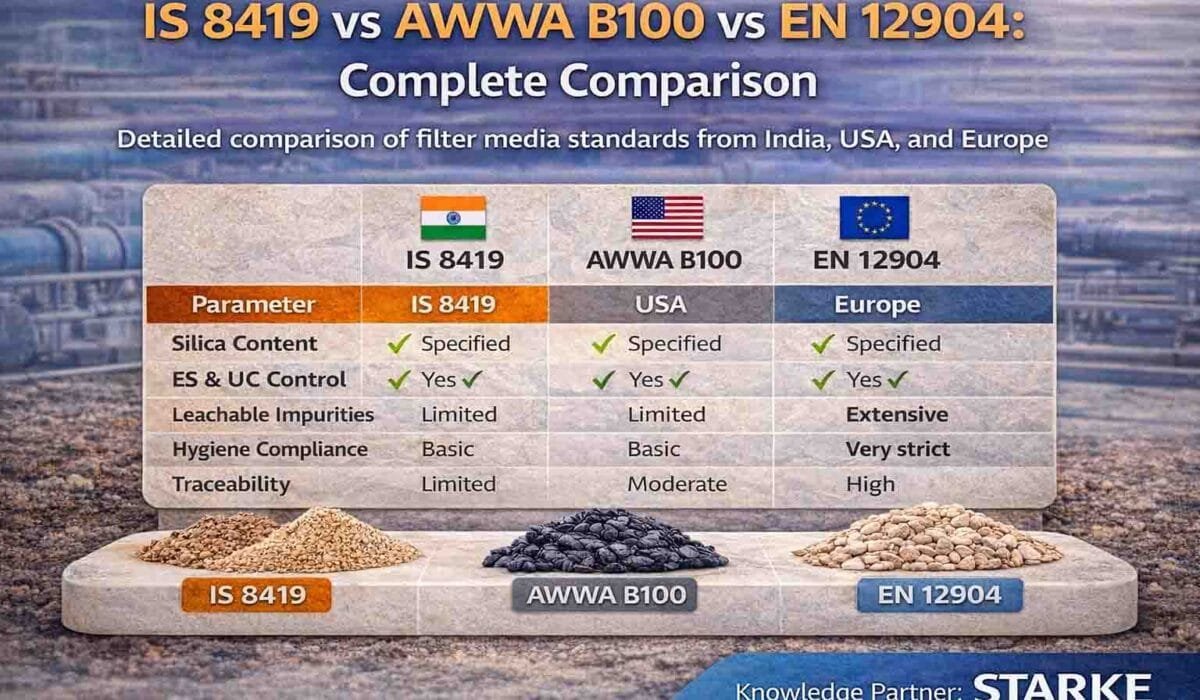
Side-by-Side Technical Comparison
| Parameter | IS 8419 | AWWA B100 | EN 12904 |
|---|---|---|---|
| Primary Focus | Sand quality | Hydraulic performance | Drinking water safety |
| Region | India | USA / Global | Europe |
| Silica Content | Specified | Specified | Specified |
| ES & UC Control | Yes | Yes | Yes |
| Leachable Impurities | Limited | Limited | Extensive |
| Hygiene Compliance | Basic | Basic | Very strict |
| Traceability | Limited | Moderate | High |
Which Standard Should You Use?
Use IS 8419 when:
Project is in India
Government or PSU tender specifies IS standards
CPHEEO guidelines apply
Use AWWA B100 when:
Project is international
Consultant specifies American standards
Focus is filtration performance and hydraulics
Use EN 12904 when:
Drinking water safety is the top priority
European utilities or regulators are involved
Project requires detailed hygienic compliance
Common Mistakes in Standards Interpretation
Assuming one standard automatically satisfies all others
Ignoring chemical leaching requirements in EN standards
Treating grading alone as compliance
Mixing standards without consultant approval
Each standard has different intent, not just different numbers.
Can One Filter Media Comply with All Three?
In practice, high-quality filter media can often be produced to meet overlapping requirements of IS 8419, AWWA B100, and EN 12904 but only if:
Raw material purity is high
Washing and grading are tightly controlled
Documentation and testing are properly managed
This is why international projects often demand multi-standard compliance.
Why This Comparison Matters for Consultants & Inspectors
Consultants and inspectors regularly face:
Mixed specifications
International suppliers
Conflicting standards
A clear understanding of how IS 8419, AWWA B100, and EN 12904 differ allows better decision-making, smoother approvals, and fewer site disputes.
Final Thoughts
IS 8419, AWWA B100, and EN 12904 all serve the same goal reliable filtration but they approach it from different technical and regulatory perspectives.
Understanding these differences helps ensure:
Correct material selection
Regulatory compliance
Long-term filtration performance
Filter media standards are not interchangeable by default they must be understood, respected, and applied correctly.