
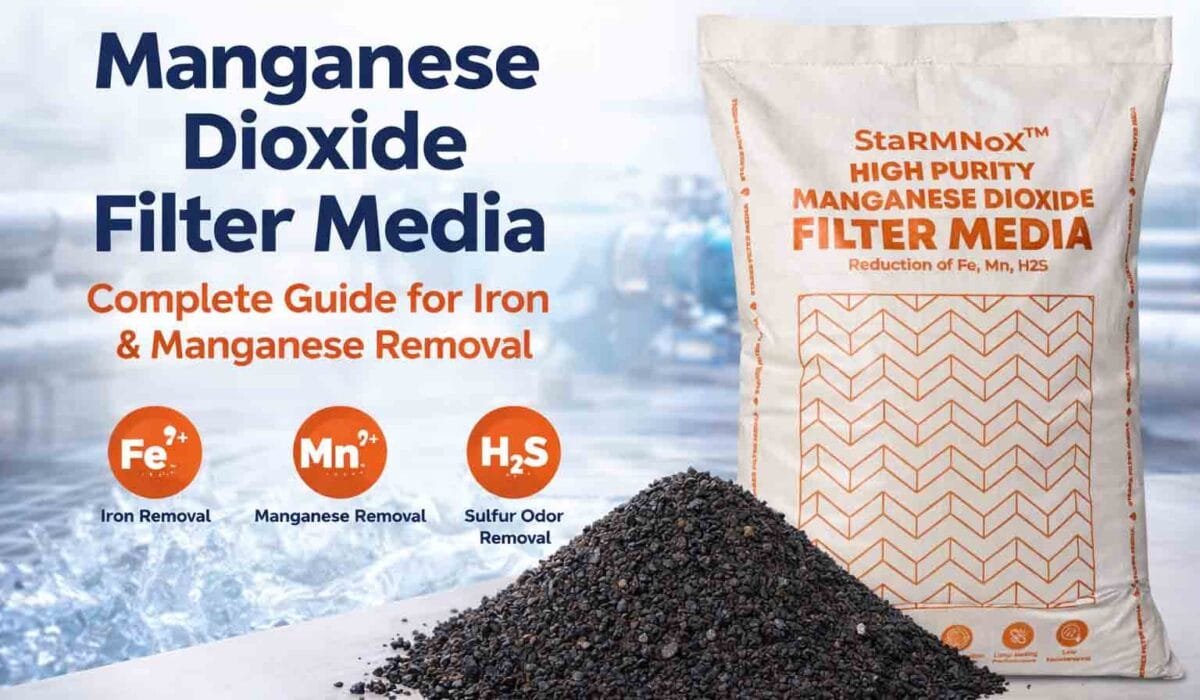
Manganese Dioxide Filter Media: Complete Guide for Water Treatment Professionals
Clean, safe, and iron-free water is a non-negotiable requirement in modern water treatment systems. Among all filtration technologies available today, manganese dioxide filter media stands out as one of the most powerful and reliable solutions for removing iron, manganese, and hydrogen sulfide (H₂S) from water.
This comprehensive guide explains what manganese dioxide filter media is, how it works, its applications, advantages, and why it is a preferred choice for industrial, municipal, and drinking water treatment systems worldwide.
What Is Manganese Dioxide Filter Media?
Manganese dioxide (MnO₂) filter media is a naturally occurring or manufactured granular filtration material composed primarily of high-purity manganese dioxide. It acts as a catalytic oxidation media, accelerating the conversion of dissolved contaminants into insoluble particles that can be easily filtered.
Unlike conventional sand or coated media, MnO₂ media works through surface catalysis, making it exceptionally efficient for contaminant removal.
Common names & related terms:
MnO₂ filter media
Manganese dioxide granular media
Catalytic manganese dioxide
Iron removal filter media
Oxidizing filter media
How Manganese Dioxide Filter Media Works
The core working principle of manganese dioxide filter media is catalytic oxidation.
Filtration Mechanism
Dissolved iron (Fe²⁺), manganese (Mn²⁺), and hydrogen sulfide (H₂S) enter the filter bed
MnO₂ acts as a catalyst, accelerating oxidation
Contaminants convert into solid precipitates
Precipitates are trapped within the filter bed
Periodic backwashing removes accumulated solids
Unlike manganese greensand, pure manganese dioxide media does not require chemical regeneration.
Key Contaminants Removed by MnO₂ Filter Media
Manganese dioxide filter media is widely used for:
Iron removal (Fe²⁺ / Fe³⁺)
Manganese removal
Hydrogen sulfide (H₂S) removal
Arsenic (with pre-oxidation)
Color & odor removal
Turbidity reduction
This makes it ideal for groundwater treatment, well water filtration, and industrial water systems.
Advantages of Manganese Dioxide Filter Media
✅ High Catalytic Activity
Faster oxidation than coated or conventional media
Effective even at lower oxidant dosages
✅ No Chemical Regeneration Required
Unlike manganese greensand, no potassium permanganate needed
Lower operating and maintenance costs
✅ Wide pH Operating Range
Performs efficiently across varying water chemistries
✅ Long Media Life
Durable, abrasion-resistant granules
Minimal media loss during backwashing
✅ High Loading Capacity
Handles higher iron and manganese concentrations
Manganese Dioxide vs Manganese Greensand
| Feature | Manganese Dioxide Media | Manganese Greensand |
|---|---|---|
| MnO₂ Content | 75–80%+ | 10–15% (coated) |
| Regeneration | Not required | Required |
| Oxidation Speed | Very fast | Moderate |
| Maintenance | Low | High |
| Media Life | Long | Shorter |
For high-performance systems, pure MnO₂ filter media is the preferred choice.
Applications of Manganese Dioxide Filter Media
1. Drinking Water Treatment
Iron & manganese removal
Odor and taste improvement
Municipal water filtration plants
2. Groundwater & Well Water Treatment
Removal of dissolved iron and H₂S
Borewell water purification
3. Industrial Water Treatment
Process water filtration
Cooling tower make-up water
Boiler feed water pretreatment
4. Wastewater & Effluent Treatment
Oxidation of dissolved metals
Pretreatment before advanced filtration
Typical Technical Parameters
While specifications vary by grade, manganese dioxide filter media generally features:
MnO₂ content: 75–80%
Particle sizes: 0.5–1.0 mm, 1–2 mm
Bulk density: ~1900 kg/m³
Specific gravity: ~4.5
Hardness: 5–6 Mohs
Uniformity coefficient (UC): ≤ 1.7
These properties make it suitable for pressure filters and rapid gravity filters.
Operating Conditions for Best Performance
pH range: 5.5 – 9.0
Service flow rate: 15–30 m³/m²/hr
Backwash rate: 50–70 m³/m²/hr
Oxidant compatibility: Chlorine, aeration, ozone
Correct design ensures maximum iron removal efficiency and long media life.
Why Manganese Dioxide Is the Best Iron Removal Media
Among all iron removal filter media options, manganese dioxide stands out because:
It accelerates oxidation naturally
Works with or without pre-oxidation
Requires minimal chemical consumption
Performs consistently in high-iron waters
This makes it a preferred iron removal media for water treatment plants globally.
Choosing the Right Manganese Dioxide Filter Media Supplier
When selecting a supplier, ensure:
High MnO₂ purity
Consistent particle size distribution
Compliance with water treatment standards
Technical support and documentation
At Starke Aquacare Technologies, we supply high-purity manganese dioxide filter media engineered for maximum performance, durability, and compliance across global water treatment projects.
Conclusion
Manganese dioxide filter media is a cornerstone technology in modern water filtration systems. Its unmatched catalytic oxidation ability, long service life, and low maintenance make it ideal for removing iron, manganese, and hydrogen sulfide from water.
Whether for municipal plants, industrial systems, or drinking water applications, MnO₂ filter media delivers reliable, cost-effective, and high-efficiency water treatment.