
Introduction: Why Filtration Is the Heart of Water Purification
Water purification is not just about removing visible dirt it is about eliminating suspended solids, colloidal impurities, organic matter, and harmful microorganisms to make water safe for use. Among all treatment processes, filtration is the most critical and universally used step in water treatment systems worldwide.
Whether it is drinking water treatment, wastewater reuse, industrial process water, swimming pools, or desalination pretreatment, filtration plays a central role. Yet, many people assume filtration simply means “water passing through sand.”
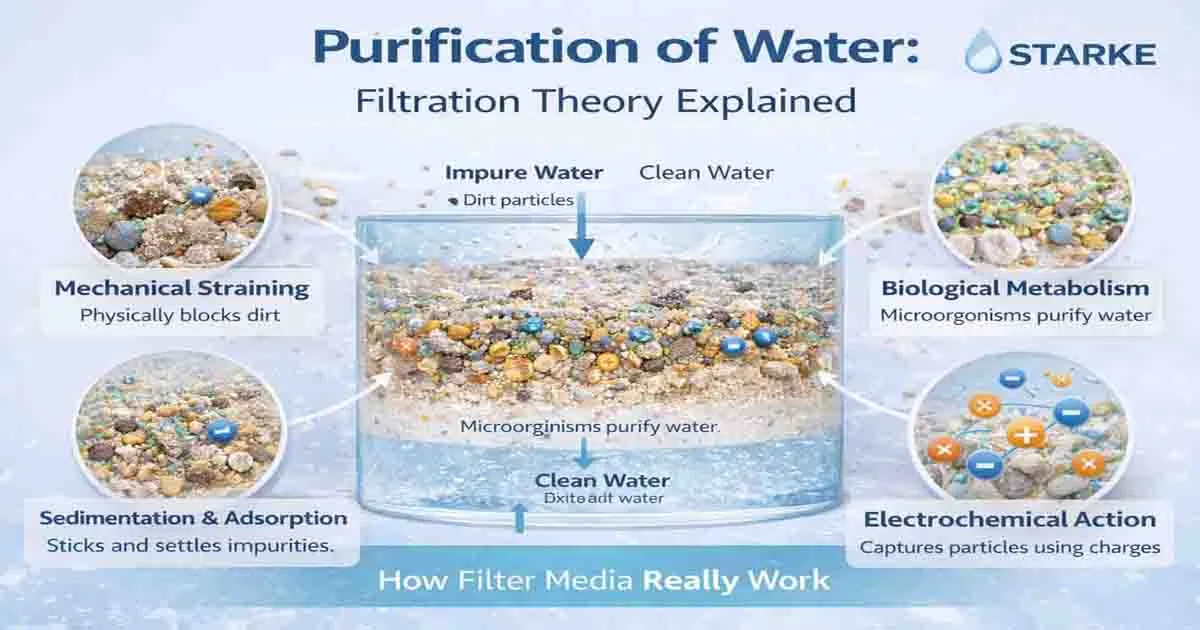
In reality, filtration works through four powerful natural mechanisms that operate simultaneously inside a filter bed. These mechanisms together form what is known as the Purification of Water – Filtration Theory.
This blog explains the complete filtration theory in a clear, structured, and practical way connecting classical principles with modern filter media used today.
What Is Filtration in Water Treatment?
Filtration is the process of allowing water to pass through porous media such as sand, gravel, anthracite, garnet, or zeolite, where impurities are removed by physical, chemical, biological, and electrical actions.
During filtration:
Suspended and colloidal impurities are removed
Turbidity is reduced
Organic matter is broken down
Bacteria levels decrease significantly
Water chemistry remains mostly unchanged
Filtration does not rely on a single action. Instead, it works through four fundamental mechanisms explained below.
1. Mechanical Straining – Physical Removal of Particles
What Is Mechanical Straining?
Mechanical straining is the most basic and visible filtration mechanism. It works on a simple principle: particles larger than the gaps between filter grains cannot pass through.
Sand grains form a network of tiny voids. When water flows through these voids:
Large suspended particles are physically blocked
Dirt gets trapped between sand grains
Clean water flows downward
In simple terms, sand acts like a sieve.
Why Mechanical Straining Is Important
Mechanical straining removes:
Silt
Suspended solids
Flocs formed after coagulation
Larger organic debris
This mechanism is especially effective in rapid sand filters, multimedia filters (MGF), and pressure sand filters.
However, mechanical straining alone is not sufficient to remove very fine or colloidal particles, which is why additional mechanisms are essential.
2. Sedimentation & Adsorption – Sticking and Settling of Fine Impurities
Understanding Sedimentation Inside Filters
Inside a filter bed, water velocity slows down significantly. The spaces between sand grains act like mini sedimentation tanks.
As water slows:
Fine particles settle
Turbulence reduces
Impurities come into contact with filter media surfaces
This process allows particles that are too small for straining to still be removed.
What Is Adsorption in Filtration?
Adsorption occurs when impurities stick to the surface of filter media grains instead of passing through.
This happens because:
Sand surfaces are not perfectly smooth
Organic matter forms sticky, gelatinous layers
Previously trapped impurities enhance surface adhesion
Over time, a thin layer of sticky material develops around sand grains, improving filtration efficiency.
Why Filters Improve with Time
Many operators notice that filters perform better after initial operation. This is due to sedimentation and adsorption building an effective capture layer inside the filter bed.
This mechanism explains why filter ripening is a real phenomenon in water treatment systems.
3. Biological Metabolism – Natural Purification by Microorganisms
What Is Biological Filtration?
Biological metabolism refers to the activity of beneficial microorganisms that grow naturally within the filter bed.
These microorganisms include:
Bacteria
Algae
Micro-flora
Micro-fauna
They attach themselves to sand grains and form a thin biological layer known as the zooglial film.
How Biological Metabolism Works
When water passes through the filter:
Organic impurities serve as food for microorganisms
Microbes consume and break down organic matter
Harmful substances are converted into harmless compounds
Pathogenic bacteria levels reduce
Most biological activity occurs in the top layers of the filter bed, especially in slow sand filters and biologically active filters.
Why Biological Filtration Is Powerful
Biological metabolism:
Removes dissolved organic matter
Reduces taste and odor
Improves microbial safety
Enhances overall filtration efficiency
This natural purification process is one of the reasons why traditional sand filtration remains relevant even today.
4. Electrochemical Action – Attraction by Electrical Charges
Electrical Charges in Filtration
Both sand particles and impurities carry electrical charges on their surfaces.
Sand grains often carry a positive charge
Colloidal impurities usually carry a negative charge
Because opposite charges attract, impurities are drawn toward sand particles and become attached.
How Electrochemical Action Helps Filtration
This attraction causes:
Neutralization of charges
Agglomeration of fine particles
Improved removal of colloidal impurities
This mechanism explains how filters can remove particles much smaller than visible pore sizes.
Why Backwashing Is Necessary
Over time:
Electrical charge capacity of sand becomes exhausted
Impurity layers build up
Filter efficiency decreases
That is why periodic backwashing or media replacement is essential to restore filtration performance.
Why Coagulation Is Needed Before Filtration
Sedimentation and filtration alone cannot remove very fine colloidal particles, because:
They are extremely small
They remain suspended
They carry similar electrical charges
Role of Coagulation
Coagulation involves adding chemicals (like alum or ferric salts) that:
Neutralize electrical charges
Allow particles to combine
Form larger flocs
These flocs can then be easily removed by sedimentation and filtration.
Without coagulation, fine turbidity cannot be effectively treated.
How Filtration Theory Applies to Modern Filter Media
Modern filtration systems use different media to enhance each filtration mechanism:
Silica Sand – Mechanical straining and sedimentation
Anthracite – High dirt-holding capacity and adsorption
Garnet – Fine filtration in multimedia beds
Zeolite – Adsorption and ion-exchange
Activated Carbon – Advanced adsorption
At Starke Filter Media, filtration media are engineered and graded to ensure:
Optimal void structure
Controlled uniformity coefficient
High mechanical strength
Long service life
This ensures all four filtration mechanisms work together efficiently.
Summary: Filtration Is More Than Just Sand
| Filtration Mechanism | What It Does |
|---|---|
| Mechanical Straining | Blocks large particles |
| Sedimentation | Allows fine particles to settle |
| Adsorption | Makes impurities stick |
| Biological Metabolism | Breaks down organic matter |
| Electrochemical Action | Uses charge attraction |
| Coagulation | Helps remove colloids |
Understanding filtration theory helps engineers, operators, and decision-makers choose the right filter media, design better systems, and achieve consistent water quality.
Why Choose High-Quality Filter Media for Effective Filtration
Filtration efficiency depends not just on theory, but on media quality:
Correct particle size distribution
Proper effective size (ES)
Controlled uniformity coefficient (UC)
Clean, washed, and graded media
Poor-quality media can disrupt filtration mechanisms, leading to poor performance and frequent maintenance.
Conclusion
The purification of water through filtration is a multi-layered, science-driven process, not a simple physical barrier. Mechanical, biological, chemical, and electrical forces work together inside every filter bed.
Understanding filtration theory allows water treatment professionals to:
Design efficient systems
Select the right filter media
Improve water quality
Reduce operating costs
At Starke, filtration is not just a product it is a science we engineer every day.