
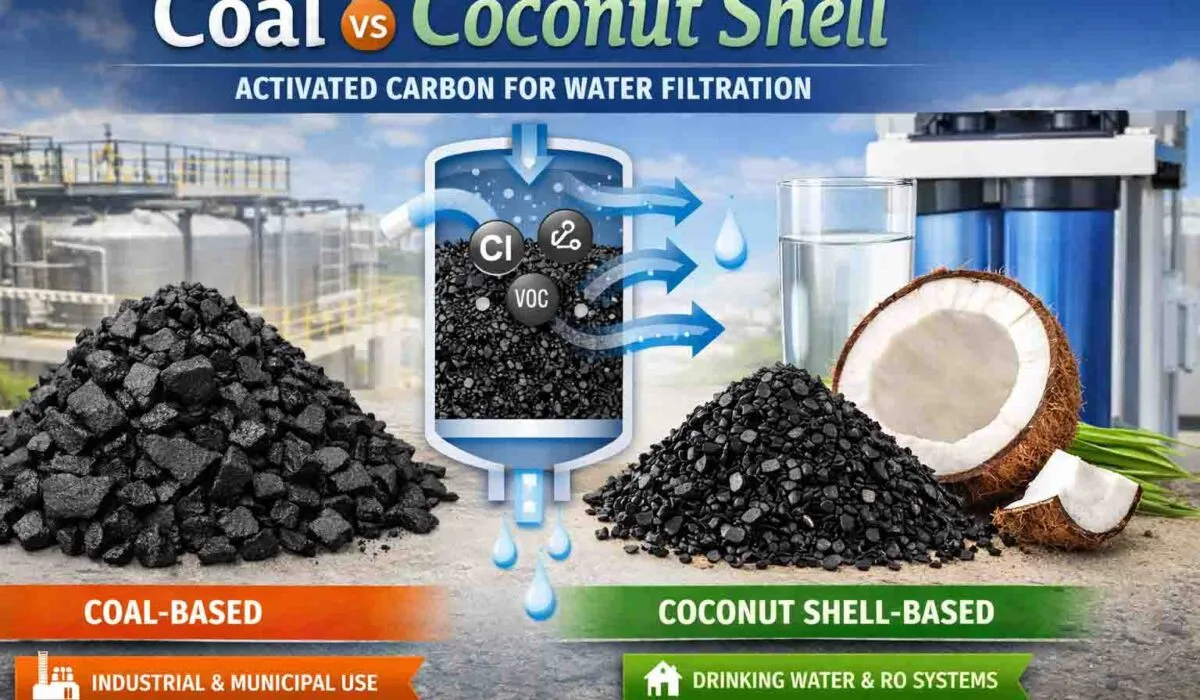
Coal vs Coconut Shell Activated Carbon for Water Filtration: Which One Should You Choose?
Activated carbon is one of the most trusted and widely used filter media in water treatment systems across the world. From drinking water purification and municipal treatment plants to industrial process water and wastewater reuse, activated carbon plays a critical role in removing chlorine, organic contaminants, odors, taste, color, and harmful compounds.
However, one common question continues to confuse engineers, plant operators, consultants, and buyers:
Should I buy coal-based activated carbon or coconut shell-based activated carbon for water filtration?
Both types are effective, but they are not interchangeable. Choosing the wrong activated carbon can result in poor water quality, higher operating costs, frequent media replacement, or system underperformance.
This detailed guide will help you clearly understand the differences, applications, and selection criteria so you can confidently choose the right activated carbon for your water filtration system.
What Is Activated Carbon and How Does It Work?
Activated carbon is a highly porous carbonaceous material produced by activating raw carbon sources at high temperatures. This activation process creates millions of microscopic pores, giving activated carbon a huge internal surface area.
How activated carbon removes contaminants
Activated carbon works primarily through adsorption, not absorption.
Contaminants stick to the carbon surface
Organic compounds are attracted by Van der Waals forces
Chlorine and chloramines are chemically reduced
Taste, odor, and color compounds are trapped inside pores
The size, shape, and distribution of pores determine how effective the carbon will be for different contaminants.
This is where coal-based and coconut shell-based activated carbon differ significantly.
Types of Activated Carbon Used in Water Filtration
Activated carbon for water treatment is mainly produced from three raw materials:
Coal
Coconut shell
Wood
In water filtration, coal-based and coconut shell-based activated carbon dominate due to their performance, availability, and cost efficiency.
This blog focuses on these two.
Coconut Shell Activated Carbon: High-Purity Choice for Drinking Water
What is coconut shell activated carbon?
Coconut shell activated carbon is manufactured from coconut shells, a renewable agricultural by-product. The shells are carbonized and steam-activated at very high temperatures, creating a carbon structure rich in micropores.
Key characteristics
Extremely high micropore content
High iodine value (typically 1000–1200 mg/g)
Very low ash content
High hardness and abrasion resistance
Clean, food-grade carbon
Advantages of coconut shell activated carbon
1. Excellent for drinking water purification
Coconut shell carbon is highly effective at removing:
Free chlorine
Chloramines
Taste and odor compounds
Volatile organic compounds (VOCs)
Low-molecular-weight organics
This makes it ideal for:
Municipal drinking water plants
RO pre-treatment systems
Household and commercial water purifiers
Bottled water plants
2. Produces better-tasting water
Due to its microporous structure, coconut shell carbon delivers crisp, neutral-tasting water, which is critical for potable water and beverage applications.
3. Low ash = cleaner water
Low ash content means:
Less leaching of impurities
Minimal turbidity during operation
Lower risk of downstream fouling
4. Long service life
Coconut shell carbon has excellent mechanical strength, resulting in:
Lower carbon breakage
Less fines generation
Longer operational cycles
5. Sustainable and eco-friendly
As it is made from renewable coconut shells, it is considered environmentally responsible and preferred in food and drinking water applications.
Limitations of coconut shell activated carbon
Higher cost compared to coal-based carbon
Less effective for large, heavy organic molecules
Not ideal for high-color or high-COD industrial wastewater alone
Coal-Based Activated Carbon: Versatile and Cost-Effective for Large Systems
What is coal-based activated carbon?
Coal-based activated carbon is produced from bituminous or lignite coal. The activation process creates a broad pore size distribution, including micropores, mesopores, and macropores.
Key characteristics
Wide pore size distribution
Good adsorption of both small and large molecules
Moderate iodine value
Higher ash content compared to coconut shell carbon
Lower cost per kilogram
Advantages of coal-based activated carbon
1. Handles a wider range of contaminants
Coal-based carbon can effectively remove:
Larger organic molecules
Industrial solvents
Color-causing compounds
High-COD contaminants
This makes it suitable for:
Industrial water treatment
Wastewater polishing
Effluent reuse systems
Municipal treatment with complex water chemistry
2. Economical for large volumes
For large filtration beds and high flow systems, coal-based carbon offers:
Lower initial media cost
Easier availability in bulk
Cost efficiency for large projects
3. Commonly used in municipal plants
Coal-based activated carbon is widely used in:
City water treatment facilities
River and lake water purification
Pre-treatment before advanced processes
Limitations of coal-based activated carbon
Higher ash content
Slightly inferior taste and odor removal
Not ideal for premium drinking water applications
Lower hardness compared to coconut shell carbon
Coal vs Coconut Shell Activated Carbon: Side-by-Side Comparison
| Parameter | Coconut Shell Activated Carbon | Coal-Based Activated Carbon |
|---|---|---|
| Raw material | Renewable coconut shells | Fossil coal |
| Pore structure | Mostly microporous | Micro + meso + macro |
| Best for | Drinking water, RO systems | Industrial & municipal |
| Taste & odor removal | Excellent | Good |
| Ash content | Very low | Moderate |
| Hardness | High | Medium |
| Cost | Higher | Lower |
| Sustainability | Eco-friendly | Less sustainable |
Which Activated Carbon Should You Choose?
Choose coconut shell activated carbon if:
You are treating drinking water
Taste and odor removal is critical
Water is used for human consumption
You need low ash and food-grade quality
You want longer service life and cleaner operation
Choose coal-based activated carbon if:
You are treating industrial or municipal water
The water has high organic load or color
Budget optimization is important
Large filtration volumes are involved
Can Coconut Shell and Coal-Based Carbon Be Used Together?
Yes. In some advanced systems:
Coal-based carbon is used for bulk organic removal
Coconut shell carbon is used as a polishing layer
This hybrid approach improves performance while controlling costs.
Why Proper Activated Carbon Selection Matters
Selecting the wrong carbon can lead to:
Poor chlorine removal
Taste and odor complaints
Frequent media replacement
Increased operational costs
Customer dissatisfaction
At Starke, activated carbon selection is always based on:
Water source analysis
Contaminant profile
Flow rate and contact time
Regulatory requirements
Long-term operational economics
Final Expert Recommendation
There is no one-size-fits-all activated carbon.
For drinking water and RO pre-treatment → Coconut shell activated carbon
For industrial, municipal, and wastewater applications → Coal-based activated carbon
For high-performance systems → Combination approach
Choosing the right activated carbon ensures better water quality, lower costs, and longer system life.
Need Help Selecting the Right Activated Carbon?
At Starke Aquacare Technologies, we help customers worldwide select the right activated carbon grade, size, and specification for their exact application whether it’s drinking water, industrial treatment, or wastewater reuse.
📩 Contact our technical team to get expert guidance tailored to your project.