
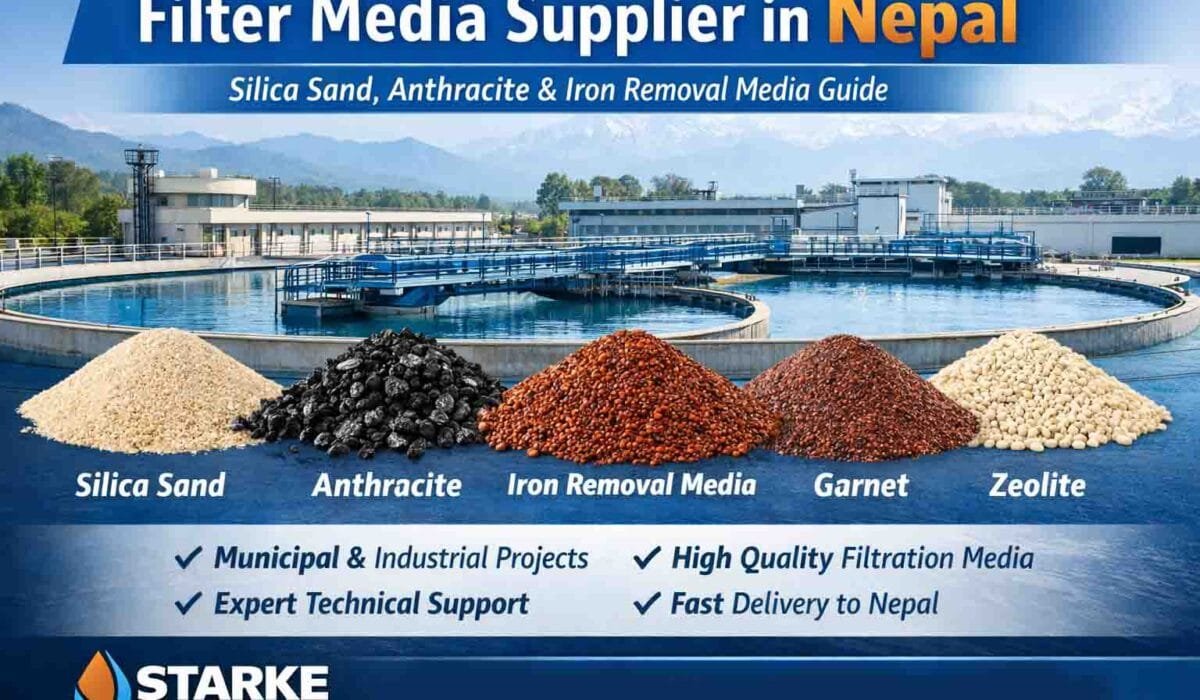
Filter Media Supplier in Nepal Complete Guide for Water Treatment Projects
Water treatment infrastructure in Nepal is expanding rapidly. From municipal drinking water plants to industrial filtration systems, the demand for high-quality filtration materials continues to grow.
However, choosing the right filter media supplier in Nepal requires more than comparing prices. Poor grading, inconsistent batch quality, and missing technical documentation often lead to premature filter failure and operational inefficiencies.
This detailed guide explains how to select silica sand, anthracite, garnet, zeolite, and iron removal media for water treatment projects in Nepal and how to contact a reliable supplier to meet your project needs.
Why Nepal’s Water Treatment Sector Is Growing
Kathmandu
Pokhara
Biratnagar
are witnessing increased demand for safe drinking water.
Additionally, Nepal faces specific water challenges:
High turbidity during the monsoon season
River silt and suspended solids
Groundwater iron contamination
Ammonia in some regions
As a result, properly selected filter media is essential for reliable performance.
What Is Filter Media in Water Treatment?
Filter media refers to granular materials placed inside pressure or gravity filters to remove contaminants from water.
Depending on the application, filter media in Nepal is used to remove:
Turbidity
Suspended solids (TSS)
Iron and manganese
Ammonia
Organic matter
Each type of media performs a different function within the filtration system, contributing to safe and efficient water treatment.
Types of Filter Media Used in Nepal
1. Silica Sand for Water Treatment in Nepal
Silica sand is the foundation of most filtration systems.
It is widely used in:
Municipal water treatment plants
Industrial filtration systems
RO pre-treatment
Hotels and resorts
Common sizes include:
0.6–1.2 mm
0.8–1.6 mm
However, performance depends heavily on:
Effective size (D10)
Uniformity coefficient (UC)
Proper washing and grading
If sand is poorly graded, it can cause channeling and inconsistent filtration.
A professional supplier should provide detailed sieve analysis documentation.
2. Iron Removal Media in Nepal
Iron contamination is common in Nepal’s groundwater sources. Excess iron causes:
Yellow or reddish water
Metallic taste
Pipe clogging
Staining of fixtures
Iron removal media, specifically designed for catalytic oxidation and filtration, is essential in these conditions.
High-performance iron removal media must have:
High manganese dioxide content
Proper grading
High mechanical strength
Reliable long-term performance
Used correctly, iron removal media significantly reduces:
Iron concentrations
Manganese levels
Hydrogen sulfide odor
This media is widely used in:
Rural drinking water schemes
Packaged drinking water plants
Hotels and commercial buildings
3. Anthracite Filter Media in Nepal
Anthracite is used in multimedia filters because:
It has a lower density than sand
It has a larger particle size
It provides excellent dirt-holding capacity
Placed above sand in multimedia filters, anthracite improves:
Filtration depth
Run time
Backwash efficiency
This is especially useful in high-turbidity river water systems common in Nepal.
4. Garnet for Advanced Multimedia Filters
Garnet is a high-density media placed at the bottom of multimedia filters.
Advantages include:
Fine particle removal
Better overall turbidity reduction
Stable bed structure during backwash
Although not yet widespread in small Nepal projects, larger municipal plants increasingly adopt garnet for superior filtration performance.
5. Zeolite for Ammonia Removal
In certain areas, ammonia contamination requires ion exchange solutions.
Natural zeolite works by:
Exchanging sodium or calcium ions with ammonium ions
Reducing dissolved ammonia and other impurities
Zeolite works especially well in small community systems that require low-cost ammonia removal.
Key Parameters to Verify Before Buying Filter Media in Nepal
When selecting a filter media supplier in Nepal, always confirm the following:
1. Effective Size (D10)
Defines filtration fineness. An incorrect D10 value can reduce removal efficiency.
2. Uniformity Coefficient (UC)
UC ideally should be below 1.7 for sand and other graded media.
Higher UC indicates uneven particle distribution.
3. Bulk Density
Affects:
Bed stability
Backwash expansion
Filtration dynamics
4. Acid Solubility
Low acid solubility ensures long service life in varied water chemistries.
5. Iron Removal Efficiency (For Iron Media)
Iron media should be tested for catalytic oxidation and retention efficiency.
Common Issues in Nepal’s Filter Media Market
Despite rising demand, several issues persist:
River sand sold as filter sand
Lack of proper grading and sieve analysis
No batch quality documentation
Inconsistent performance across batches
No traceability or export-grade packaging
As a result, filtration systems may experience:
Frequent backwashing
Shorter filtration cycles
Iron or turbidity breakthrough
Higher operational costs
Therefore, verifying technical credentials is essential before purchase.
How to Calculate Filter Media Quantity
To calculate required media:
Volume (m³) = π × (D/2)² × Bed Depth
Weight (kg) = Volume × Bulk Density
For example:
If vessel diameter = 2 m
Bed depth = 1 m
Bulk density = 1500 kg/m³
Required sand = 4,700 kg
Accurate calculation prevents under-filling or over-filling the filter vessel.
Logistics for Supplying Filter Media to Nepal
Nepal is landlocked, so most shipments move by road.
Common routes:
Raxaul – Birgunj border
Lucknow → Nepal border
Transit time is typically 3-5 days from North India.
Required documents:
Commercial invoice
Packing list
Certificate of origin
GST export invoice
Compared to sea exports, Nepal shipments are faster and more cost-effective.
Why Technical Documentation Matters
Municipal and industrial tenders in Nepal increasingly require:
Sieve analysis reports
Batch testing certificates
Safety data sheets
Quality compliance documentation
Without proper documentation, project approvals may be delayed or rejected.
A credible supplier should provide full export documentation along with technical support.
How to Choose the Right Filter Media Supplier in Nepal
Before finalizing a supplier, evaluate:
✔ Manufacturing capability
✔ Quality control processes
✔ Export documentation experience
✔ Iron removal performance data
✔ Batch traceability and testing reports
Avoid suppliers who only quote prices without technical specifications.
Instead, choose suppliers who provide transparent documentation and engineering support.
Contact Starke – Trusted Filter Media Supplier for Nepal
If you are planning a project in Nepal and need reliable filtration media, contact:
Starke Aquacare Technologies
Filter Media Manufacturer & Export Supplier
☎️ Phone: +91-7070704639
📧 Email: info@starkefiltermedia.com
🌐 Website: www.starkefiltermedia.com
Whether you need silica sand, anthracite, iron removal media, garnet, or zeolite, Starke provides:
✔ International quality filter media
✔ Detailed sieve analysis & QC certificates
✔ Export-ready packaging
✔ Technical support for Nepal projects
Future Demand for Filter Media in Nepal
With increasing urbanization and stricter water quality standards, demand will grow for:
Silica sand
Anthracite
Garnet
Iron removal media
Zeolite and specialty media
Iron removal media, in particular, will see continued adoption due to widespread groundwater iron.
Choosing the right filter media supplier in Nepal ensures consistent results, regulatory compliance, and long-term system reliability.
Conclusion
Nepal’s water treatment market requires technically sound filtration materials.
Although low-cost options are available, improper grading and inconsistent quality lead to operational problems — frequent backwashing, shorter filter runs, and unexpected breakthrough of contaminants.
Instead, engineers and contractors should focus on:
Verified sieve analysis documentation
Controlled uniformity coefficient values
Reliable iron removal performance
Transparent supplier communication
By doing so, filtration systems will operate efficiently, sustainably, and with minimal maintenance.