
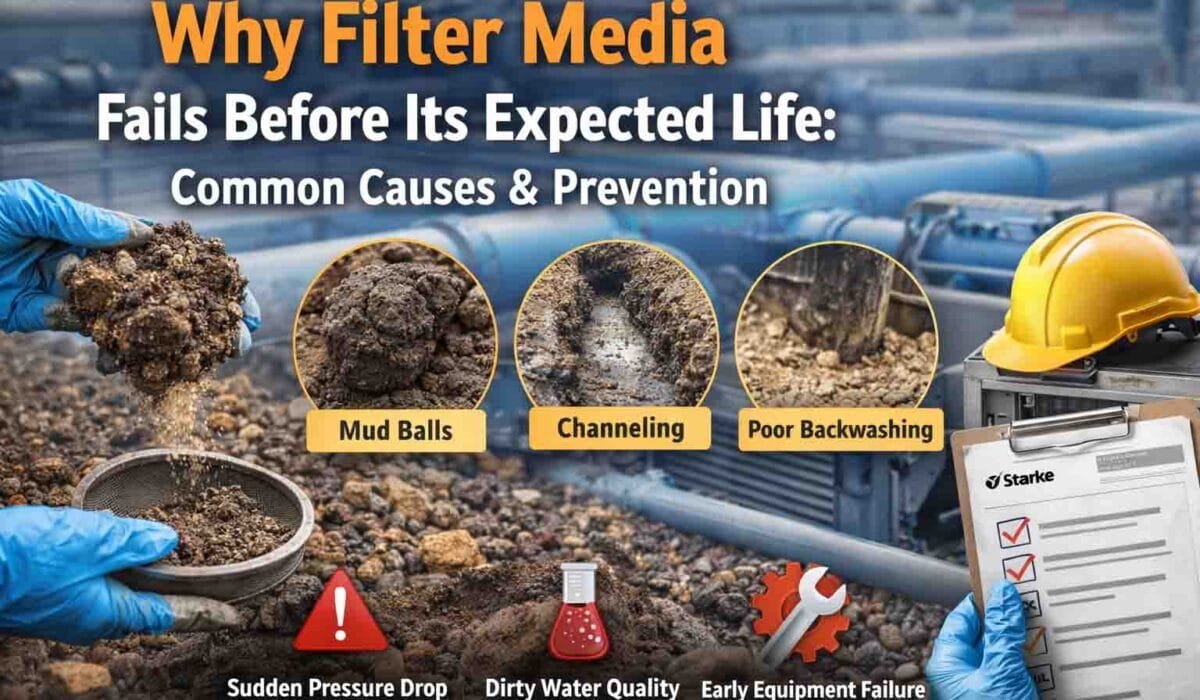
Filter media is designed to operate reliably for several years in water and wastewater treatment systems. Yet, in real-world installations, filter media often fails far earlier than expected, sometimes within months instead of years.
Premature filter media failure leads to:
Rapid pressure drop
Poor water quality
Increased backwash frequency
Higher operating costs
Unplanned shutdowns and media replacement
Understanding why filter media fails prematurely is essential for plant operators, EPC contractors, consultants, and facility owners who want stable filtration performance and long service life.
This article explains the most common causes of filter media failure, early warning signs, and proven preventive measures.
What Is the Expected Life of Filter Media?
The expected life of filter media depends on the media type, water quality, and operating conditions. Under proper design and operation:
Silica sand and gravel: 5–10 years
Activated carbon: 1–3 years
Zeolite and specialty media: 3–7 years
Iron and manganese removal media: 3–8 years
When media fails significantly earlier, it is rarely due to “bad luck.” In most cases, failure can be traced to design errors, operational mistakes, or poor media quality.
Common Signs of Premature Filter Media Failure
Early identification can prevent full system failure. Warning signs include:
Sudden or frequent pressure drop
Reduced filter run time
Increased turbidity in filtered water
Media loss during backwash
Formation of mud balls or clumping
Channeling and uneven flow distribution
Ignoring these signs often leads to irreversible media damage.
1. Incorrect Filter Media Selection
One of the most common reasons for early failure is wrong media selection for the application.
Typical Mistakes:
Using sand where iron or oil is present
Using low-density media in high-flow systems
Selecting incorrect effective size (D10)
Ignoring uniformity coefficient (UC) limits
When filter media is not matched to the contaminant load, it becomes overloaded quickly, causing rapid clogging or structural breakdown.
2. Poor Media Quality and Inconsistent Grading
Not all filter media is equal even when it looks similar.
Quality-related failure causes include:
High fines content
Poorly washed media
Wide particle size distribution (high UC)
Weak or friable grains
Low-quality media breaks down under hydraulic stress, generating fines that block pore spaces and reduce filtration efficiency.
This results in shortened filter runs and frequent backwashing, accelerating wear.
3. Improper Backwashing Practices
Backwashing is essential but incorrect backwashing is one of the fastest ways to destroy filter media.
Common Backwashing Errors:
Insufficient backwash velocity
Excessive backwash velocity causing media loss
Inadequate bed expansion
Skipping air scouring where required
Poor backwashing leads to dirt accumulation, mud-ball formation, and cementing of the media bed.
Over-aggressive backwashing, on the other hand, causes media attrition and loss, reducing bed depth and performance.
4. Channeling Due to Uneven Flow Distribution
Channeling occurs when water finds preferential flow paths through the media bed, bypassing effective filtration.
Causes of Channeling:
Poor underdrain design
Uneven media layering
Incorrect gravel support sizes
Media segregation during installation
Once channels form, large portions of the filter bed become inactive, leading to poor water quality despite normal pressure readings.
Channeling often goes unnoticed until water quality deteriorates significantly.
5. Mud Ball Formation and Media Cementing
Mud balls are hardened clusters of dirt, biofilm, and fines that form inside the filter bed.
Why Mud Balls Form:
Inadequate backwashing
High organic load
Biological growth
Long filter runs without proper cleaning
Mud balls block flow paths and reduce effective filtration area. Over time, they cause localized clogging, forcing water through fewer channels and accelerating failure.
Once severe mud-ball formation occurs, media replacement is often the only solution.
6. Biological Fouling and Biofilm Growth
Biological growth inside filters is a silent but destructive process.
Biofouling Effects:
Sticky biofilm binds media particles together
Reduced porosity and permeability
Increased head loss
Release of bacteria into treated water
Biofouling is common in:
Activated carbon filters
Slow sand filters
Systems with high organic content
Without proper pre-treatment and periodic sanitation, biological fouling can destroy media performance long before its expected life.
7. Overloading Beyond Design Capacity
Filters are designed for specific:
Flow rates
Solids loading
Contaminant concentration
Operating beyond these limits causes continuous stress on the media bed.
Overloading Examples:
Increased raw water turbidity
Seasonal contamination spikes
Flow increases without redesign
Reduced backwash intervals
Overloaded media compacts faster, clogs more frequently, and loses structural integrity.
8. Chemical Attack and pH Extremes
Certain water chemistries are aggressive to filter media.
Chemical Causes of Failure:
Acidic water dissolving silica-based media
High chlorine damaging carbon structure
Oxidants reacting with catalytic media
Industrial contaminants attacking media surfaces
Operating outside recommended pH or chemical limits leads to gradual but irreversible media degradation.
9. Poor Installation and Layering Practices
Even high-quality media can fail if installed incorrectly.
Installation Mistakes:
Incorrect gravel support layer thickness
Mixing of media layers
Poor leveling of the bed
No protective filling method
Improper installation causes early channeling, uneven flow, and media loss during backwashing.
10. Lack of Monitoring and Preventive Maintenance
Many systems fail simply because no one is watching the filter closely enough.
Common Oversights:
Ignoring pressure differential trends
No turbidity monitoring
No inspection during shutdowns
No performance benchmarking
Without routine monitoring, minor issues escalate into major failures.
How to Prevent Premature Filter Media Failure
1. Correct Media Selection
Match media to contaminants
Follow standard specifications
Verify D10 and UC values
2. Use Consistent, Certified Media
Ensure proper washing and grading
Avoid excessive fines
Demand test reports and batch consistency
3. Optimize Backwash Design
Verify expansion rates
Adjust velocity for media density
Include air scouring where required
4. Maintain Proper Operating Conditions
Stay within flow and loading limits
Control pH and chemical dosing
Use pre-treatment when needed
5. Monitor Performance Regularly
Track pressure drop trends
Monitor effluent turbidity
Inspect media condition periodically
Why Understanding Filter Media Failure Matters
Premature filter media failure is not just a maintenance issue it is a system reliability and cost issue.
Replacing media early:
Increases operating expenses
Causes downtime
Reduces system credibility
Impacts water quality compliance
Understanding the real reasons behind failure allows engineers and operators to extend media life, stabilize performance, and reduce total lifecycle cost.
Final Thoughts
Filter media rarely fails randomly. In almost every case, premature failure can be traced back to selection, quality, design, operation, or maintenance issues.
By recognizing early warning signs and addressing root causes, water treatment systems can achieve the full expected life of their filter media and often exceed it.
Smart filtration is not about replacing media more often. It is about making the right decisions from the start.