
NSF/ANSI/CAN 61 for Filter Media: What It Really Means in Water Treatment
In the water treatment industry, few certifications are mentioned as frequently as NSF/ANSI/CAN 61. Whether it is a municipal tender, packaged drinking water plant, beverage project, desalination pretreatment system, or industrial filtration setup, buyers often demand NSF 61 certified filter media.
However, there is a major misconception in the industry:
Many people believe NSF 61 certification automatically means better filtration performance.
Technically, this is incorrect.
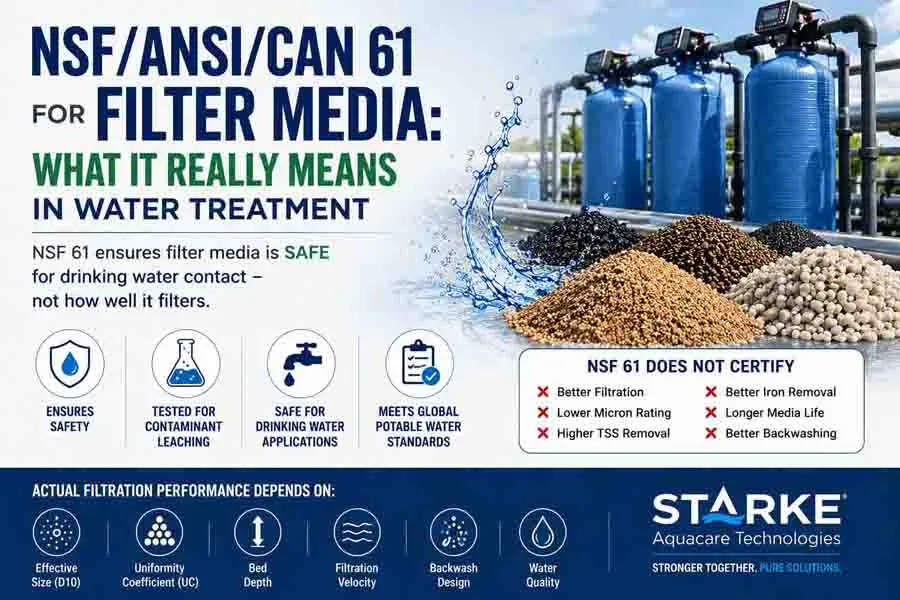
NSF/ANSI/CAN 61 is primarily a drinking water safety certification. It confirms that the filter media does not release harmful contaminants into potable water under tested operating conditions. It does not certify micron rating, filtration efficiency, iron removal capability, or solids loading performance.
Understanding this difference is extremely important for consultants, EPC contractors, plant operators, and water treatment professionals.
In this article, we will explain:
- What NSF/ANSI/CAN 61 actually means
- How filter media is tested
- What the certification does not guarantee
- Why it is critical for potable water systems
- Common industry misconceptions
- The relationship between certification and filtration performance
What Is NSF/ANSI/CAN 61?
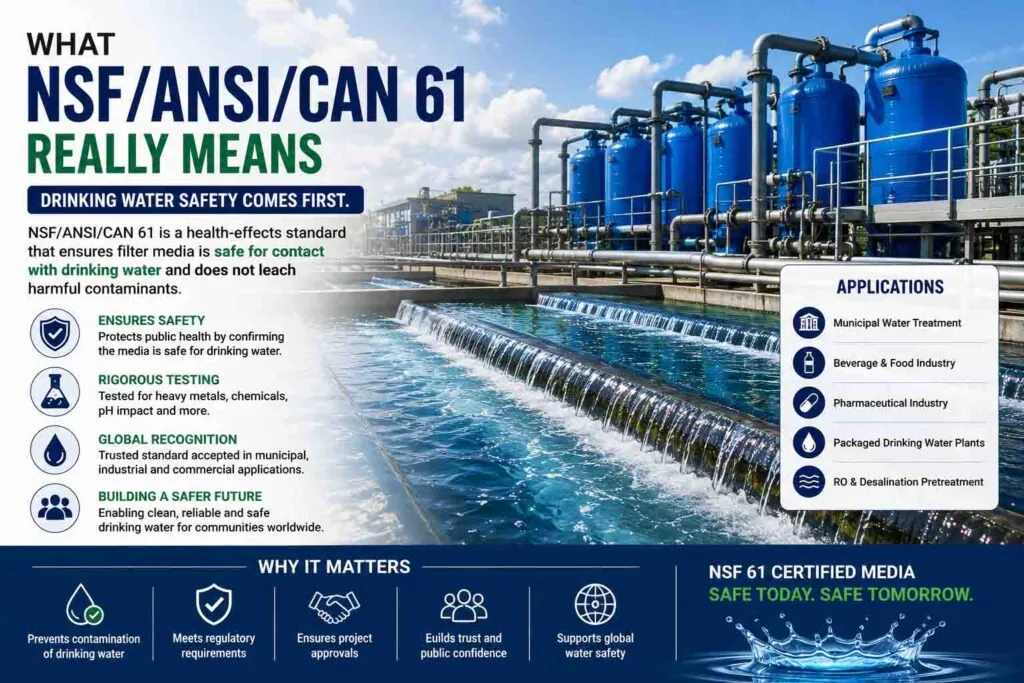
NSF International NSF/ANSI/CAN 61 is a health-effects standard developed for products and materials that come into contact with drinking water.
The certification evaluates whether a material releases harmful contaminants into potable water.
For filter media, NSF 61 focuses on:
- Chemical safety
- Heavy metal leaching
- Drinking water compatibility
- Extraction testing
- Public health protection
The standard is recognized across:
- United States
- Canada
- Middle East potable water projects
- International EPC projects
- Municipal water systems
Many government and industrial tenders specify NSF/ANSI/CAN 61 approved media as a mandatory requirement.
Types of Filter Media That Can Be NSF 61 Certified
Various water filtration media can obtain NSF 61 certification, including:
- Silica sand
- Filter gravel
- Anthracite
- Activated carbon
- Zeolite
- Clinoptilolite
- Garnet
- Manganese dioxide media
- Calcite
- Glass media
- Ion exchange resin
The certification is especially important in potable water applications where water quality directly affects public health.
What NSF 61 Tests in Filter Media
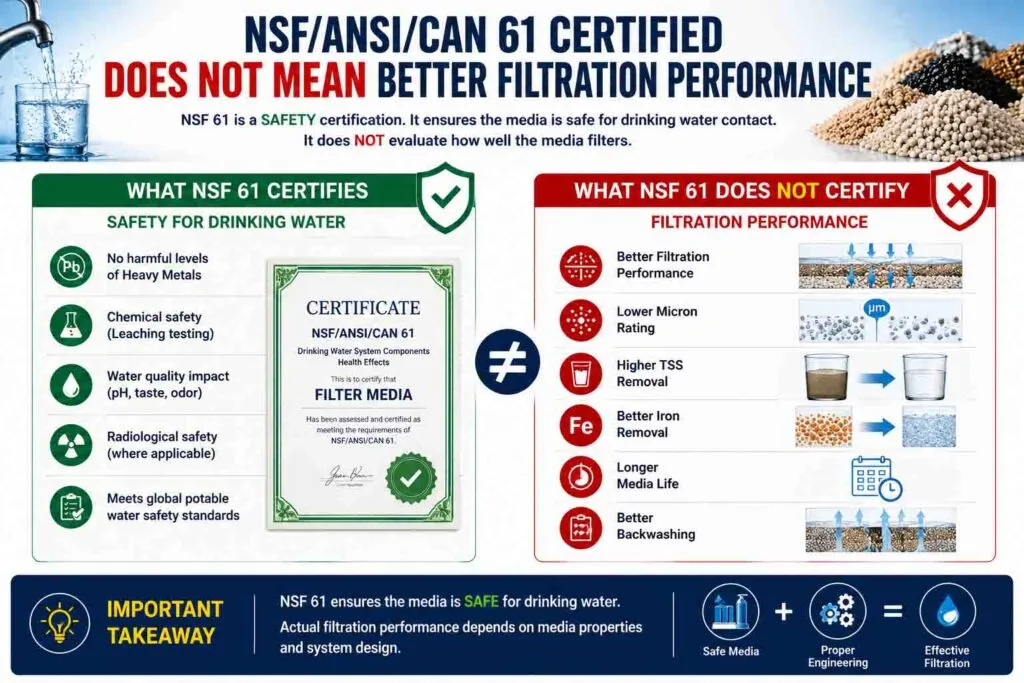
NSF 61 certification does not evaluate how well the media filters water. Instead, it evaluates whether the media contaminates the water.
This distinction is extremely important.
1. Heavy Metal Leaching Testing
The certification checks whether the media releases dangerous heavy metals such as:
- Lead
- Arsenic
- Mercury
- Cadmium
- Chromium
- Selenium
Natural mineral media may contain trace impurities depending on the mining source and processing method.
2. Chemical Extraction Testing
The media is exposed to controlled water conditions and the extracted water is analyzed for:
- Toxic organics
- VOCs
- Chemical residues
- Processing contaminants
This ensures the media remains safe for drinking water applications.
3. pH Compatibility Testing
Certain media can alter water chemistry by:
- Increasing pH
- Reducing pH
- Changing alkalinity
NSF evaluates whether the changes remain within acceptable potable water limits.
4. Radioactivity Evaluation
Natural minerals such as:
- Zeolite
- Garnet
- Anthracite
- Silica sand
may contain trace naturally occurring radioactive materials (NORM).
NSF testing evaluates whether radioactive content remains within safe drinking water standards.
5. Surface Extraction Testing
The certification evaluates the interaction between:
- Surface area exposure
- Contact time
- Water chemistry
- Temperature
- pH conditions
The extracted water is then tested in laboratories for harmful contaminants.
What NSF 61 Does NOT Mean
This is where the industry often misunderstands the certification.
NSF 61 does NOT certify:
- Better filtration performance
- Lower micron rating
- Better turbidity removal
- Higher TSS reduction
- Better iron removal
- Longer media life
- Superior backwashing
- Better hydraulic performance
A filter media can be fully NSF 61 certified and still perform poorly in an actual filtration system.
Real Industry Example
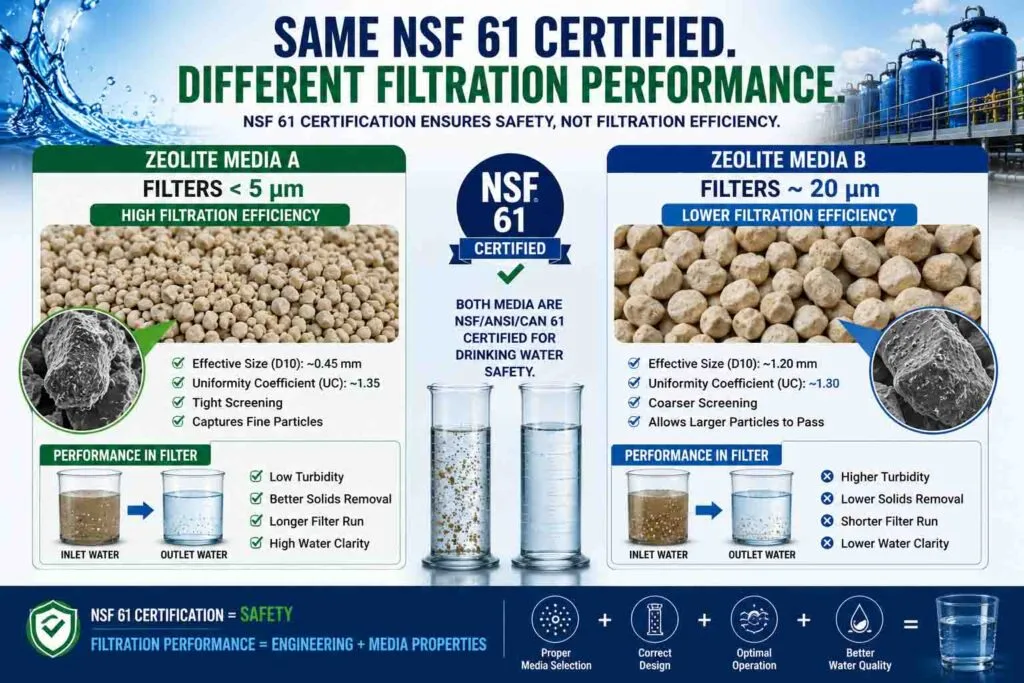
Consider two zeolite media products.
Both may be NSF/ANSI/CAN 61 certified.
However:
- One media may filter below 5 microns
- Another may only filter around 20 microns
Both can still pass NSF 61 because the certification evaluates safety, not filtration efficiency.
This is one of the biggest misconceptions in water treatment tenders today.
Why Filter Media Performance Depends on Engineering
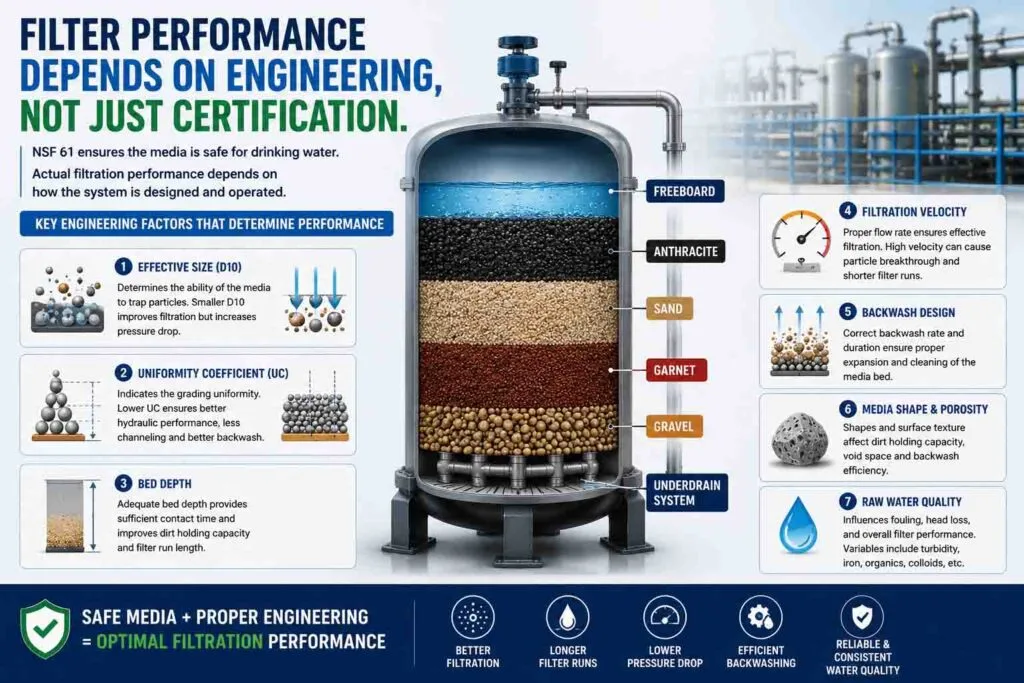
Actual filtration performance depends on multiple engineering parameters.
Effective Size (D10)
The effective size directly affects:
- Filtration efficiency
- Head loss
- Dirt holding capacity
- Pressure drop
Smaller effective sizes generally improve filtration but increase pressure drop.
Uniformity Coefficient (UC)
The uniformity coefficient determines grading consistency.
Lower UC generally provides:
- Better hydraulic performance
- Improved backwashing
- Reduced channeling
- More stable filtration beds
Poor UC can reduce filter efficiency even with certified media.
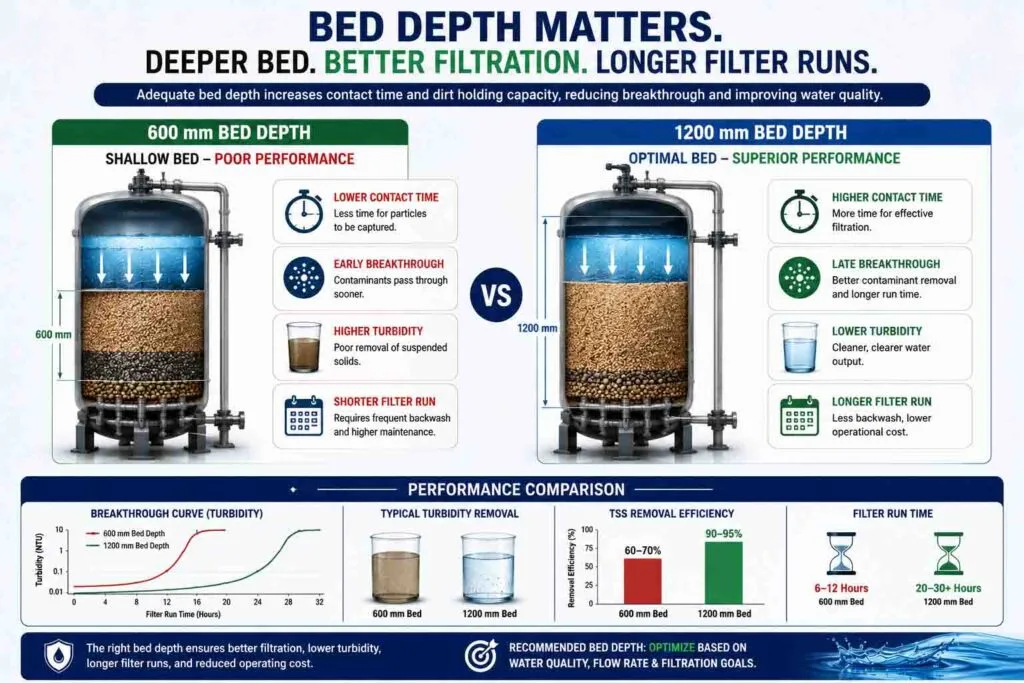
Bed Depth
Bed depth significantly impacts:
- Contact time
- Solids removal
- Turbidity reduction
- Filter run length
A shallow bed can cause early breakthrough even with premium media.
Media Shape and Porosity
Media geometry affects:
- Dirt loading
- Void space
- Hydraulic flow
- Backwash expansion
Angular and irregular media behave differently than spherical media.
Filtration Velocity
Operating velocity is critical.
Excessively high flow rates can cause:
- Media fluidization
- Reduced filtration efficiency
- Particle carryover
- Shorter filter runs
Even high-quality media cannot compensate for poor hydraulic design.
Backwash Design
Improper backwash systems can result in:
- Mudball formation
- Channeling
- Media stratification issues
- Permanent fouling
Backwash expansion rates must match the media density and particle size.
Raw Water Quality
Water chemistry greatly affects filtration performance.
Parameters such as:
- Turbidity
- Iron
- Manganese
- Organics
- Oil and grease
- Colloids
- Biological contamination
all influence filter behavior.
Why NSF 61 Is Critical for Potable Water Systems
Although NSF 61 does not guarantee filtration performance, it remains extremely important.
Without NSF-certified media:
- Harmful contaminants may leach into drinking water
- Municipal approvals may fail
- EPC approvals may get rejected
- Regulatory compliance may become difficult
- Public health risks may increase
That is why NSF/ANSI/CAN 61 approved media is commonly specified in:
- Municipal water treatment plants
- Packaged drinking water plants
- Beverage industry systems
- Pharmaceutical water systems
- Desalination pretreatment systems
- Commercial RO plants
Common Tender Mistakes in Water Treatment
Many tenders incorrectly assume:
“NSF certified media automatically means superior filtration.”
This is technically inaccurate.
A properly designed filtration system requires:
- Safe media
- Correct grading
- Proper bed depth
- Optimized flow velocity
- Correct backwash design
- Proper vessel hydraulics
Certification alone cannot solve poor system engineering.
The Difference Between NSF 61 and Performance Standards
It is important to understand that different standards address different aspects of filtration.
| Standard | Purpose |
|---|---|
| NSF/ANSI/CAN 61 | Drinking water safety |
| AWWA B100 | Filter media grading & physical quality |
| EN standards | Material and physical specifications |
| System design | Filtration performance |
All are important, but they serve different purposes.
Why Source and Manufacturing Matter
NSF certification is usually linked to:
- Specific manufacturing plants
- Specific product grades
- Defined size ranges
- Controlled processing methods
For natural minerals, mine source matters significantly.
Two silica sands from different mines may contain:
- Different purity levels
- Different heavy metal traces
- Different radioactivity profiles
This is why certification is not automatically transferable between suppliers.
The Future of Filter Media Selection
Modern water treatment is moving toward performance-based engineering rather than certification-only purchasing.
Today’s best filtration systems combine:
- Certified safe media
- Optimized particle sizing
- Correct hydraulic loading
- Proper bed design
- Effective backwashing
- Real process understanding
The industry is gradually realizing that filtration success depends on system engineering as much as the media itself.
Choosing the Right Filter Media Supplier
When selecting a filter media supplier, buyers should evaluate:
- NSF compliance
- Manufacturing consistency
- Effective size control
- Uniformity coefficient
- Technical support
- Backwash guidance
- Application engineering
- Process understanding
A good supplier should provide more than just certification documents.
They should help optimize the entire filtration process.
Conclusion
NSF/ANSI/CAN 61 is one of the most important certifications in the potable water industry because it ensures the filter media is safe for drinking water contact.
However, it is critical to understand what the certification does and does not mean.
NSF 61 confirms:
✔ Safety
✔ Chemical compatibility
✔ Drinking water suitability
But it does not guarantee:
✘ Better filtration
✘ Lower micron rating
✘ Better TSS removal
✘ Superior system performance
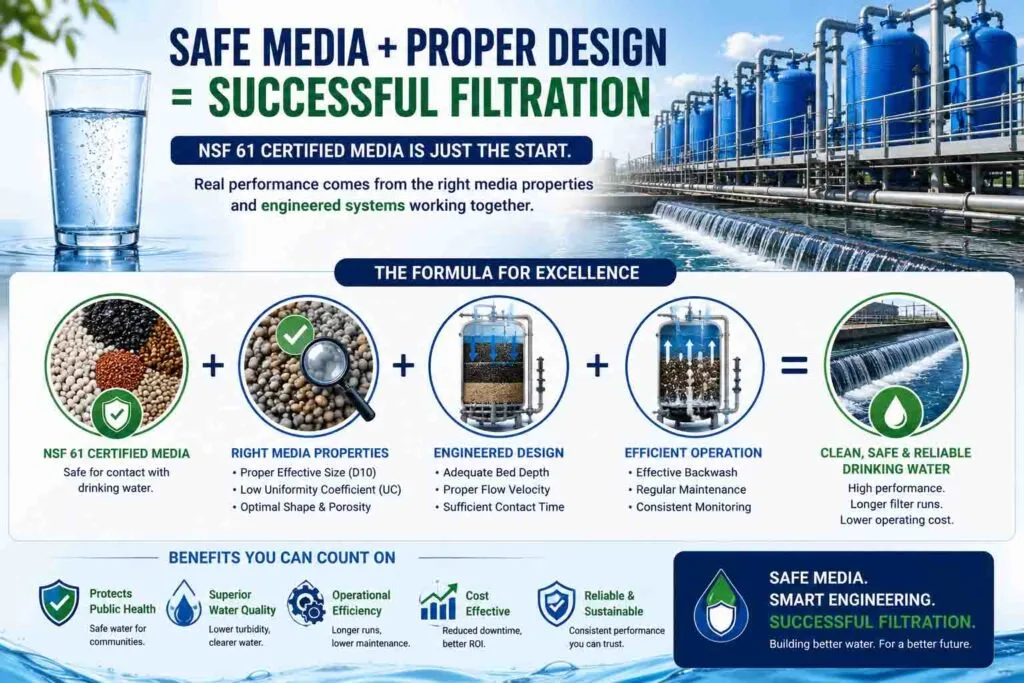
Actual filtration performance depends on engineering factors such as:
- Effective size
- Uniformity coefficient
- Bed depth
- Flow velocity
- Backwash design
- Water quality
- Hydraulic design
The best water treatment systems combine both:
- Certified safe media
- Proper engineering design
Understanding this difference can help prevent design failures, improve plant performance, and ensure safer drinking water systems.
About Starke Aquacare Technologies
Starke Aquacare Technologies is a global supplier of water filtration media for municipal, industrial, commercial, and desalination applications.
Starke supplies:
- Silica sand
- Anthracite
- Activated carbon
- Zeolite
- Garnet
- Manganese dioxide media
- Gravel
- Specialty filtration media
with a strong focus on quality consistency, grading control, and technical filtration support.