
Iron Removal from Water in North East India
Why Assam, Tripura, Meghalaya and Manipur Face High Iron Levels
Groundwater is the primary source of drinking water for millions of people across North East India. However, many regions face a serious challenge: high iron contamination in groundwater.
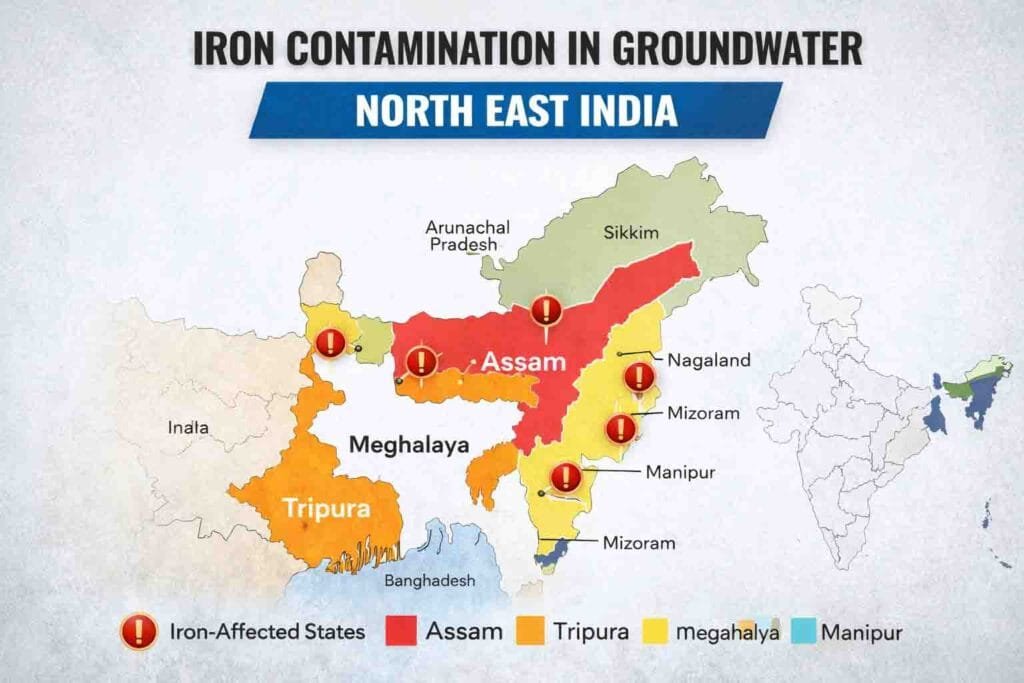
States such as Assam, Tripura, Meghalaya and Manipur frequently report iron concentrations far above recommended drinking water limits.
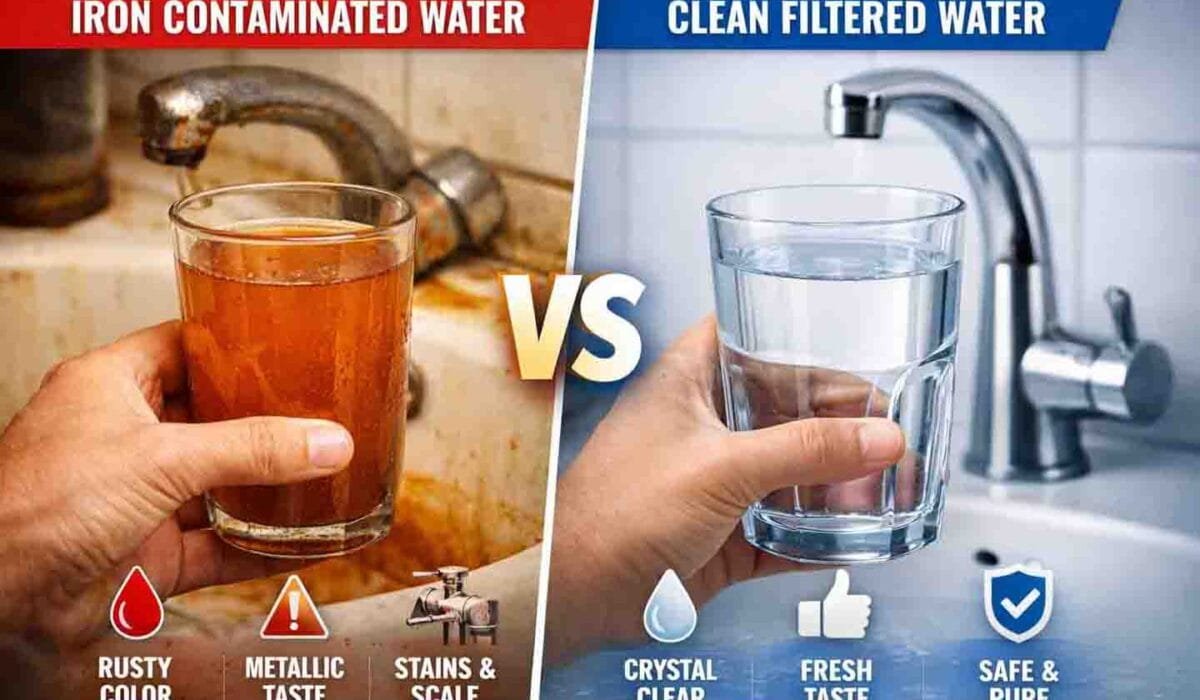
Water containing excess iron often appears yellow, brown, or reddish, develops a metallic taste, and causes staining on plumbing fixtures and clothing. In many cases, untreated groundwater cannot be used for drinking or industrial purposes without proper treatment.
As water demand increases and groundwater extraction continues, the need for effective iron removal solutions and filtration media has become increasingly important across North East India.
The Problem: Iron Contamination in Groundwater
Iron contamination is one of the most common water quality issues in groundwater sources.
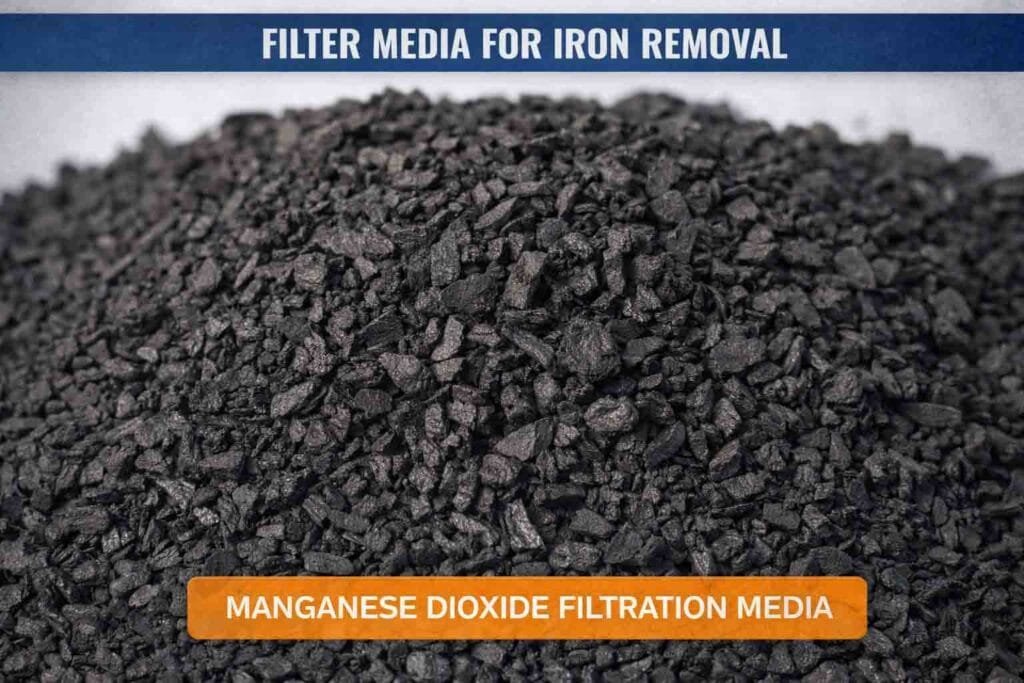
When groundwater passes through soil layers containing iron minerals, it dissolves ferrous iron (Fe²⁺) into the water. This dissolved iron is invisible when the water is pumped from the ground.
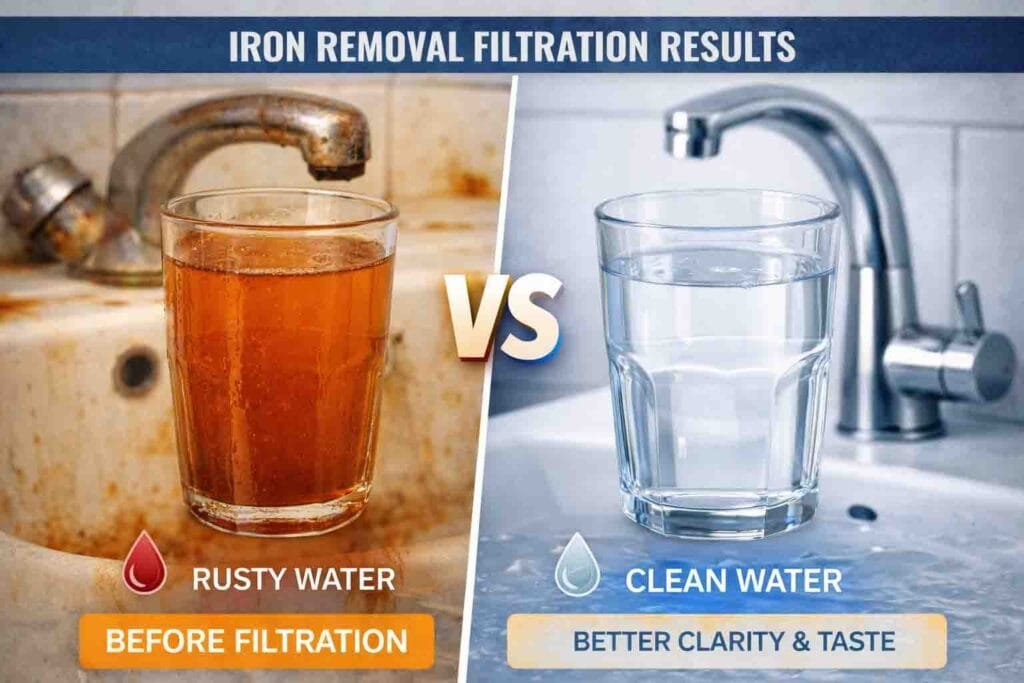
However, when the water is exposed to oxygen, the iron oxidizes and forms ferric iron (Fe³⁺) particles. These particles give water its characteristic reddish or rusty appearance.
Common problems caused by iron contamination include:
- Reddish or yellow discoloration in water
- Metallic taste in drinking water
- Staining on sinks, tiles, and laundry
- Blockage of pipelines and pumps
- Reduced efficiency of water treatment equipment
Without proper filtration, iron contamination can significantly affect water quality, infrastructure, and operational efficiency.
Acceptable Iron Levels in Drinking Water
According to the Bureau of Indian Standards, the acceptable limit of iron in drinking water is:
| Parameter | Acceptable Limit |
|---|---|
| Iron (Fe) | 0.3 mg/L |
In many parts of North East India, groundwater iron levels range between 1 mg/L and 10 mg/L, which is significantly higher than the recommended limit.
This makes iron removal from water an essential step in groundwater treatment systems.
Why Iron Contamination Is Common in North East India
The geology of North East India plays a major role in groundwater iron contamination.
The region contains:
- Iron-rich sedimentary formations
- Alluvial soil deposits in river basins
- Organic matter in aquifers
- High rainfall and groundwater recharge
These conditions allow iron to dissolve easily into groundwater sources.
The Brahmaputra river basin, which covers large parts of Assam and surrounding states, contains sediments that are particularly rich in iron minerals. As groundwater moves through these deposits, it absorbs dissolved iron.
Iron Contamination in Key North East States
Assam – Severe Iron Contamination
Groundwater in Assam frequently contains high iron concentrations due to the geological composition of the Brahmaputra valley.
Many groundwater samples show iron levels between 2 mg/L and 10 mg/L, which is far above safe drinking water limits.
As a result, iron removal plants (IRP) are widely installed in municipal and rural water supply systems.
Tripura – Iron and Manganese in Groundwater
Groundwater in Tripura often contains both iron and manganese, making water treatment more complex.
Many tube wells exceed recommended iron limits, increasing the demand for iron removal filtration systems and catalytic filter media.
Meghalaya – Localized Iron Issues
While Meghalaya receives high rainfall, certain districts such as West Garo Hills and East Khasi Hills report iron contamination in groundwater.
Water treatment facilities in these areas often install iron filtration systems to improve drinking water quality.
Manipur – Iron in Groundwater Sources
Groundwater in the Imphal valley of Manipur frequently contains elevated iron levels.
Municipal water treatment systems rely on filtration technologies and specialized media to remove iron before distribution.
The Solution: Iron Removal from Water
Fortunately, iron contamination can be effectively treated using modern water treatment technologies.
The most common method involves oxidation followed by filtration.
This process converts dissolved iron into solid particles that can be removed through filtration.
Typical Iron Removal Treatment Process
A standard iron removal system works through the following steps:
1. Oxidation
Dissolved ferrous iron (Fe²⁺) is converted into ferric iron (Fe³⁺) through oxidation.
This can be achieved using:
- Aeration
- Chemical oxidants
- Catalytic filter media
2. Precipitation
Once oxidized, ferric iron forms insoluble particles that can be filtered out of water.
3. Filtration
Water passes through specialized filter media that capture iron particles.
Common filtration systems include:
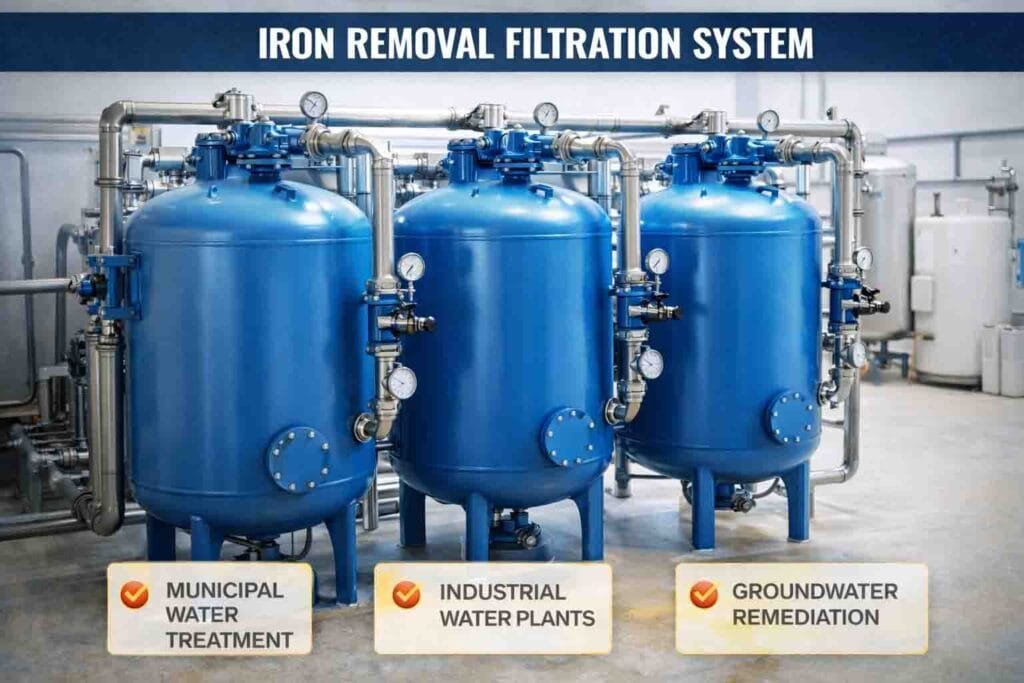
- Pressure sand filters
- Multi-media filtration systems
- Iron removal plants
4. Backwashing
Periodic backwashing removes accumulated iron particles from the filter bed and restores filtration efficiency.
Filter Media Used for Iron Removal
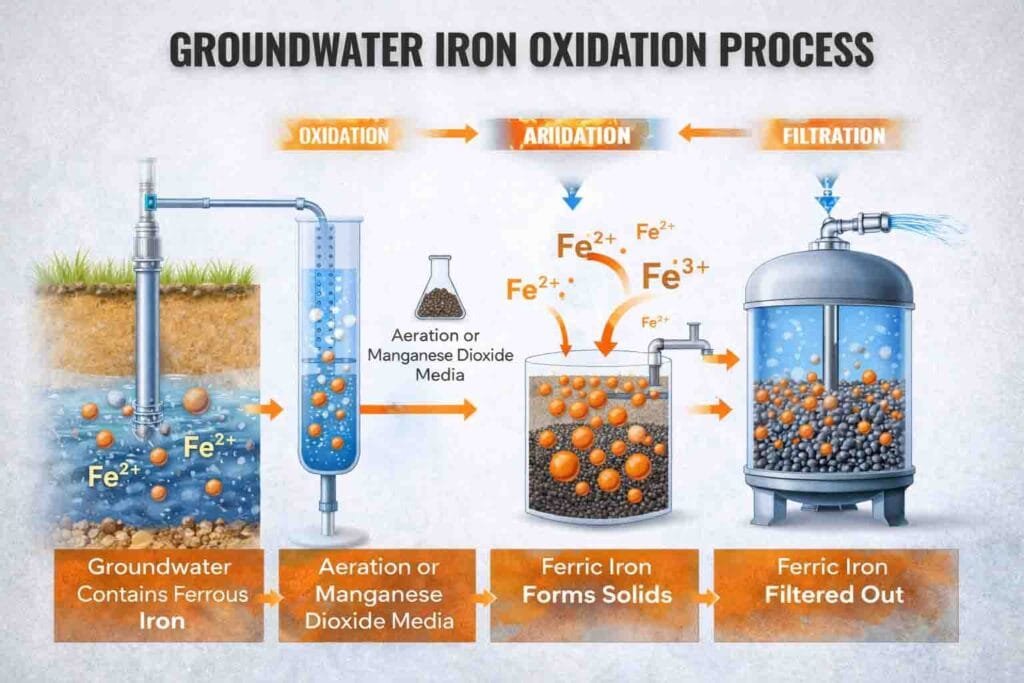
The effectiveness of iron removal systems depends largely on the quality of filter media used in the filtration system.
Common filtration media used in iron removal plants include:
- Manganese dioxide media
- Catalytic filtration media
- Multi-layer filter media systems
These media accelerate oxidation and capture iron particles efficiently.
High-quality filter media can improve:
- Iron removal efficiency
- Filter run time
- System reliability
- Overall water quality
Applications of Iron Removal Systems
Iron removal filtration systems are widely used across multiple sectors.
Municipal Water Supply
Government water treatment plants use iron removal systems to treat groundwater before distribution.
Rural Drinking Water Projects
Tube wells and bore wells often require filtration systems to remove iron before household use.
Industrial Water Treatment
Industries require iron-free water to prevent corrosion and scaling in equipment.
Institutional Water Supply
Schools, hospitals, and residential complexes often install iron filtration systems to improve water quality.
Growing Demand for Iron Removal Solutions in North East India
With increasing awareness of water quality, many states in North East India are expanding their water treatment infrastructure.
This has increased demand for:
- Iron removal plants
- Filtration media
- Groundwater treatment systems
States such as Assam, Tripura, Meghalaya and Manipur continue to invest in water treatment technologies to provide safe drinking water to growing populations.
Buy Iron Removal Filter Media from Starke Aquacare Technologies
If you are planning to install or upgrade an iron removal plant or groundwater treatment system, selecting the right filtration media is essential for long-term performance.
Starke Aquacare Technologies is a trusted supplier of water filtration media used in municipal, industrial, and groundwater treatment projects worldwide.
Starke supplies high-quality filter media suitable for iron removal applications, including:
- Manganese dioxide filtration media
- Catalytic filter media
- Multi-media filtration materials
- Pressure sand filter media
These filtration solutions are widely used for groundwater treatment, borewell iron removal systems, and municipal water filtration plants.
Contact Starke Aquacare Technologies
If you are designing or upgrading an iron removal plant, our team can assist in selecting the right filtration media for your system.
Starke Aquacare Technologies
📧 Email: info@starkefiltermedia.com
🌐 Website: www.starkefiltermedia.com
Our filtration media are supplied to water treatment projects across Asia, Africa, the Middle East, and Europe, helping engineers achieve reliable water purification performance.
- iron removal from water
- iron removal plant for groundwater
- iron filter media for water treatment
- manganese dioxide media for iron removal
- iron removal system for borewell water
- groundwater iron removal technology
- catalytic media for iron removal
- iron removal filter for drinking water
- iron removal plant suppliers in India
- manganese dioxide filter media supplier