
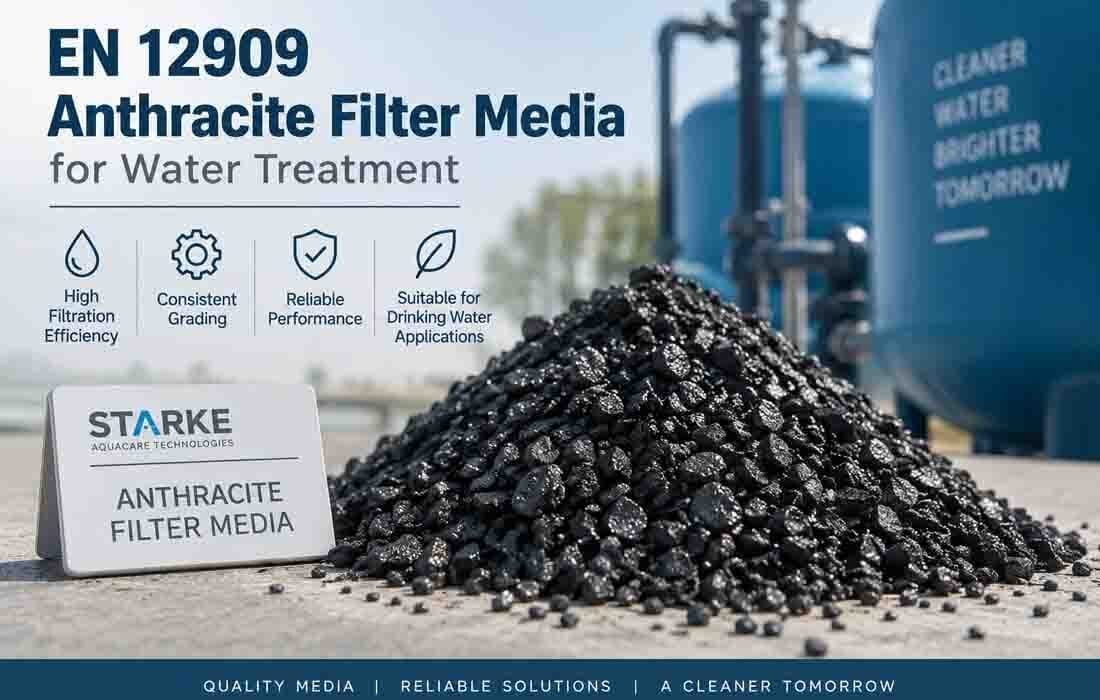
EN 12909 Anthracite Filter Media: What Water Treatment Buyers Should Know
When purchasing anthracite filter media for water treatment, price and particle size are only part of the specification. Media quality, particle-size distribution, purity, density and consistency can directly influence filtration performance.
For projects involving water intended for human consumption, EN 12909 anthracite filter media is frequently referenced by consultants, EPC contractors, water-treatment companies and procurement teams.
But what does EN 12909 actually cover? And what should you check before placing an order for anthracite filter media?
This guide explains the important considerations for water-treatment buyers.
What Is EN 12909?
EN 12909 is the European standard covering anthracite used for the treatment of water intended for human consumption.
The standard describes the characteristics of anthracite, establishes relevant requirements and corresponding test methods, and provides information about its use in water treatment.
It addresses areas such as:
- Physical characteristics
- Chemical characteristics
- Particle-size distribution
- Bulk density
- Composition and purity
- Sampling and testing
- Labelling
- Transportation
- Storage
For buyers, therefore, EN 12909 provides a useful framework for evaluating anthracite intended for water-treatment applications.
Important: Buyers should always specify the required edition of the standard in project documentation and verify the applicable regulatory requirements for the country where the media will be used.
Why Is Anthracite Used as Filter Media?
Anthracite is widely used in dual-media and multimedia filtration systems.
One of its key advantages is its relatively low density compared with silica sand. When correctly selected and backwashed, anthracite can form the upper filtration layer while the denser and generally finer silica sand remains below it.
This creates a depth-filtration arrangement where larger suspended particles can be captured in the upper portion of the filter while finer particles penetrate deeper into the bed.
As a result, properly designed anthracite-and-sand filters can provide effective solids removal while making better use of the available filter-bed depth.
Anthracite may be used in applications such as:
- Drinking-water treatment
- Municipal water-treatment plants
- Industrial water treatment
- Process-water filtration
- Pretreatment systems
- Dual-media filters
- Multimedia filters
- Gravity filters
- Pressure filters
The actual suitability of anthracite, however, depends on the water characteristics and filter design.
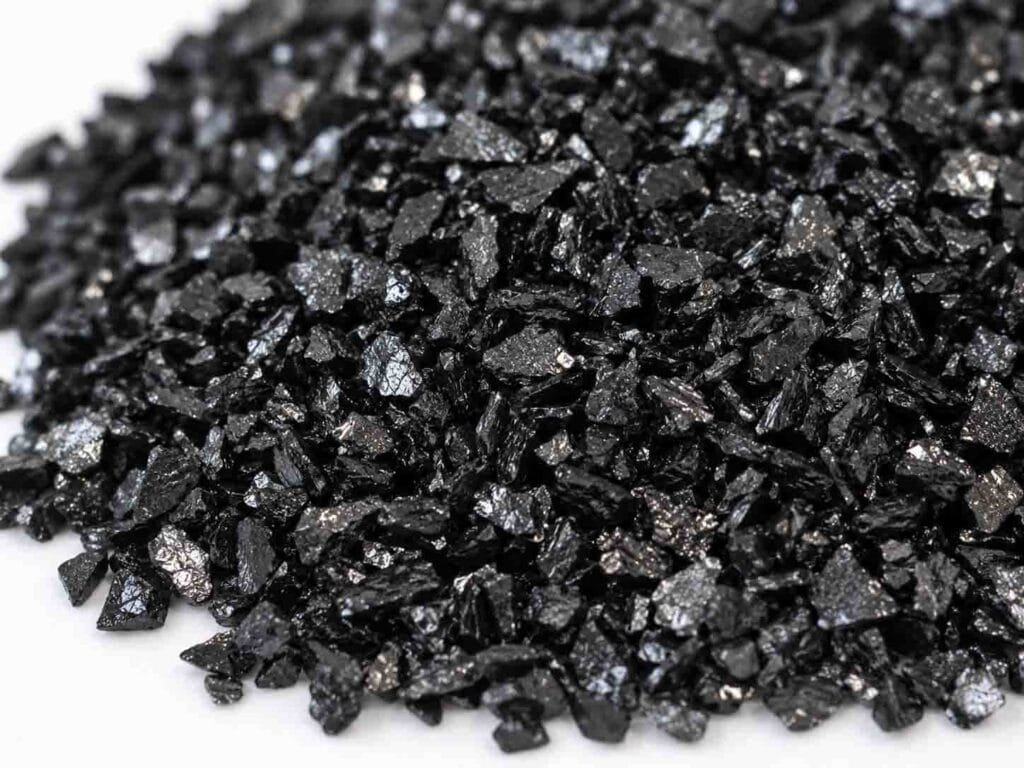
EN 12909 Anthracite Filter Media: What Should Buyers Check?
A common purchasing mistake is to specify only:
“Anthracite Filter Media – 0.8–1.6 mm.”
Particle-size range is important, but it does not provide enough information to properly evaluate filtration media.
Several parameters should be considered before purchasing.
1. Particle-Size Distribution
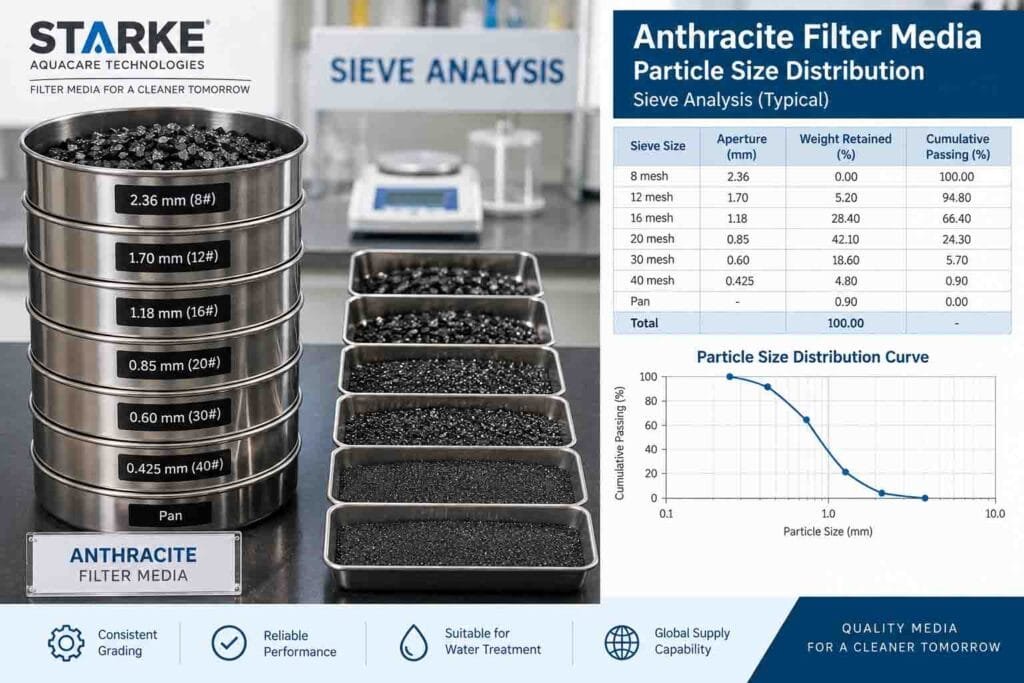
Particle-size distribution tells you how the anthracite particles are distributed throughout the specified grading.
Two products can both be labelled 0.8–1.6 mm while having significantly different distributions within that range.
This can affect:
- Bed porosity
- Hydraulic behaviour
- Solids-loading characteristics
- Backwashing
- Bed expansion
- Interaction with the underlying sand layer
For critical projects, ask your supplier for an actual sieve analysis or particle-size distribution report rather than relying only on the nominal size printed on the bag.
2. Effective Size (D10)
Effective Size, commonly called D10, is one of the most important parameters in granular filtration.
D10 represents the particle size at which approximately 10% of the media by weight is finer.
For example, specifying only a broad particle range does not necessarily tell the filter designer the effective size.
That is why engineers should evaluate particle-size distribution, D10 and uniformity coefficient together when the filter design requires these parameters.
3. Uniformity Coefficient
The Uniformity Coefficient (UC) provides an indication of how narrowly or broadly the filter media is graded.
It is commonly expressed as:
UC = D60 / D10
where:
- D10 = particle size at 10% passing
- D60 = particle size at 60% passing
A tighter particle-size distribution generally gives the designer greater control over the hydraulic characteristics of the filter bed.
However, the correct UC should be determined by the project specification and filter design rather than assuming that one value is ideal for every application.
When sending an RFQ, buyers should therefore consider specifying:
Particle size + D10/Effective Size + UC requirement
instead of specifying only the nominal particle-size range.
4. Anthracite Purity and Composition
Anthracite used for water treatment should not be evaluated in the same way as ordinary coal supplied primarily as a fuel.
EN 12909 includes requirements relating to the composition of commercial anthracite.
The standard specifies a minimum carbon content of 90% on a water- and ash-free basis, together with limits for ash and volatile matter.
This distinction matters because filtration anthracite is a processed filtration material, not simply crushed coal.
Buyers should request relevant technical documentation and confirm that the offered material corresponds to the requirements of their particular project.
5. Bulk Density
Bulk density is particularly important when calculating the quantity of anthracite required for a filter vessel.
For Starke anthracite filter media, typical bulk density is approximately 720–850 kg/m³, depending on the grade and material characteristics.
For example, if a filter requires:
5 m³ of anthracite
and the selected material has a bulk density of:
800 kg/m³
the approximate media requirement would be:
5 × 800 = 4,000 kg
Actual procurement quantity should be based on the confirmed bulk density of the offered grade, design volume, loading requirements and any appropriate project allowance.
6. Anthracite Size Selection
There is no single anthracite particle size that is correct for every water-treatment filter.
Common Starke anthracite grades include:
- 0.6–1.8 mm
- 0.8–1.6 mm
- 0.9–1.1 mm
- 1.2–2.5 mm
- 1.4–2.9 mm
- 3–6 mm
- 6–12 mm
The correct grade should be selected according to the filtration system rather than simply choosing the most commonly available size.
Factors to consider include:
- Underlying silica-sand grading
- Required effective size
- Uniformity coefficient
- Filtration velocity
- Influent suspended solids
- Required treated-water quality
- Anthracite bed depth
- Backwash velocity
- Target bed expansion
- Filter configuration
For this reason, anthracite size selection should form part of the filter design.
Anthracite vs Silica Sand: Why Are They Often Used Together?
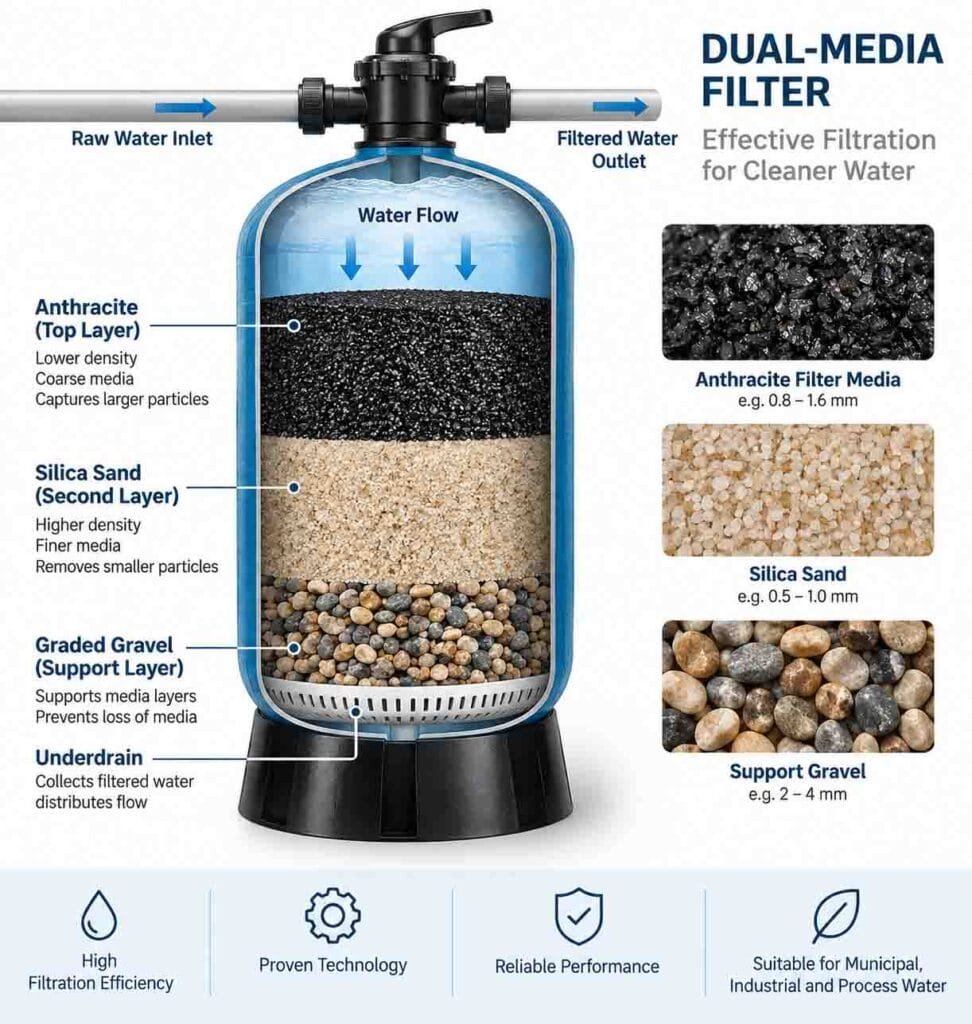
Silica sand and anthracite perform complementary roles in a properly designed dual-media filter.
Anthracite is generally less dense and can be selected at a coarser grading than the underlying filter sand.
After appropriate backwashing and settling, the media should restratify so that the lower-density anthracite remains above the denser sand.
A simplified arrangement may look like:
Top Layer → Anthracite
Lower Filtration Layer → Silica Sand
Bottom Support Layers → Graded Gravel
The exact media sizes, bed depths and layer configuration must be determined according to the filter design.
The objective is not simply to stack different materials. Their particle size and density relationships must work together hydraulically.
Why D10 and UC Matter When Buying Anthracite
Consider two suppliers offering:
Anthracite: 0.8–1.6 mm
On paper, the products appear identical.
However, Supplier A’s material could be concentrated toward the finer end of the grading while Supplier B’s material could be concentrated toward the coarser end.
Both could potentially fall within the nominal range while behaving differently inside the filter.
That is why experienced buyers increasingly look beyond the product name and nominal grading.
A technical evaluation should consider the complete particle-size distribution and any specified D10 and UC requirements.
This becomes especially important in tightly engineered dual-media and multimedia filters.
The Importance of Batch-to-Batch Consistency
A perfect pre-shipment sample does not automatically guarantee that hundreds of bags will have identical characteristics.
This is one of the most overlooked issues when purchasing filter media.
Natural mineral and coal-based filtration materials require controlled processing, screening, sampling and quality inspection.
Small variations can also occur because of:
- Sampling technique
- Sample splitting
- Sieve loading
- Particle orientation
- Laboratory equipment
- Testing procedure
- Natural raw-material variation
For large projects, buyers should evaluate the supplier’s quality-control process and ability to maintain grading consistency across production batches, rather than making a purchasing decision from a small sample alone.
What Documentation Should You Request?
Before ordering anthracite filter media, consider requesting the documents relevant to your project.
These may include:
- Technical Data Sheet (TDS)
- Certificate of Analysis (COA)
- Particle-size distribution / sieve analysis
- Effective Size (D10), where specified
- Uniformity Coefficient, where specified
- Bulk-density information
- Chemical composition
- Packing details
- Applicable quality certifications
- Statement or test documentation relating to the required standard, where applicable
For major projects, the consultant or EPC contractor may specify additional inspection and testing requirements.
7 Questions to Ask an Anthracite Filter Media Supplier
Before comparing quotations purely on price, ask:
1. What is the exact particle-size distribution?
Do not rely only on the nominal grading.
2. What are the Effective Size (D10) and Uniformity Coefficient?
These may be critical to your filter design.
3. What is the bulk density?
This affects vessel loading and procurement quantity.
4. Can you provide a sieve-analysis report?
This helps verify the actual grading.
5. Can you maintain the required grading across the complete shipment?
Batch consistency becomes increasingly important for large projects.
6. What quality-control documentation is available?
Request the documents required by your project before ordering.
7. Is the offered anthracite suitable for my sand grading and filter design?
Anthracite should not be selected independently of the rest of the filter bed.
Common Mistakes When Buying Anthracite Filter Media
Buying Only on Price
A lower price per kilogram can become expensive if the media does not meet the required grading or design specification.
Specifying Only Particle Range
“0.8–1.6 mm” alone may not adequately define the media required for an engineered filtration system.
Ignoring the Underlying Sand
Anthracite and sand must be selected as part of the same filtration system.
Ignoring Bulk Density
Ordering by volume without confirming bulk density can result in incorrect weight calculations.
Assuming Every Anthracite Is the Same
Raw material, processing, screening and quality control can differ considerably between suppliers.
Not Checking Documentation Before Dispatch
Technical requirements should ideally be agreed before production and shipment, particularly for export and project orders.
EN 12909 Anthracite Filter Media from Starke Aquacare Technologies
Starke Aquacare Technologies supplies filtration media for municipal, industrial and commercial water-treatment applications.
Our filter-media portfolio includes:
- Anthracite Filter Media
- Silica / Quartz Filter Sand
- Support Gravel
- Garnet Filter Media
- Activated Carbon
- Manganese Dioxide Media
- Manganese Greensand
- Purozite™ Clinoptilolite
- Walnut Shell Filter Media
- Activated Alumina
- Glass Filter Media
- Ion Exchange Resin
Anthracite is available in multiple particle-size ranges to suit different filtration-system requirements.
For project enquiries, our team can review the required particle size, effective size, uniformity coefficient, bed depth, vessel dimensions and filtration conditions before recommending an appropriate grade.
Need Anthracite Filter Media for Your Project?
If you are sourcing anthracite filter media for a water-treatment project, send us your technical specification.
For a faster technical evaluation, provide:
- Required anthracite size
- Effective Size / D10
- Uniformity Coefficient
- Required quantity
- Filter vessel diameter
- Anthracite bed depth
- Filtration flow rate
- Application
- Required standard
- Delivery country / destination
Starke Aquacare Technologies can then review the requirement and recommend a suitable filter-media grade.
Website: www.starkefiltermedia.com
Product: Anthracite Filter Media
Applications: Drinking Water | Industrial Water | Dual Media Filtration | Multimedia Filtration | Water Treatment Plants
Frequently Asked Questions About EN 12909 Anthracite Filter Media
What is EN 12909?
EN 12909 is a European standard applicable to anthracite used in the treatment of water intended for human consumption. It describes anthracite characteristics, requirements, test methods and information relating to its use in water treatment.
What is anthracite filter media used for?
Anthracite filter media is commonly used as an upper filtration layer in dual-media and multimedia filters for removing suspended solids and improving depth filtration.
What size anthracite is used for water filtration?
There is no universal size. Grades such as 0.8–1.6 mm, 1.2–2.5 mm and other ranges may be used depending on the underlying sand, filtration velocity, bed design and project specification.
What is the bulk density of anthracite filter media?
Bulk density varies according to the source and grade. Starke anthracite typically falls around 720–850 kg/m³. The value for the actual supplied grade should be used for media-quantity calculations.
What is D10 in anthracite filter media?
D10, or Effective Size, is the particle size at which approximately 10% of the media by weight is finer. It is an important parameter for specifying granular filtration media.
What is the Uniformity Coefficient of filter media?
Uniformity Coefficient is commonly calculated as D60 ÷ D10. It indicates the spread of particle sizes within a granular filter-media grading.
Is anthracite better than silica sand?
They should not necessarily be viewed as competing materials. Anthracite and silica sand are frequently used together in dual-media filtration because their different particle sizes and densities can create complementary filtration layers.
How much anthracite do I need for my filter?
The approximate quantity can be calculated using:
Media Volume (m³) × Bulk Density (kg/m³) = Media Weight (kg)
Media volume depends primarily on the filter area and required anthracite bed depth.