
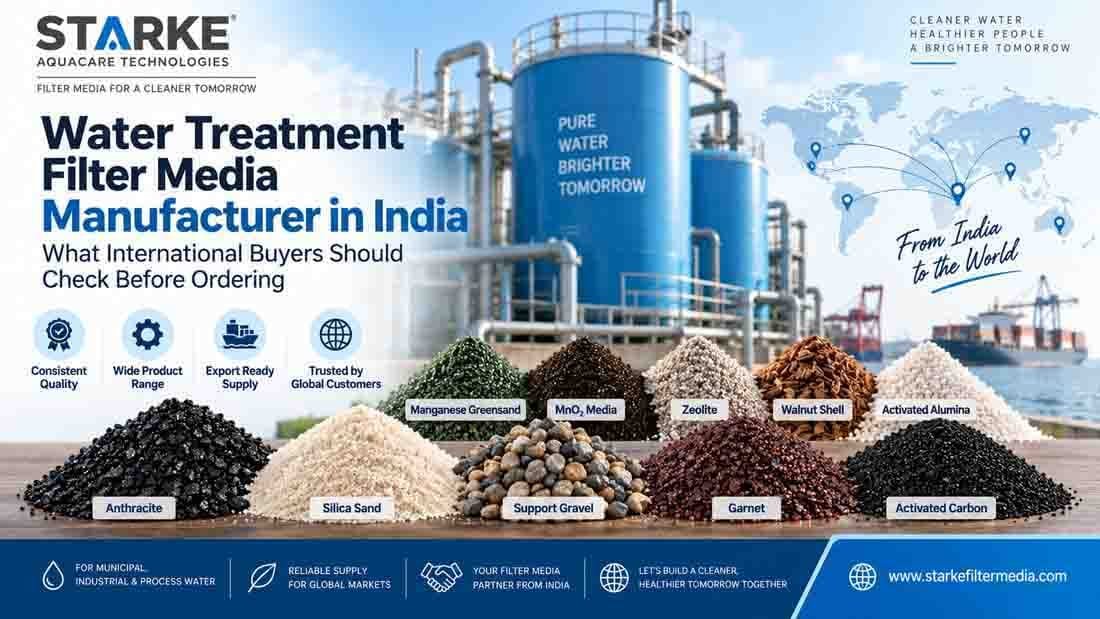
India has become an important sourcing destination for water treatment filter media, serving municipal water projects, industrial treatment plants, desalination systems, wastewater facilities, OEMs and EPC contractors worldwide.
However, choosing a water treatment filter media manufacturer in India should involve more than comparing price per kilogram.
Filter media may look simple, but parameters such as particle size distribution, Effective Size (D10), Uniformity Coefficient (UC), bulk density, purity, batch consistency, documentation and export packaging can directly affect whether the supplied material meets a project’s technical requirements.
For international buyers, the real question is not simply:
“Who can supply filter media from India?”
It is:
“Which supplier can consistently manufacture, test, document, pack and export the filter media my project actually requires?”
This guide explains what international buyers should check before ordering.
Why Source Water Treatment Filter Media from India?
India has a well-developed water-treatment industry supported by manufacturers of filtration media, pressure vessels, membranes, pumps, chemicals, treatment systems and related equipment.
For overseas buyers, sourcing filter media from India can provide access to a broad selection of products for drinking water, industrial water, wastewater and desalination applications.
Commonly sourced filtration media include:
- Silica / quartz filter sand
- Support gravel
- Anthracite filter media
- Garnet filter media
- Activated carbon
- Zeolite filter media
- Clinoptilolite
- Manganese dioxide media
- Manganese greensand
- Activated alumina
- Walnut shell filter media
- Glass filter media
- Ion exchange resin
However, availability alone should never determine supplier selection.
The first priority should always be technical compliance with the filtration design and project specification.
10 Things International Buyers Should Check Before Ordering Filter Media from India
1. Check the Exact Particle Size Distribution
One of the most common mistakes when purchasing granular filter media is looking only at the nominal size.
Consider:
Silica Sand: 0.5–1.0 mm
Two manufacturers can offer material labelled 0.5–1.0 mm, yet the actual distribution of particles within this range can be quite different.
One batch may be concentrated around the finer end, while another may contain significantly more coarse material.
This can influence the behaviour of the filter bed.
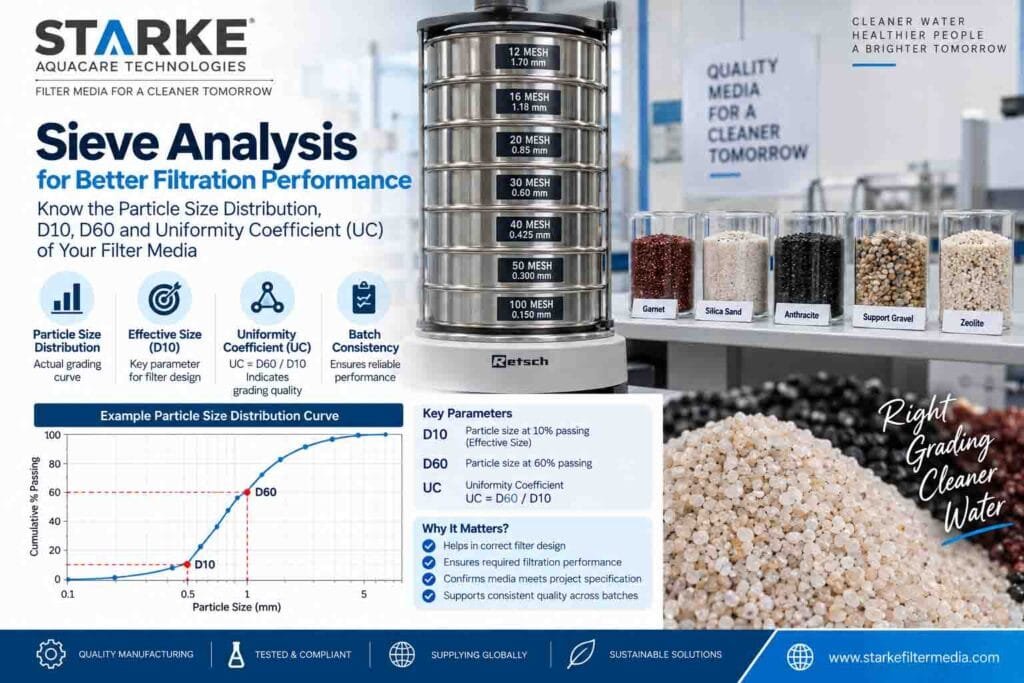
For engineered filtration projects, buyers should consider requesting a sieve analysis or particle size distribution report.
This is particularly important for:
Silica sand | Anthracite | Garnet | Gravel | Zeolite | Manganese media
Buyer Tip
Don’t ask only:
“Can you supply 0.5–1.0 mm?”
Also ask:
“Can you provide the sieve analysis for the offered grade?”
2. Check Effective Size (D10)
Effective Size, or D10, is an important parameter for granular filtration media.
D10 represents the particle size at which approximately 10% of the material by weight is finer.
For example, a project specification may require:
Effective Size: 0.45–0.55 mm
Simply offering a product labelled 0.5–1.0 mm does not automatically demonstrate that the required Effective Size has been achieved.
Where D10 is specified by the consultant or filter designer, international buyers should include it clearly in the RFQ.
Better RFQ:
Silica Sand: 0.5–1.0 mm
Effective Size (D10): As specified
Uniformity Coefficient: As specified
Quantity: 100 MT
This gives the manufacturer much clearer production and testing criteria.
3. Check the Uniformity Coefficient (UC)
The Uniformity Coefficient indicates how broad or narrow the particle size distribution is.
It is commonly calculated as:
UC = D60 / D10
where:
D10 = particle size corresponding to 10% passing
D60 = particle size corresponding to 60% passing
For tightly engineered filters, UC can be just as important as the nominal particle-size range.
A specification requiring:
UC ≤ 1.5
should not be treated as equivalent to simply requesting a particular mesh or millimetre range.
The manufacturer must control the grading closely enough to achieve the required distribution.
4. Verify the Applicable Filter Media Standard
International projects frequently reference recognized standards.
Depending on the material and application, specifications may refer to standards such as:
EN 12904 — certain silica sand and gravel products used for treatment of water intended for human consumption.
EN 12909 — anthracite used for treatment of water intended for human consumption.
AWWA B100 — granular filter material used in water-supply service.
The applicable standard should always be confirmed against the project’s latest technical specification and local regulatory requirements.
Important for Buyers
Don’t simply ask:
“Is your filter media standard?”
Instead specify:
Material + Grade + Required Standard + Edition/Project Specification + Required Tests
This reduces ambiguity during technical evaluation.
5. Check Bulk Density Before Calculating Quantity
Bulk density is extremely important when converting filter-media volume into weight.
A simple calculation is:
Required Weight (kg) = Media Volume (m³) × Bulk Density (kg/m³)
Consider a filter requiring 10 m³ of anthracite.
At a bulk density of 800 kg/m³:
10 × 800 = 8,000 kg
But if the assumed bulk density is incorrect, the procurement quantity will also be incorrect.
Typical Starke values used for preliminary calculations include approximately:
| Filter Media | Typical Bulk Density |
|---|---|
| Silica / Quartz Sand | 1,500 kg/m³ |
| Support Gravel | 1,500–1,600 kg/m³ |
| Anthracite | 720–850 kg/m³ |
| Garnet | 2,300 kg/m³ |
| Purozite™ Clinoptilolite | 850–900 kg/m³ |
| Walnut Shell Media | 625 kg/m³ |
These values are useful for preliminary estimation. Final calculations should use the confirmed bulk density of the actual offered grade.
6. Don’t Approve a Supplier Based Only on One Sample
This is especially important for large international projects.
Suppose a manufacturer sends a 2 kg sample.
The laboratory tests it.
Everything passes.
The project then orders 100 tonnes.
The critical question becomes:
Can the manufacturer reproduce the approved grading across 100 tonnes?
Producing one good sample and producing a consistently graded commercial shipment are two different challenges.
International buyers should therefore evaluate:
- Production control
- Screening capability
- Batch identification
- Sampling procedures
- In-process inspection
- Final QC
- Sieve analysis
- Lot traceability, where required
For filter media, repeatability matters as much as achieving one perfect test result.
7. Understand Why Laboratory Results Can Vary
Even with tightly controlled filter media, small differences between laboratories can occur.
Possible reasons include:
- Sample representativeness
- Sample splitting method
- Sieve loading
- Particle orientation
- Testing duration
- Equipment tolerances
- Sieve condition
- Laboratory procedure
This becomes particularly relevant when specifications have narrow acceptance limits.
For example, if the required D10 range is very tight, even a relatively small difference in measured particle-size distribution can affect the reported result.
The solution is not to ignore tolerances.
Instead, the buyer and manufacturer should agree in advance on:
Test method + sampling method + acceptance criteria + inspection procedure
This can prevent disputes after production.
8. Check the Filter Media Layer Compatibility
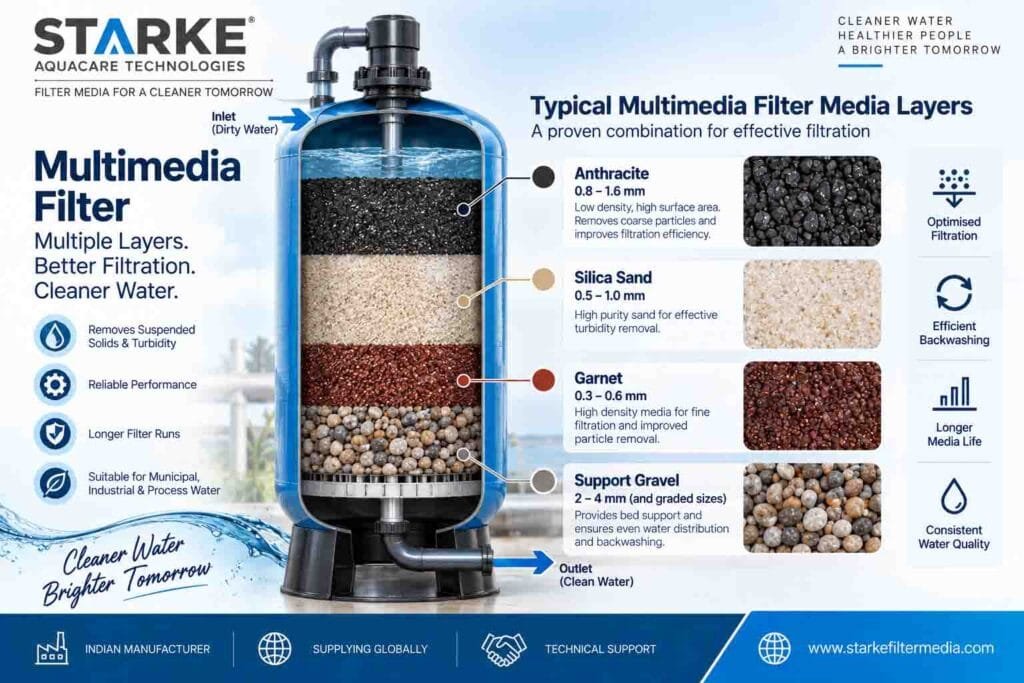
A multimedia filter should be evaluated as a complete filtration system.
For example, a typical configuration may include:
Anthracite
↓
Silica Sand
↓
Garnet, where applicable
↓
Graded Support Gravel
Each layer has a different:
- Particle size
- Density
- Bed depth
- Hydraulic role
Selecting each material independently without considering the other layers can create problems during filtration or backwashing.
For a dual-media filter, for example, anthracite is typically the lower-density and coarser upper layer, while silica sand forms the denser and finer layer below.
Therefore, buyers should ideally provide the manufacturer with the complete media configuration, not just one isolated product requirement.
9. Ask for the Right Technical Documentation
International procurement normally requires more documentation than domestic spot purchasing.
Before placing an order with a filter media supplier in India, determine exactly which documents the project requires.
These may include:
- Technical Data Sheet (TDS)
- Certificate of Analysis (COA)
- Sieve Analysis
- Particle Size Distribution
- Effective Size (D10)
- Uniformity Coefficient
- Bulk Density
- Specific Gravity, where required
- Chemical Analysis
- Product origin information
- Packing details
- Quality certifications
- Inspection documents
- Applicable standard-related test documentation
It is better to agree on documentation before the purchase order is finalized rather than requesting additional tests after the material has already been produced.
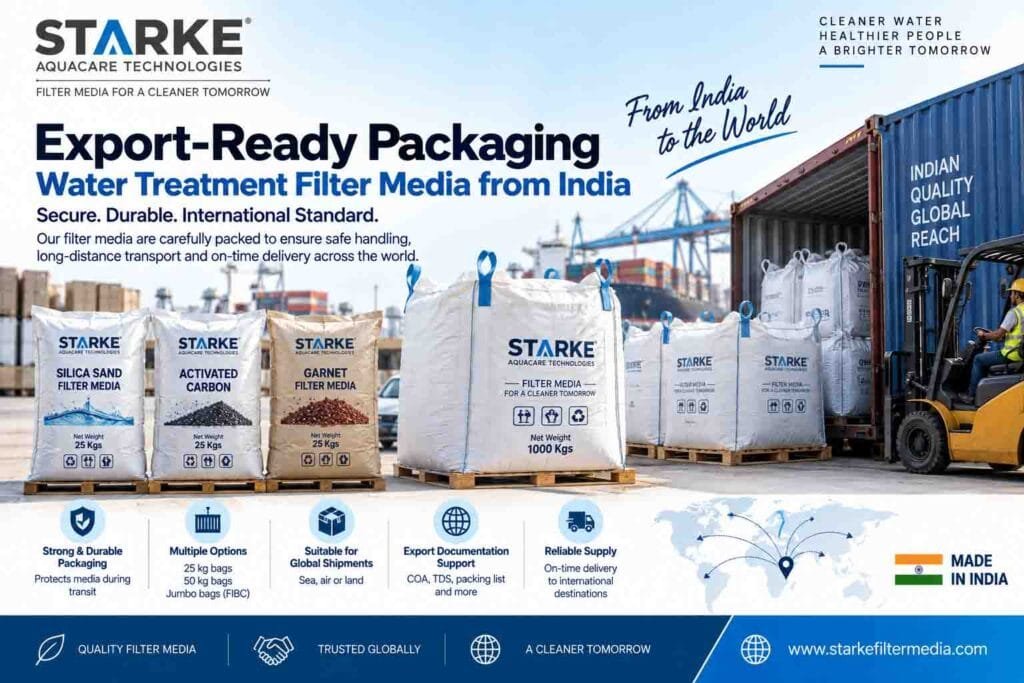
10. Evaluate Export Packaging and Logistics
A filter media can meet every laboratory specification and still cause problems if the export packaging is unsuitable.
Granular media are heavy materials.
International buyers should therefore discuss packaging during the quotation stage.
Common options can include:
25 kg bags
50 kg bags
500–1,000+ kg FIBC / jumbo bags, depending on product and requirement.
The correct option depends on the product, shipment size, destination, unloading facilities and customer preference.
Buyers should also clarify the required commercial term, such as:
EXW | FOB | CFR | CIF
and specify the destination port clearly.
For container shipments, payload limitations should be considered alongside the theoretical container volume because dense media such as sand and garnet can reach weight limitations well before the container is physically full.
Should You Buy Filter Media Based on Price per Kg?
Price is important.
But price per kilogram alone is a poor way to compare filter-media quotations.
Consider two quotations:
Supplier A: Lower price, broad grading, limited documentation.
Supplier B: Slightly higher price, controlled PSD, required D10/UC, documented QC and suitable export packing.
If Supplier A’s material fails inspection at destination, the cheaper material may ultimately become considerably more expensive.
Potential costs can include:
- Rejection
- Replacement material
- Additional testing
- Freight
- Port charges
- Project delays
- Filter reloading
- Commissioning delays
For international projects, the better question is:
“What is the total cost of receiving compliant filter media at site?”
not simply:
“Who has the lowest price per tonne?”
What Should an International Filter Media RFQ Include?
A good RFQ allows manufacturers to quote more accurately.
Instead of:
“Please quote filter sand.”
send something closer to:
Product: Silica Filter Sand
Particle Size: 0.5–1.0 mm
Effective Size (D10): ___ mm
Uniformity Coefficient: ≤ ___
SiO₂: ≥ ___%
Standard: ___
Quantity: ___ MT
Packing: 25 kg / 50 kg / Jumbo Bag
Application: Drinking Water / Industrial / Desalination / Wastewater
Incoterm: FOB / CFR / CIF
Destination Port: ___
Documentation Required: TDS / COA / PSD / Inspection / Other
This eliminates unnecessary emails and makes technical comparison between suppliers much easier.
Filter Media Manufacturer in India: Products Available from Starke
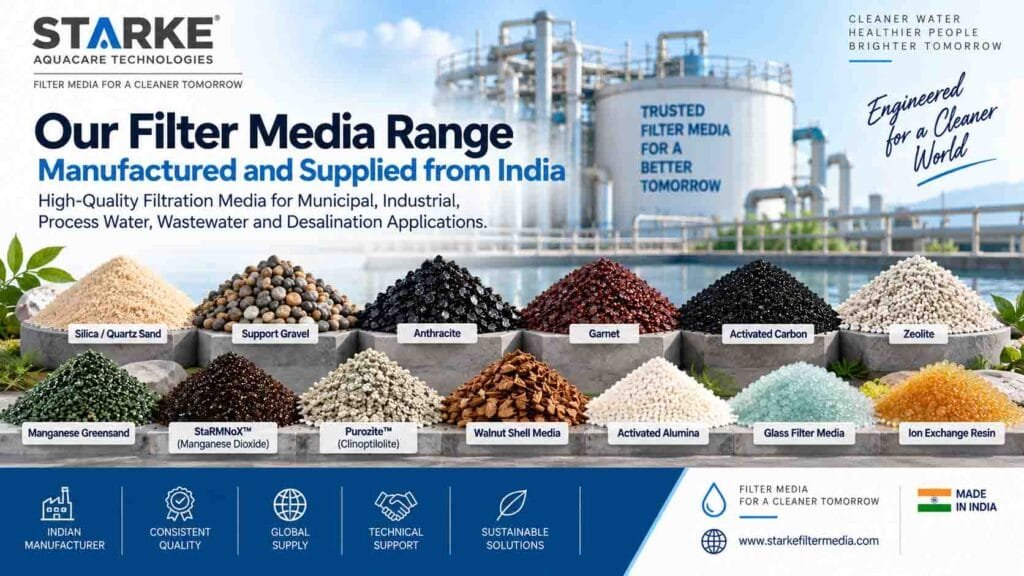
Starke Aquacare Technologies manufactures and supplies a broad range of water-treatment filtration media from India.
Our portfolio includes:
Silica / Quartz Filter Sand
Available in multiple gradings for pressure filters, gravity filters, dual-media and multimedia filtration.
Support Gravel
Graded support media available in multiple particle-size ranges for filter-bed support.
Anthracite Filter Media
Lower-density media commonly used as an upper layer in dual-media and multimedia filtration.
Garnet Filter Media
High-density filtration media commonly used as a lower layer in multimedia filtration systems.
Activated Carbon
Granular activated carbon options for water-treatment applications, including coconut-shell and bituminous coal-based grades.
STARCARB™
Bituminous coal-based granular activated carbon for water-treatment applications.
Purozite™ Clinoptilolite
Natural clinoptilolite zeolite media used in selected filtration and ion-exchange applications, including ammonia/ammonium reduction.
StaRMNoX™
Natural manganese dioxide filtration media for selected iron and manganese removal applications.
Manganese Greensand
Filtration media for iron and manganese treatment applications where suitable process conditions are maintained.
Walnut Shell Filter Media
Specialized granular media used for selected filtration applications, including oily-water treatment.
Other media available include Activated Alumina, Glass Filter Media, Zeolite Granules, Zeolite Powder, pH correction media and Ion Exchange Resin.
Why International Buyers Work with Starke Aquacare Technologies
Starke Aquacare Technologies has been involved in the water filtration media industry since 2005.
Our focus is not simply supplying bags of media.
For project enquiries, we aim to understand the technical requirement before recommending the appropriate product and grading.
Depending on the project, requirements may include:
Particle Size | Effective Size | UC | Bulk Density | Specific Gravity | Chemical Composition | Packing | Quantity | Standards | Documentation
Starke supplies filtration media for domestic and international water-treatment requirements and works with water-treatment companies, OEMs, EPC contractors, consultants, distributors and industrial users.
Buying Water Treatment Filter Media from India? Send the Specification First.
If you are an international buyer looking for a water treatment filter media manufacturer in India, start by sending the complete technical requirement.
For a faster evaluation, include:
1. Filter media type
2. Particle size
3. Effective Size / D10
4. Uniformity Coefficient
5. Required quantity
6. Application
7. Applicable standard
8. Required documentation
9. Packing requirement
10. Destination country and port
Our team can then review the requirement and offer a technically appropriate grade and commercial proposal.
Starke Aquacare Technologies
Filter Media for a Cleaner Tomorrow
Frequently Asked Questions
Who manufactures water treatment filter media in India?
India has manufacturers and processors supplying silica sand, gravel, anthracite, garnet, activated carbon, zeolite and specialty filtration media. International buyers should compare manufacturers based on technical compliance, QC capability, documentation, consistency and export experience rather than price alone.
What filter media are commonly exported from India?
Common products include silica sand, quartz sand, support gravel, anthracite, garnet, activated carbon, zeolite, manganese filtration media and activated alumina, depending on the application and destination requirements.
What should I check before importing filter media from India?
Check the particle-size distribution, D10, UC, bulk density, chemical characteristics, required standard, QC documentation, packing and shipment terms.
What is D10 in filter media?
D10, or Effective Size, represents the particle size at which approximately 10% of the media by weight is finer. It is commonly used when specifying granular filtration media.
What is the Uniformity Coefficient of filter media?
Uniformity Coefficient is commonly calculated as:
UC = D60 / D10
It provides an indication of the spread of particle sizes in granular filter media.
How do I calculate the quantity of filter media required?
A basic weight calculation is:
Filter Media Weight (kg) = Media Volume (m³) × Bulk Density (kg/m³)
For cylindrical vessels, media volume can first be estimated using the vessel’s cross-sectional area and required media bed depth.
Can filter media be supplied in jumbo bags for export?
Many granular filter media can be supplied in FIBC/jumbo bags depending on the material, quantity, customer requirement and shipping conditions. Packaging should be agreed before ordering.
Can different filter media be shipped together?
Depending on quantities, densities, packaging and container payload restrictions, different media can potentially be consolidated into one container. The loading plan should be checked before confirming the shipment.