
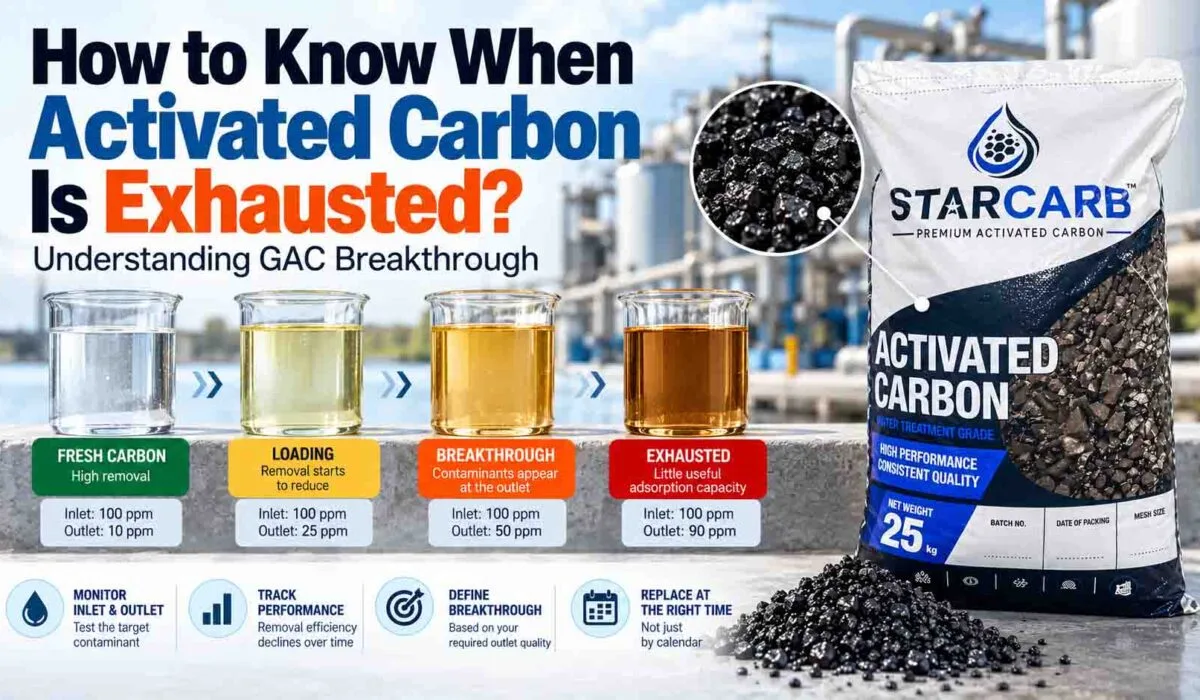
How to Know When Activated Carbon Is Exhausted: Understanding GAC Breakthrough
Your activated carbon may look perfectly normal and still be exhausted.
This is one of the most important concepts for anyone operating a granular activated carbon (GAC) filter.
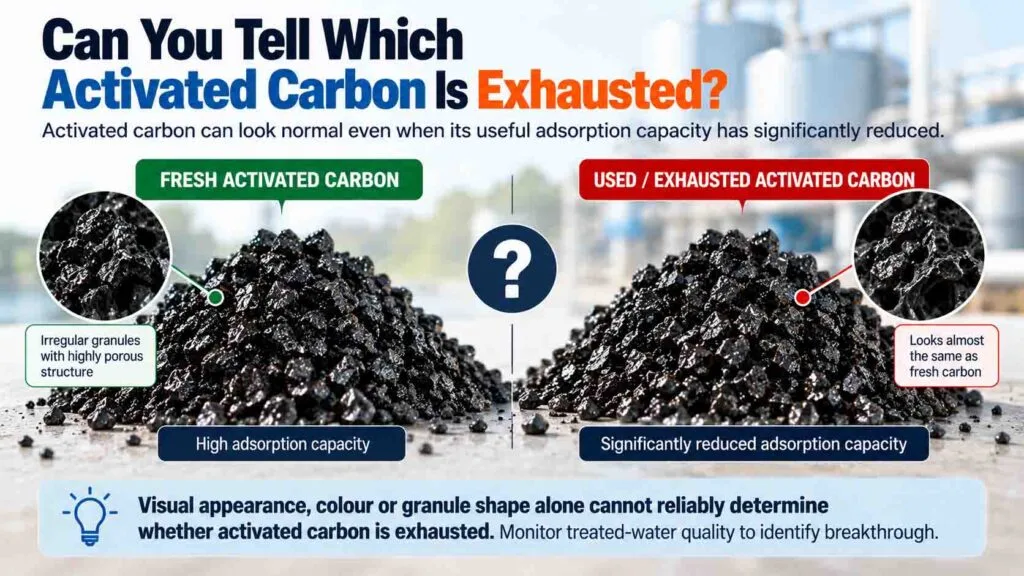
Activated carbon does not normally provide an obvious visual warning when its useful adsorption capacity is approaching exhaustion. The granules may remain black, hard and apparently unchanged.
So, how do you know when activated carbon is exhausted?
The answer is not simply operating time, colour or pressure drop.
The most reliable indicator is breakthrough: the point at which the contaminant being adsorbed begins appearing at an unacceptable concentration in the treated-water outlet.
Understanding breakthrough can help water-treatment operators improve carbon utilization, maintain treated-water quality and avoid replacing activated carbon unnecessarily.
What Does Activated Carbon Actually Do?
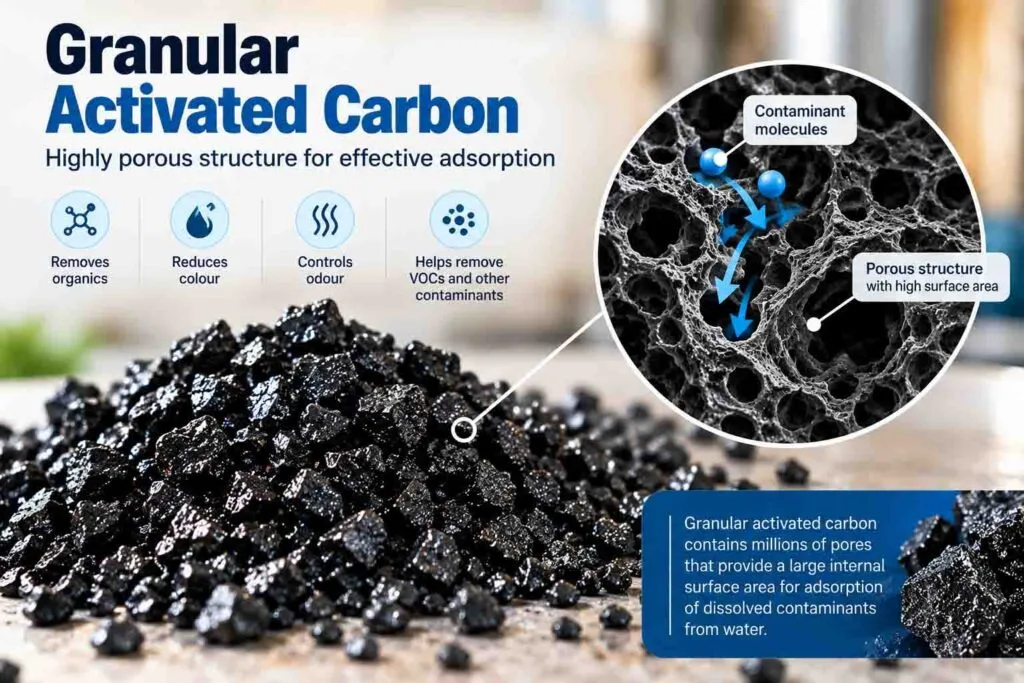
Granular activated carbon contains a highly developed porous structure.
When contaminated water passes through a GAC bed, certain dissolved compounds are attracted to and retained on the carbon’s internal surface through adsorption.
This makes granular activated carbon useful in applications involving compounds such as:
- organic contaminants,
- taste- and odour-causing compounds,
- VOCs,
- colour-causing compounds,
- certain synthetic organic compounds, and
- disinfection by-product precursors.
The suitability and treatment capacity of GAC vary significantly depending on the contaminant and the properties of the activated carbon.
However, activated carbon has finite adsorption capacity.
As operation continues, more adsorption sites become occupied. Eventually, the carbon cannot maintain the required removal efficiency.
That is when breakthrough becomes important.
What Is Activated Carbon Breakthrough?
In a fixed GAC bed, adsorption does not stop everywhere simultaneously.
Instead, an adsorption or mass-transfer zone progresses through the carbon bed as the upstream carbon becomes increasingly loaded.
Eventually, the adsorption zone approaches the outlet.
The concentration of the target contaminant in the treated water then begins to increase.
This is called activated carbon breakthrough.
The U.S. EPA describes breakthrough using the relationship between effluent and influent contaminant concentrations. When a predetermined contaminant concentration appears in the effluent and the water no longer meets the treatment objective, breakthrough has occurred. When the carbon becomes sufficiently saturated that it can no longer adsorb the contaminant effectively, it is considered spent.
This distinction is important:
Breakthrough does not necessarily mean waiting until the carbon has absolutely zero capacity remaining.
For practical operation, the relevant breakthrough point is normally determined by the maximum acceptable outlet concentration for the particular application.
A Simple Example of Activated Carbon Breakthrough
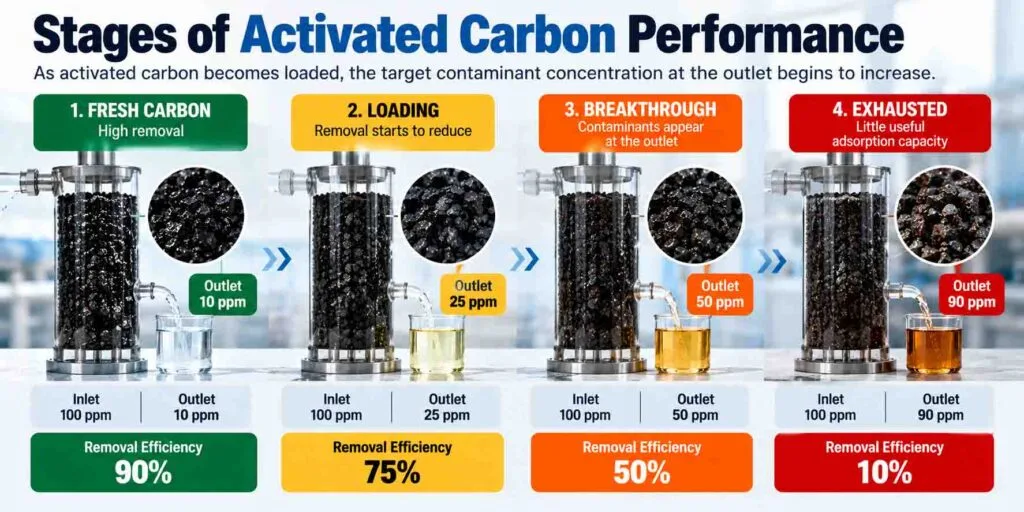
Suppose an activated carbon filter receives water containing a target organic contaminant at:
Inlet concentration = 100 mg/L
When the carbon is fresh:
Outlet = 10 mg/L
Removal efficiency:
(100 − 10) ÷ 100 × 100 = 90%
After extended operation:
Outlet = 25 mg/L
Removal has fallen to:
75%
Later:
Outlet = 50 mg/L
Removal is now only:
50%
Near complete exhaustion:
Outlet = 90 mg/L
Only:
10% removal
The important point, however, is that 50% removal is not automatically the definition of breakthrough.
If the process requires an outlet below 20 mg/L, then the operational breakthrough point occurs when the outlet approaches that specified limit—not when it reaches an arbitrary percentage of the inlet.
How to Calculate Activated Carbon Removal Efficiency
A simple way of monitoring GAC performance is:
Removal Efficiency (%) = [(C₀ − C) / C₀] × 100
Where:
C₀ = influent concentration
C = effluent concentration
For example:
C₀ = 100 mg/L
C = 15 mg/L
Therefore:
Removal Efficiency = 85%
Recording this regularly can reveal whether activated carbon performance is declining.
How Do You Know When Activated Carbon Is Exhausted?
The best approach is to monitor the contaminant that the carbon was selected to remove.
Measure it before and after the GAC filter.
For example:
| Application | What to Monitor |
|---|---|
| Chlorine removal | Free chlorine |
| Organic removal | TOC, COD or specific organic compound |
| Colour removal | Colour/Hazen |
| VOC removal | Target VOC concentration |
| Phenol removal | Phenol concentration |
| Pesticide removal | Specific target pesticide |
| Taste & odour | Relevant causative compounds |
Create a baseline when the carbon is fresh.
Then monitor the outlet concentration periodically.
If the outlet concentration begins increasing consistently, it may indicate that the adsorption zone is approaching the end of the carbon bed.
Once the outlet reaches the predetermined process limit, breakthrough has occurred for that treatment objective.
What Is a Breakthrough Curve?
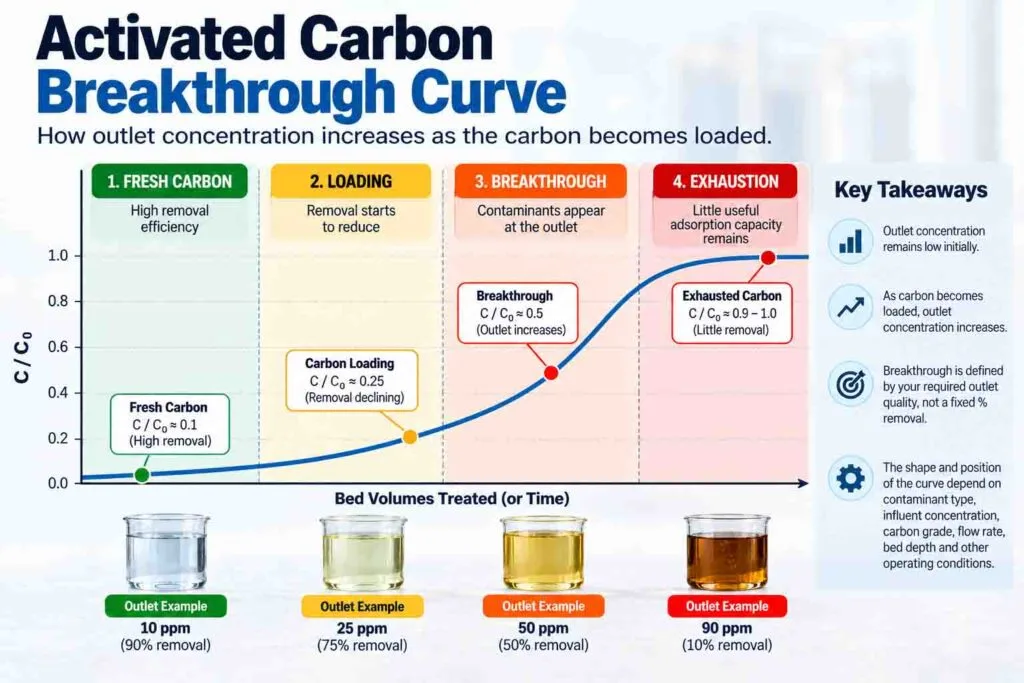
For better activated carbon monitoring, engineers can plot a breakthrough curve.
A common parameter is:
C/C₀
Where:
C = outlet concentration
C₀ = inlet concentration
The ratio is plotted against either:
- operating time, or
- volume/bed volumes of water treated.
Initially, C/C₀ should be low when the GAC is effectively adsorbing the target contaminant.
As the carbon becomes loaded, the ratio increases.
Eventually:
C approaches C₀
At that stage, little effective adsorption of that target contaminant remains.
The EPA describes this increasing effluent concentration with operating time or treated volume as the breakthrough curve. Its position and shape depend on adsorption equilibrium, adsorption rate and operating conditions.
What Affects Activated Carbon Breakthrough Time?
There is no universal answer to the question:
“How many months will activated carbon last?”
The same activated carbon may have very different service lives in two different treatment plants.
Several factors influence breakthrough.
1. Influent Contaminant Concentration
Higher contaminant loading generally consumes adsorption capacity faster.
Therefore, a filter receiving a consistently higher organic load may require more frequent carbon replacement or regeneration.
2. Type of Contaminant
Activated carbon does not adsorb every compound equally.
Molecular size, solubility, polarity and chemical characteristics can significantly influence adsorption.
3. Competing Contaminants
Real water rarely contains only one organic compound.
Other adsorbable substances can compete for adsorption sites and potentially reduce the working capacity available for the target contaminant.
4. Empty Bed Contact Time
Empty Bed Contact Time (EBCT) is an important GAC design parameter.
Insufficient contact time can reduce the opportunity for adsorption and influence treatment performance. EPA guidance identifies EBCT, GAC usage rate and system configuration among major design considerations for liquid-phase GAC systems.
5. Activated Carbon Particle Size
Particle size affects adsorption kinetics as well as hydraulic characteristics.
Therefore, selecting a mesh size should involve more than simply choosing the smallest granule available.
6. Bed Depth
A deeper, correctly designed bed can provide more carbon inventory and mass-transfer depth before the adsorption zone reaches the outlet.
7. Flow Rate
Increasing hydraulic loading can influence contact time and breakthrough behaviour.
8. Water Chemistry
Parameters such as pH, temperature and the overall organic composition of the water can affect adsorption.
The EPA notes that breakthrough behaviour can be influenced by contaminant concentration, pH, particle size, bed depth and flow velocity, among other factors.
Does High Pressure Drop Mean Activated Carbon Is Exhausted?
No.
This is an important distinction.
A high differential pressure across a GAC filter may indicate:
- suspended solids accumulation,
- biological growth,
- bed fouling,
- hydraulic problems, or
- other physical restrictions.
It does not automatically indicate loss of adsorption capacity.
EPA guidance similarly discusses accumulated solids as a cause of increasing pressure drop in GAC systems and notes that backwashing may be required to remove them.
Therefore, operators should distinguish between two different issues:
Pressure drop → hydraulic/physical condition
Breakthrough → adsorption performance
A carbon bed can have an acceptable pressure drop while its adsorption performance is approaching breakthrough.
Likewise, a relatively fresh carbon bed can experience excessive pressure drop because of suspended-solids fouling.
Can You Tell If Activated Carbon Is Exhausted by Looking at It?
Generally, no.
Used activated carbon may still look almost identical to fresh activated carbon.
Colour, appearance and granule shape alone cannot reliably establish remaining adsorption capacity.
This is why water analysis is much more valuable than visual inspection when determining operational breakthrough.
Does Iodine Number Tell You When Activated Carbon Is Exhausted?
This is another common misunderstanding.
Iodine number is an important activated-carbon characterization parameter, but it should not be treated as a universal predictor of field performance for every contaminant.
ASTM D4607 describes iodine number as a relative indicator of porosity and specifically notes that it does not necessarily measure the carbon’s ability to adsorb other species. The relationship also varies with raw material, manufacturing conditions and pore-volume distribution.
Therefore:
Higher iodine number ≠ automatically longer service life for every application.
And:
Fresh-carbon iodine number ≠ your actual breakthrough point in a working filter.
For practical operation, monitoring the target contaminant at the inlet and outlet provides much more meaningful information about treatment performance.
When Should Activated Carbon Be Replaced?
Activated carbon should generally be considered for replacement or appropriate regeneration when the treated-water concentration approaches the predetermined breakthrough limit for the application.
The EPA similarly describes spent carbon as carbon for which treated-water contaminant concentration has reached an unacceptable level, after which virgin or reactivated GAC may be required.
Therefore, instead of saying:
“We replace our activated carbon every six months.”
A better operating philosophy is:
“We monitor carbon performance and replace it when breakthrough approaches our defined treatment limit.”
Historical operating data can then help establish an approximate replacement interval for that particular system.
How Can You Extend Activated Carbon Bed Life?
Activated carbon life is not determined by carbon quality alone.
Proper system operation matters.
Operators should consider:
- suitable pretreatment where suspended solids are high,
- appropriate GAC grade and particle size,
- sufficient bed depth,
- appropriate flow rate,
- adequate EBCT,
- preventing excessive fouling,
- monitoring inlet contaminant loading, and
- maintaining good hydraulic distribution through the carbon bed.
A well-selected carbon used in a poorly designed or poorly operated vessel may still produce disappointing results.
The Better Question to Ask Your Activated Carbon Supplier
Instead of asking only:
“What is the iodine value?”
or:
“How many months will this carbon last?”
ask:
“How suitable is this carbon for my target contaminant and operating conditions?”
Provide your supplier with:
1. Target contaminant
2. Influent concentration
3. Required outlet concentration
4. Flow rate
5. Vessel diameter and bed depth
6. Carbon quantity
7. Operating hours per day
8. Water pH and temperature
9. Relevant COD/TOC or water-analysis data
This information allows for a much more meaningful technical discussion.
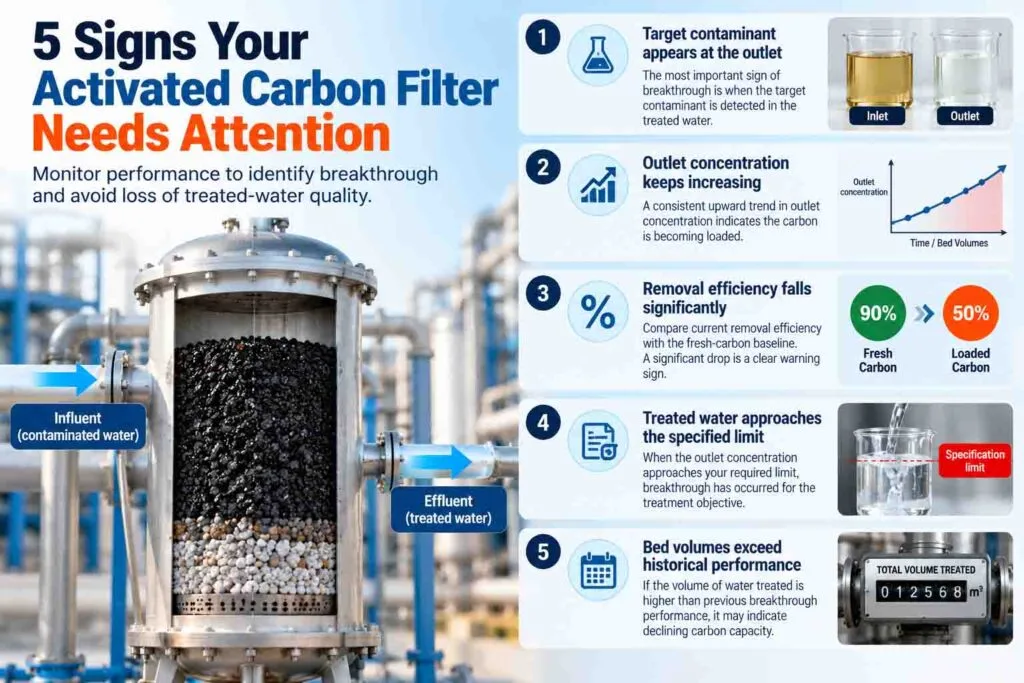
5 Warning Signs Your Activated Carbon Filter Needs Attention
Watch for these indicators:
1. Target contaminant begins appearing at the outlet
This is the most important indication of breakthrough.
2. Outlet concentration continues increasing
A trend is usually more informative than one isolated result.
3. Removal efficiency falls significantly
Compare current performance with the fresh-carbon baseline.
4. Treated water approaches the specified limit
Do not wait for a compliance failure before acting.
5. Bed volumes treated exceed historical performance
If you maintain good operational records, previous breakthrough data can help predict future carbon change-outs.
Activated Carbon Breakthrough: Frequently Asked Questions
How do I know if activated carbon is exhausted?
Monitor the target contaminant at the inlet and outlet. If the outlet concentration increases toward the predetermined acceptable limit, the carbon is approaching or experiencing breakthrough.
What is breakthrough in activated carbon?
Breakthrough occurs when a predetermined concentration of the target contaminant begins appearing in the GAC effluent such that the required treatment objective is no longer being achieved.
Does exhausted activated carbon change colour?
Not necessarily. Activated carbon may look physically normal even when its useful adsorption capacity for the target contaminant has significantly declined.
Does high pressure drop mean carbon is exhausted?
No. High pressure drop is generally associated with hydraulic restrictions such as solids accumulation or fouling. Adsorption exhaustion should be evaluated using contaminant breakthrough.
Can iodine value determine activated carbon life?
Not by itself. ASTM states that iodine number is a relative indicator of porosity and does not necessarily indicate adsorption capacity for other substances.
How often should granular activated carbon be replaced?
There is no universal replacement interval. Carbon life depends on influent contaminant loading, carbon characteristics, flow, bed depth, EBCT, water chemistry, competing substances and the required outlet quality.
Looking for Reliable Granular Activated Carbon? Introducing STARCARB™
Once you understand breakthrough, one thing becomes clear:
Activated carbon should be selected for performance not simply compared on price per kilogram.
STARCARB™ from Starke Aquacare Technologies is our bituminous coal-based granular activated carbon developed for water and wastewater treatment applications.
Available in 25 kg bags, STARCARB™ is intended for buyers looking for consistent GAC quality for filtration and adsorption applications.
When evaluating activated carbon, we encourage customers to look beyond a single specification such as iodine value.
Consider the complete application:
What are you removing?
What is the inlet concentration?
What outlet quality do you need?
What is your flow rate and contact time?
How much carbon is installed?
That is how activated-carbon selection becomes an engineering decision rather than simply a ₹/kg comparison.
Need Activated Carbon for Your Water-Treatment Application?
Send Starke Aquacare Technologies your water analysis, target contaminant, flow rate, required outlet quality and vessel details.
Our team can review the requirement and recommend a suitable STARCARB™ grade and quantity for the application.
STARCARB™ – Bituminous Coal Granular Activated Carbon
Starke Aquacare Technologies
🌐 starkefiltermedia.com
Cleaner water. Better filtration. More informed carbon selection.