
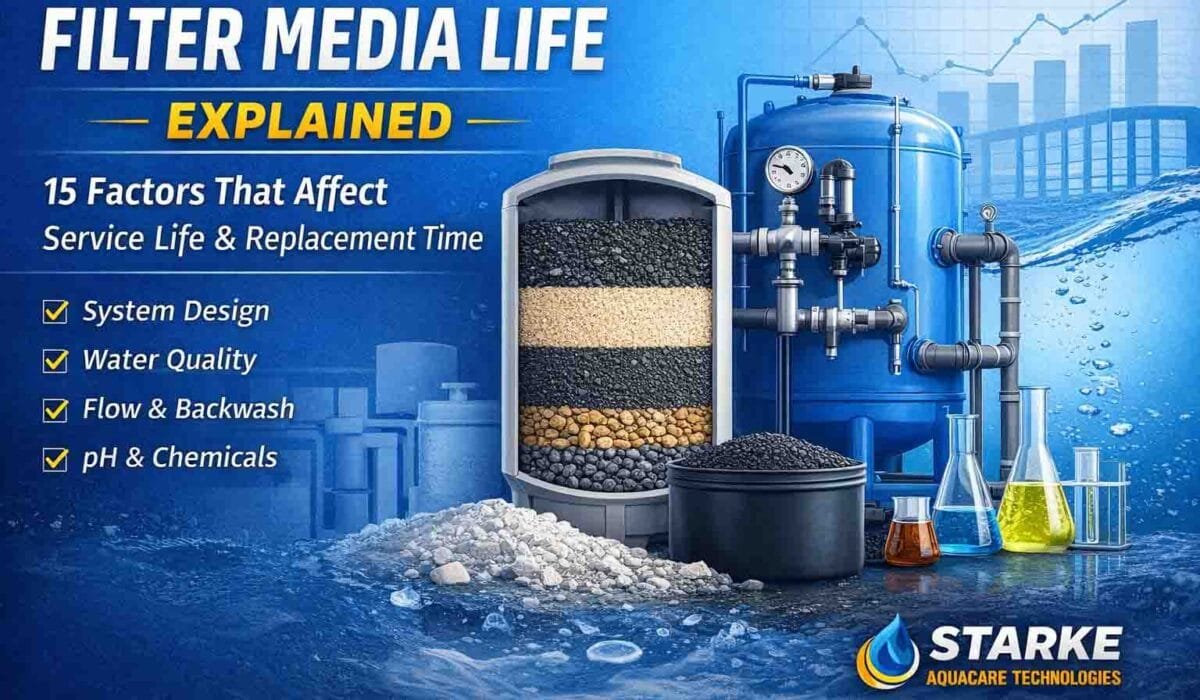
One of the most common questions in water treatment is: “How long does filter media last?”
It sounds simple. However, the real answer depends on engineering, chemistry, hydraulics, and operational discipline.
Filter media life is not fixed. It does not have an expiry date. Instead, filter media life expectancy varies based on system design, raw water quality, operating conditions, and maintenance practices.
In fact, more than 80% of filter media life is system-dependent not just material-dependent.
This detailed guide explains:
The average filter media life
What affects filter media durability
When to replace filter media
How to extend service life and reduce replacement costs
What Is the Average Filter Media Life?
The average filter media life in water treatment systems typically ranges from 3 to 10 years, depending on:
Filtration system design
Filtration velocity
Raw water quality
Backwash rate
pH and chemical exposure
Operator maintenance
For example:
Silica sand filter media life: 3–5 years
Anthracite filter media life: 4–6 years
Garnet filter media life: 5–8+ years
Zeolite filter media life: 3–5 years
Iron removal media life: 5–10 years
However, these values assume proper design and operation. In poor conditions, filter media replacement time may reduce significantly.
What Affects Filter Media Life in Water Treatment Systems?
Filter media life expectancy is influenced by multiple interacting factors. Let us examine all critical variables in detail.
1. Filtration System Design
Filtration system design is the single most important factor affecting filter media life.
Even premium-quality media will fail early in a poorly designed system.
Design Elements That Impact Service Life
Bed depth
Media layering sequence
Effective size (D10)
Uniformity coefficient
Vessel diameter-to-height ratio
Hydraulic loading rate
Freeboard height
Underdrain configuration
If bed depth is too shallow, loading concentrates on the surface. Consequently, head loss increases quickly. Similarly, incorrect multimedia filter layering reduces separation efficiency and increases clogging.
Proper engineering design significantly improves filter media durability.
2. Filtration Velocity (Service Flow Rate)
Operating above recommended filtration velocity reduces filter media life expectancy.
When velocity is too high:
Media abrasion increases
Particle carryover occurs
Head loss rises rapidly
Backwash frequency increases
Over time, mechanical stress reduces effective size and increases fines. Therefore, maintaining recommended service flow rate protects filter media life.
3. Backwash Rate and Expansion
Backwashing plays a crucial role in extending filter media life.
If backwash rate is insufficient:
Mudballs form
Channeling develops
Media cements together
Permanent head loss increases
However, excessive backwash expansion can also damage media.
Correct backwash expansion (typically 15–40% depending on media type) ensures long-term multimedia filter performance.
4. Raw Water Quality Impact
Raw water quality directly influences filter media life.
Higher contamination load means higher mechanical and chemical stress.
Critical Raw Water Parameters
Turbidity (TSS)
Particle size distribution
Iron and manganese
Oil and grease
Organic content (COD, BOD, TOC)
Ammonia
Hydrogen sulfide
Biological growth
Colloidal solids
For example, oil contamination causes irreversible fouling. Iron bacteria coat media surfaces. Fine colloids penetrate deep into the bed and increase head loss.
Therefore, raw water quality impact must be considered when evaluating filter media replacement time.
5. pH Effect on Filter Media
The pH effect on filter media varies depending on material type.
Calcite dissolves under low pH conditions.
Manganese dioxide filter media requires optimal pH for iron oxidation.
Zeolite ion exchange efficiency changes with pH.
Activated carbon adsorption performance varies with pH.
Operating outside recommended pH range reduces filter media durability and service life.
6. Chemical Exposure and Oxidants
Chemical compatibility is critical for maintaining filter media life.
Exposure to aggressive chemicals such as:
Strong acids
Strong alkalis
High chlorine levels
Hydrogen peroxide
Solvents
can damage media structure or surface properties.
For example, excessive chlorine reduces activated carbon life. Hydrogen peroxide can degrade manganese dioxide media.
Therefore, chemical exposure must be carefully controlled.
7. Temperature
Temperature affects chemical reactions and biological growth.
Higher temperatures:
Accelerate oxidation
Increase microbial growth
Reduce adsorption efficiency
Increase biofouling
In industrial wastewater applications, temperature becomes a major factor influencing filter media life expectancy.
8. Underdrain & Distribution System
Underdrain systems often determine whether filter media lasts 3 years or 8 years.
If nozzles or laterals are:
Broken
Blocked
Incorrectly slotted
Unevenly spaced
Hydraulic distribution becomes uneven.
Consequently, channeling develops and some areas overload. Over time, this reduces filter media life significantly.
9. Mechanical Stress & Abrasion
Mechanical forces affect particle integrity.
Common causes include:
High service flow
Frequent backwashing
Air scour intensity
Pump surges
Pressure fluctuations
Over time, mechanical abrasion reduces particle size, increases fines, and reduces service life.
10. Media Quality & Manufacturing Standards
Although system factors dominate, media quality remains essential.
High-quality filter media manufactured as per AWWA, ASTM, or EN standards ensures:
Controlled effective size
Low uniformity coefficient
High hardness
Low fines content
Chemical stability
Inferior grading significantly reduces filter media life expectancy and increases replacement frequency.
When selecting silica sand filter media, anthracite filter media, garnet filter media, or zeolite filter media, quality consistency directly affects durability.
11. Operator Skill & Maintenance Discipline
Operator practices strongly influence filter media life.
Common mistakes include:
Skipping scheduled backwash
Incorrect backwash flow rate
Overdosing chemicals
Ignoring head loss monitoring
Delayed maintenance
A well-trained operator can extend filter media life by several years.
12. Head Loss Monitoring
Permanent head loss increase is one of the first signs of reduced filter media life.
If head loss does not recover after backwash, it indicates:
Deep bed fouling
Biological clogging
Media compaction
Therefore, continuous monitoring helps determine optimal filter media replacement time.
13. Regeneration Practices (For Zeolite & Ion Exchange Media)
For ammonia removal systems, regeneration efficiency directly affects service life.
Improper brine concentration, insufficient contact time, or poor rinsing reduces ion exchange capacity.
However, with correct regeneration, zeolite media life can sustain hundreds of cycles.
Thus, regeneration discipline plays a major role in filter media life expectancy.
14. Biological Fouling
Biofilm formation blocks pores and increases head loss.
Causes include:
Warm temperature
Nutrient-rich water
Inadequate disinfection
Biological fouling significantly reduces filter media durability if not controlled.
15. Start-Up & Commissioning Practices
Improper commissioning can shorten filter media life from day one.
Common errors include:
No initial backwash
Rapid pressurization
Incorrect layering
Insufficient rinse cycles
Proper commissioning ensures stable multimedia filter performance.
When Should You Replace Filter Media?
Filter media replacement time should not be based on years alone.
Replace filter media when:
Permanent head loss increases
Water quality declines
Media grading changes
Excessive fines appear
Channeling becomes visible
These indicators are more reliable than fixed timelines.
How to Extend Filter Media Life and Reduce Replacement Costs
To maximize filter media life:
Design system correctly
Maintain recommended filtration velocity
Perform proper backwash with correct expansion
Monitor head loss regularly
Control pH and chemical exposure
Inspect underdrain systems periodically
Prevent oil contamination
Train plant operators
With proper engineering and discipline, filter media life expectancy can exceed standard estimates.
Filter Media Life in Municipal vs Industrial Applications
The service life of filter media in municipal water treatment plants is generally longer than in industrial wastewater applications.
Municipal systems have:
Lower chemical exposure
Stable raw water characteristics
Controlled operating conditions
Industrial wastewater, however, exposes media to:
Variable pH
Oils and solvents
High COD
Aggressive chemicals
Therefore, application type significantly affects filter media durability.
Final Conclusion
Filter media life is not a fixed number of years.
Instead, it depends on:
System design
Filtration velocity
Raw water quality
Backwash rate
pH and chemical exposure
Temperature
Distribution system condition
Operator discipline
Media quality
In reality, filter media rarely fails on its own. Most failures are system-related.
Understanding these 15 factors helps optimize filter media life expectancy and reduce long-term operational costs.
Need Help Increasing Your Filter Media Life?
At Starke Aquacare Technologies, we do not just supply filter media — we analyze system design, hydraulic loading, and water chemistry to help clients maximize filter media life.
Our range includes:
Silica Sand
Anthracite
Garnet
Zeolite (Clinoptilolite)
Activated Carbon
If you need technical guidance on filter media replacement time or performance optimization, contact our team.
📩 info@starkefiltermedia.com
🌐 www.starkefiltermedia.com
Frequently Asked Questions About Filter Media Life
How long does filter media last?
Filter media life typically ranges from 3 to 10 years depending on system design, water quality, and maintenance practices.
What reduces filter media life?
High filtration velocity, poor backwash, oil contamination, incorrect pH, chemical exposure, and improper system design reduce filter media life expectancy.
Does filter media expire?
No. Filter media does not expire. It loses effectiveness due to fouling, abrasion, or hydraulic stress.
How do you know when to replace filter media?
Replace filter media when head loss increases permanently, water quality declines, or media grading changes significantly.