

Introduction
In water and wastewater treatment systems, filter media performance depends heavily on particle size distribution. Two of the most important parameters used by engineers and filtration specialists to evaluate granular filtration media are Effective Size (ES) and Uniformity Coefficient (UC).
These parameters determine how well a filter media removes suspended particles, how evenly water flows through the bed, and how frequently the filtration system requires backwashing.
Understanding the difference between effective size vs uniformity coefficient in filter media is essential for designing efficient filtration systems in:
Municipal water treatment plants
Industrial filtration systems
RO pretreatment units
Swimming pool filtration
Beverage and food processing plants
This engineering guide explains what Effective Size and Uniformity Coefficient mean, how they are calculated, and why they are critical for selecting filter media.
What is Effective Size (ES) in Filter Media?
Effective Size, commonly referred to as D10, represents the particle diameter at which 10% of the media sample by weight is finer.
In simple terms:
Effective size indicates the minimum representative particle size of the filtration media.


Why Effective Size Matters
The effective size determines the filtration capability of the media. Smaller particles create tighter pore spaces between grains, allowing the filter to remove finer suspended solids.
Key impacts of effective size include:
• Filtration efficiency
• Head loss development
• Flow resistance
• Particle retention capability
For example:
| Media Type | Typical Effective Size |
|---|---|
| Silica Sand | 0.45 – 0.7 mm |
| Anthracite | 0.8 – 1.6 mm |
| Garnet | 0.2 – 0.6 mm |
| Activated Carbon | 0.6 – 1.2 mm |
| Zeolite | 0.6 – 1.5 mm |
A smaller effective size generally improves filtration efficiency, but it also increases pressure drop across the filter bed.
What is Uniformity Coefficient (UC)?
The Uniformity Coefficient (UC) measures the range of particle sizes within a filter media sample.
It is defined as the ratio between two particle diameters obtained from sieve analysis:
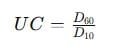

Where:
D60 = particle size at which 60% of the sample is finer
D10 = effective size
Meaning of Uniformity Coefficient
Uniformity coefficient indicates how consistent the particle sizes are within the media.
A low UC value means the particles are more uniform in size, which leads to predictable filtration performance.
Typical UC values for filter media:
| Media | Typical UC |
|---|---|
| Silica Sand | ≤ 1.7 |
| Anthracite | ≤ 1.5 |
| Garnet | ≤ 1.7 |
| Activated Carbon | ≤ 1.9 |
For most water treatment standards such as AWWA B100 and EN 12904, the recommended UC is generally below 1.7.
Difference Between Effective Size and Uniformity Coefficient
Although these two parameters are related, they measure different characteristics of the filter media.
| Parameter | Effective Size (ES) | Uniformity Coefficient (UC) |
|---|---|---|
| Definition | Particle size where 10% of media is finer | Ratio of D60 to D10 |
| Purpose | Indicates filtration fineness | Indicates particle size distribution |
| Impact | Determines filtration capability | Determines consistency of filtration |
| Typical Value | 0.4 – 1.6 mm | 1.3 – 1.7 |
Simplified Explanation
Think of effective size as the average working particle size, while uniformity coefficient describes how consistent those particle sizes are.
Both parameters must be optimized together for efficient filtration.

How Effective Size and UC Are Determined
Both ES and UC are calculated using sieve analysis.
During sieve analysis:
A sample of filter media is placed on a stack of sieves.
The stack is vibrated to separate particles by size.
The percentage retained on each sieve is measured.
A particle size distribution curve is plotted.
From the distribution curve:
D10 is obtained where 10% of particles pass.
D60 is obtained where 60% of particles pass.
These values are then used to calculate UC.
Why Effective Size is Critical for Filtration Performance
Effective size controls the pore space between media grains.
Smaller effective sizes produce:
✔ better removal of suspended solids
✔ higher filtration efficiency
✔ improved turbidity removal
However, smaller particles also lead to:
• higher pressure drop
• faster clogging
• more frequent backwashing
Therefore, engineers must carefully select the optimal effective size for each application.
Why Uniformity Coefficient is Important
Uniform particle sizes allow uniform water distribution across the filter bed.
If particle sizes vary widely (high UC):
small particles settle between large particles
pore spaces become uneven
filtration performance becomes inconsistent
Low UC ensures:
✔ uniform hydraulic performance
✔ stable filtration cycles
✔ predictable backwash expansion
Typical Effective Size and UC for Common Filter Media
Silica Sand
Used as the primary filtration layer in many water treatment systems.
Typical specifications:
Effective Size: 0.45 – 0.7 mm
UC: ≤ 1.5
Anthracite
Used in multimedia filters as the top layer.
Typical specifications:
Effective Size: 0.8 – 1.5 mm
UC: ≤ 1.7
Anthracite allows higher filtration rates due to its lower density.
Garnet
Garnet is used as the bottom layer in multimedia filters due to its high density.
Typical specifications:
Effective Size: 0.2 – 0.6 mm
UC: ≤ 1.7
Its smaller particle size enables fine particle removal.
Activated Carbon
Activated carbon removes:
organic contaminants
chlorine
taste and odor compounds
Typical specifications:
Effective Size: 0.6 – 1.2 mm
UC: ≤ 1.9
Role of Effective Size in Multimedia Filters
Multimedia filters combine several media layers such as:
Anthracite (top layer)
Sand (middle layer)
Garnet (bottom layer)
Each layer has different effective sizes and densities.
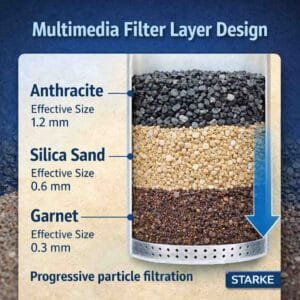
Typical configuration:
| Media | Effective Size |
|---|---|
| Anthracite | 1.2 mm |
| Sand | 0.6 mm |
| Garnet | 0.3 mm |
This arrangement creates progressive filtration, allowing particles of different sizes to be captured at various depths of the filter bed.
Recommended Standards for Filter Media
Several international standards specify acceptable ES and UC values.
Important standards include:
AWWA B100 – Filter media specifications for municipal water treatment
EN 12904 – European standard for granular filtration media
NSF/ANSI 61 – Drinking water system components
These standards ensure:
✔ consistent particle grading
✔ reliable filtration performance
✔ safe use in potable water systems
Common Mistakes When Selecting Filter Media
Selecting media with high UC
This causes inconsistent filtration and premature clogging.
Ignoring effective size
Oversized particles reduce filtration efficiency.
Using mixed particle grades
Poor grading leads to uneven flow distribution.
Ignoring backwash expansion
Incorrect media size can cause media loss during backwash.
Proper specification of effective size and uniformity coefficient prevents these problems.
How Engineers Select Filter Media
When designing filtration systems, engineers consider:
• influent water turbidity
• filtration velocity
• filter bed depth
• backwash expansion requirements
• particle size distribution
Based on these factors, they select media with appropriate effective size and UC values to ensure reliable filtration performance.
Filter Media Supplier for Water Treatment Projects
Selecting the right filter media is critical for maintaining efficient filtration systems.
Starke Aquacare Technologies supplies high-quality filter media used in water treatment plants worldwide, including:
Silica Sand Filter Media
Anthracite Filter Media
Garnet Filter Media
Zeolite (Clinoptilolite)
Activated Carbon
Walnut Shell Media
These materials are used in:
municipal water treatment plants
industrial filtration systems
RO pretreatment systems
swimming pool filtration
beverage and food processing plants
With strict quality control and compliance with international standards, Starke provides consistent particle grading and reliable filtration performance.
Conclusion
Effective Size and Uniformity Coefficient are two of the most important parameters used to evaluate granular filter media.
Effective size determines the filtration capability, while the uniformity coefficient indicates the consistency of particle size distribution.
Together, these parameters influence:
filtration efficiency
pressure drop
backwash performance
filter bed stability
Understanding these concepts allows engineers to design filtration systems that deliver reliable and efficient water treatment.
By selecting filter media with the correct effective size and uniformity coefficient, water treatment facilities can achieve optimal performance and long operational life.