
Introduction
Reverse osmosis (RO) systems are widely used in municipal, industrial, and desalination water treatment plants to produce high-quality purified water. However, the efficiency and lifespan of RO membranes depend heavily on the quality of the feed water entering the system. Suspended solids, turbidity, colloidal particles, and organic matter can quickly foul membranes and reduce plant performance.
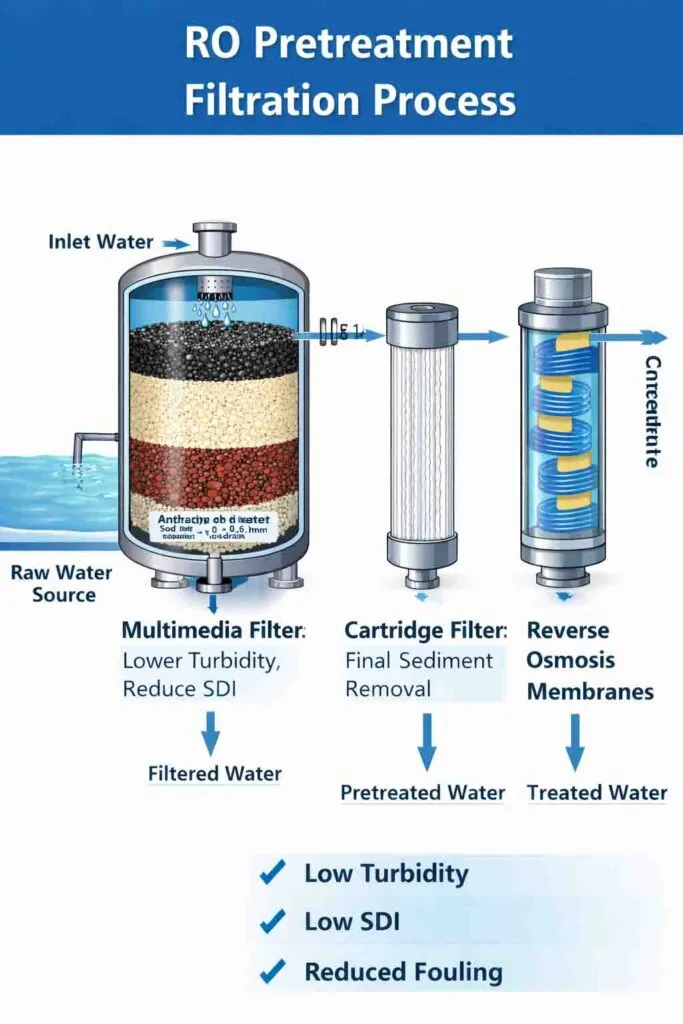
This is where RO pretreatment filtration plays a critical role. Properly designed pretreatment systems remove suspended contaminants before water reaches the RO membranes, protecting the system and ensuring consistent operation.
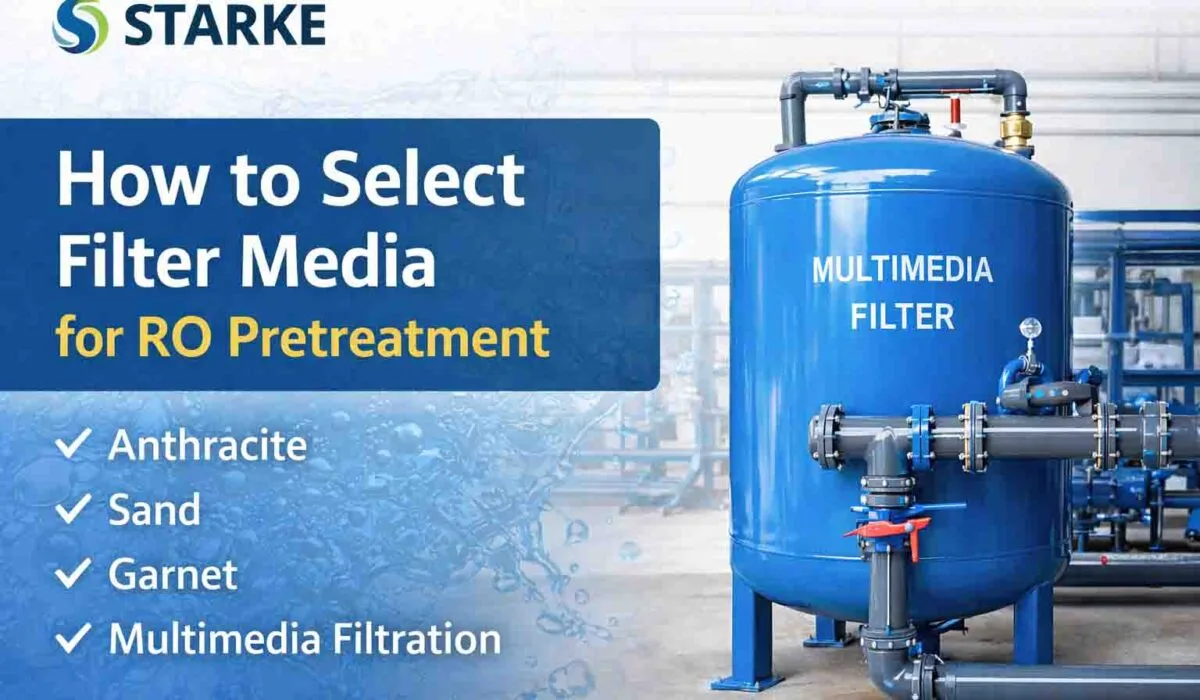
One of the most widely used pretreatment technologies is multimedia filtration, which relies on carefully selected granular filter media such as sand, anthracite, garnet, and sometimes specialized media like zeolite. Choosing the correct filter media is essential for achieving high turbidity removal, reducing the silt density index (SDI), and maintaining stable RO plant performance.
In this guide, we explain how engineers and plant designers can select the right RO pretreatment filter media for optimal filtration efficiency.
What is RO Pretreatment Filter Media?
RO pretreatment filter media refers to the granular materials used in filtration vessels to remove suspended particles from feed water before it enters reverse osmosis membranes. These media form a filter bed that physically traps contaminants such as silt, algae, rust, and organic debris.
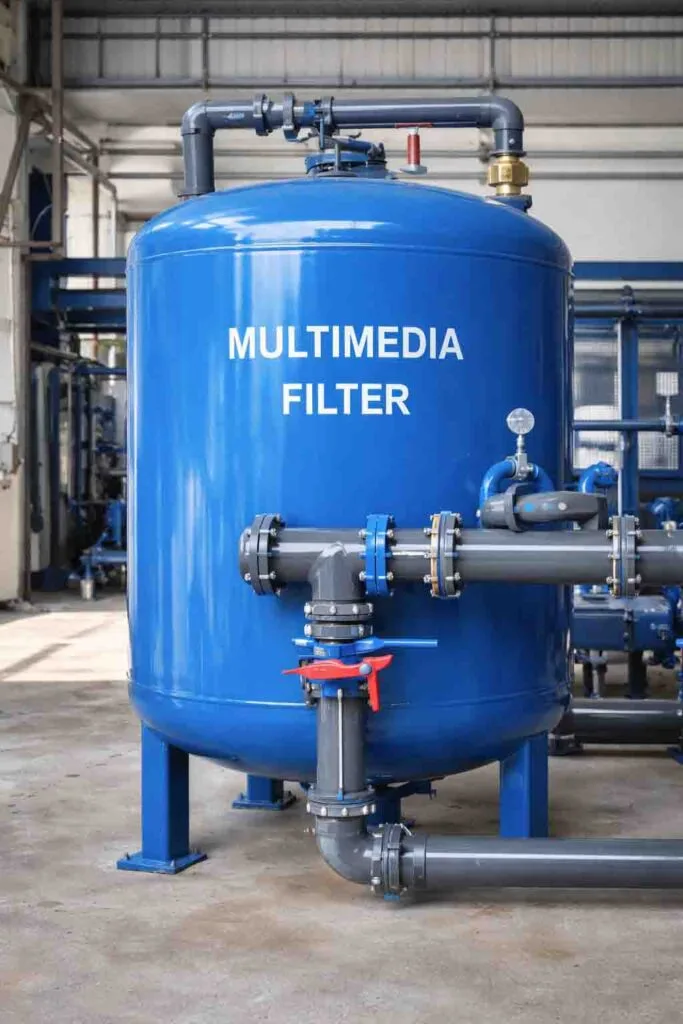
In most water treatment plants, pretreatment filtration is achieved using multimedia filters (MMF). These filters contain layers of different media with varying densities and particle sizes to improve filtration performance.
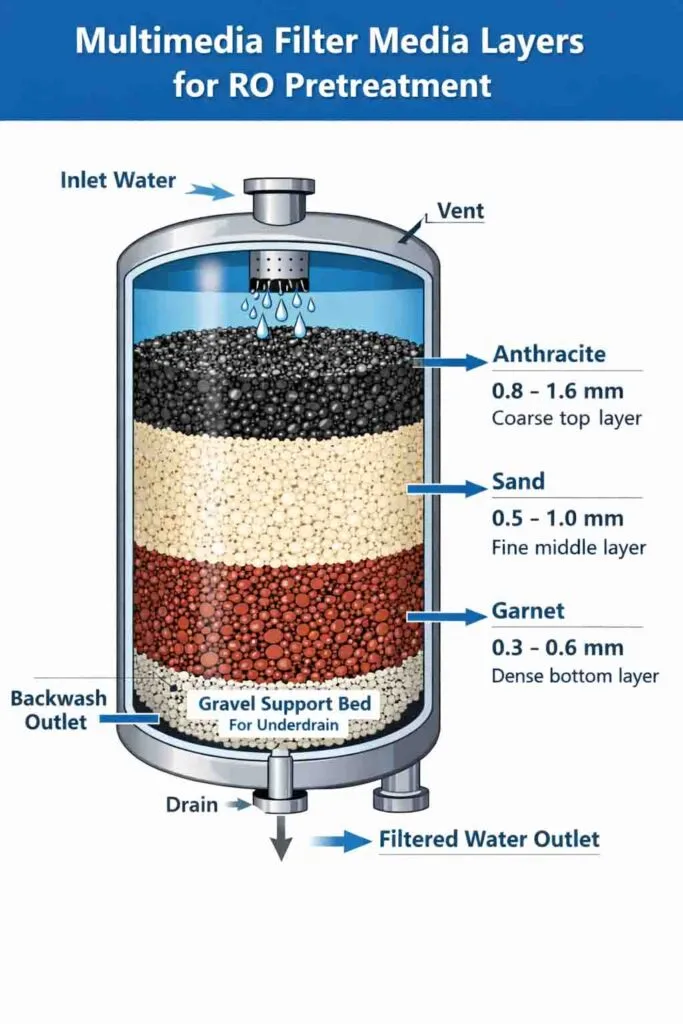
Typical RO pretreatment media layers include:
Anthracite filter media (top layer)
Silica sand filter media (middle layer)
Garnet filter media (bottom layer)
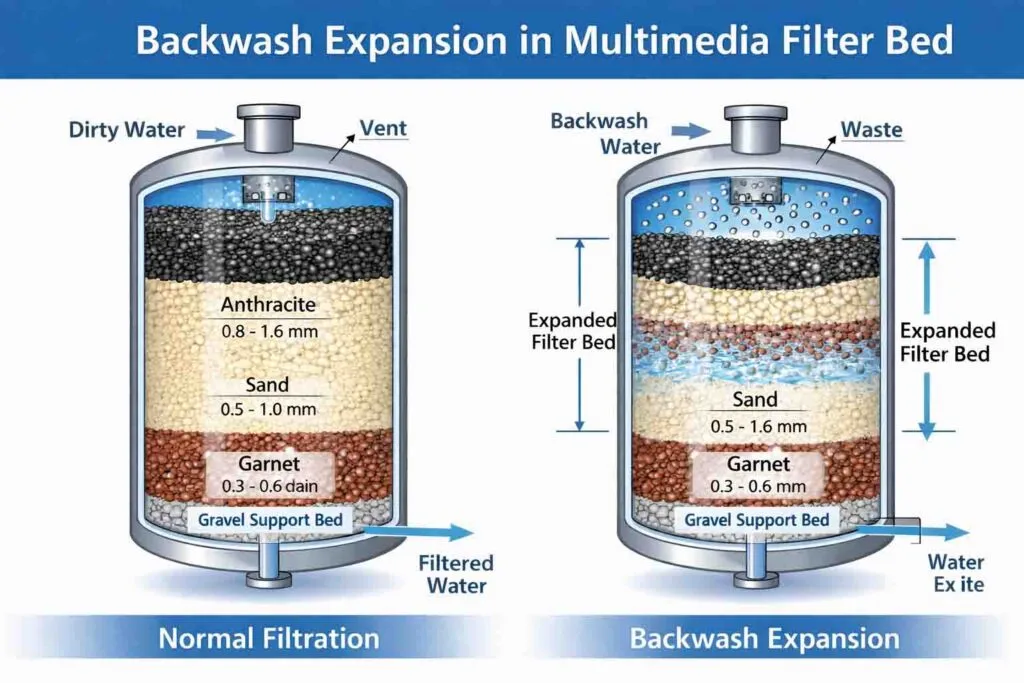
Each media layer performs a specific function. The upper layers capture larger suspended solids, while finer media at the bottom remove smaller particles.
Multimedia filtration offers several advantages over single-media filters because it allows deeper filtration, higher loading capacity, and longer operating cycles.
Why Filter Media is Used in RO Pretreatment
RO membranes are extremely sensitive to particulate contamination. Without proper pretreatment, suspended solids can cause rapid fouling and increase membrane cleaning frequency.
Filter media is used in RO pretreatment systems to achieve several key objectives:
Reduce Turbidity
Suspended solids in raw water increase turbidity. Multimedia filtration reduces turbidity to acceptable levels before water enters the RO system.
Lower SDI (Silt Density Index)
The SDI test measures fouling potential of water. RO plants typically require SDI values below 5, and often below 3 for optimal operation.
Protect RO Membranes
Filtration removes particles that can block membrane channels or cause irreversible fouling.
Improve Plant Reliability
Proper pretreatment prevents unexpected shutdowns, reduces chemical cleaning frequency, and extends membrane life.
In large industrial systems, effective filtration also improves operational stability and reduces maintenance costs.
Technical Specifications for RO Pretreatment Filter Media
Selecting the correct filter media requires understanding the technical properties that influence filtration performance.
Effective Size (D10)
The effective size represents the particle diameter at which 10 percent of the media particles are smaller. It determines filtration fineness and flow resistance.
Typical values:
Anthracite: 0.8 – 1.6 mm
Sand: 0.5 – 1.0 mm
Garnet: 0.3 – 0.6 mm
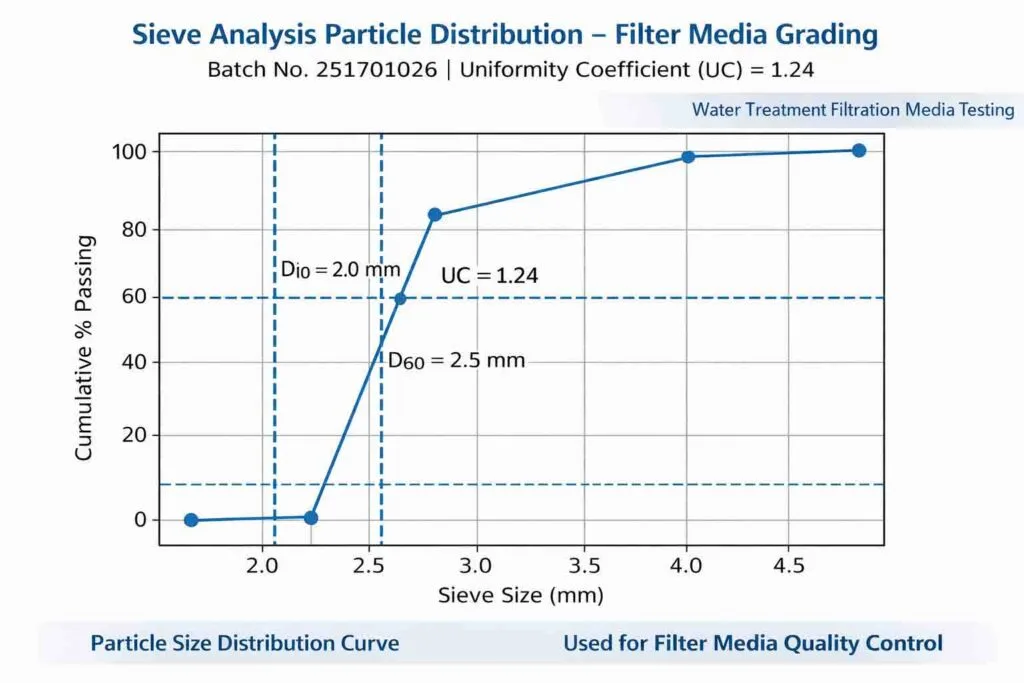
Uniformity Coefficient (UC)
The uniformity coefficient indicates particle size distribution. Lower values indicate more uniform media.
Recommended UC values:
Anthracite: ≤ 1.7
Sand: ≤ 1.5
Garnet: ≤ 1.5
Specific Gravity
Different densities allow proper layer separation during backwashing.
Typical densities:
Anthracite: ~1.6
Sand: ~2.65
Garnet: ~4.0
Bed Depth
Typical multimedia filter bed configuration:
Anthracite: 400 – 600 mm
Sand: 200 – 300 mm
Garnet: 100 – 150 mm
Filtration Velocity
Most multimedia filters operate between:
5 – 15 m/h
Higher velocities may reduce filtration efficiency.
How Filter Media Works in RO Pretreatment
The filtration process in multimedia filters relies on several physical mechanisms that remove suspended contaminants from water.
Mechanical Straining
Large particles are trapped in the upper layers of the filter bed.
Interception
Particles following water flow paths collide with filter media grains and become attached.
Sedimentation
Heavier particles settle within the pore spaces of the media bed.
Depth Filtration
Unlike surface filtration, multimedia filters capture particles throughout the entire depth of the filter bed, increasing solids holding capacity.
When filtration resistance increases due to particle accumulation, the filter is cleaned through backwashing, where water flows upward through the bed to expand and wash away trapped contaminants.
Applications of RO Pretreatment Filter Media
RO pretreatment filtration is used in a wide range of water treatment applications.
Municipal Water Treatment
Cities use multimedia filters to remove suspended solids before desalination or drinking water treatment.
Industrial RO Systems
Industries such as power plants, pharmaceuticals, and food processing require pretreatment filtration before RO membranes.
Desalination Plants
Seawater desalination systems use pretreatment filtration to remove suspended solids and biological contaminants.
Groundwater Treatment
Groundwater sources containing silt, iron particles, or turbidity require filtration before membrane treatment.
Wastewater Reuse
Industrial wastewater treatment systems often use multimedia filtration as a pretreatment step before RO systems.
Comparison with Other Pretreatment Methods
Several pretreatment technologies are available for RO systems. Each method has different advantages.
Cartridge Filters
Cartridge filters provide fine filtration but have limited solids holding capacity and require frequent replacement.
Ultrafiltration (UF)
UF membranes provide superior filtration but involve higher capital and operational costs.
Multimedia Filtration
Multimedia filters offer an effective balance between cost, performance, and reliability.
Comparison summary:
| Pretreatment Method | Filtration Efficiency | Cost | Maintenance |
|---|---|---|---|
| Multimedia Filter | High | Moderate | Low |
| Cartridge Filter | Moderate | Low | High |
| Ultrafiltration | Very High | High | Moderate |
For most RO plants, multimedia filtration is used as the primary pretreatment step.
Advantages of Using Multimedia Filter Media
Selecting the correct filter media provides several operational advantages.
High Filtration Efficiency
Layered media structure captures particles across different sizes.
Long Filter Runs
Multimedia filters allow longer operating cycles before backwashing.
Lower Operating Costs
Reduced backwash frequency and energy consumption improve efficiency.
Improved RO Membrane Life
Better pretreatment reduces fouling and membrane replacement costs.
Higher Solids Loading Capacity
Multimedia filters can handle higher turbidity loads compared to single-media filters.
Common Mistakes When Selecting RO Pretreatment Media
Incorrect media selection can reduce filtration efficiency and cause operational problems.
Using Incorrect Media Sizes
Improper particle size distribution reduces filtration efficiency and increases pressure drop.
Ignoring Uniformity Coefficient
Poorly graded media can lead to channeling and uneven filtration.
Insufficient Bed Depth
Shallow filter beds cannot provide adequate depth filtration.
Incorrect Backwash Design
Improper backwash velocities may cause media loss or inadequate cleaning.
Mixing Media with Similar Densities
Incorrect density differences prevent proper media layering.
Proper engineering design is essential for achieving reliable filtration performance.
FAQs
What turbidity level should RO pretreatment filtration achieve?
Most RO systems require feed water turbidity below 1 NTU before entering the membranes.
What SDI level is required before RO membranes?
Typical RO systems require SDI values below 5, while high-performance plants may require SDI below 3.
What is the most common filter media for RO pretreatment?
Multimedia filters using anthracite, sand, and garnet are the most widely used combination.
How often should multimedia filters be backwashed?
Backwashing frequency depends on turbidity loading, but most filters are cleaned once every 24–72 hours.
Can zeolite be used in RO pretreatment?
Yes. Zeolite-based filter media can enhance filtration performance by improving fine particle removal and increasing solids holding capacity.
Conclusion
Proper filter media selection is a critical factor in the successful operation of reverse osmosis systems. Multimedia filtration using carefully graded layers of anthracite, sand, and garnet provides effective removal of suspended solids and protects RO membranes from fouling.
Engineers designing RO pretreatment systems must consider factors such as effective size, uniformity coefficient, media density, and bed depth to ensure optimal filtration performance. With the right filter media configuration, water treatment plants can achieve lower turbidity, improved SDI values, and longer membrane life.
Selecting high-quality filter media and following proper design guidelines ensures reliable RO system operation across municipal, industrial, and desalination applications.