
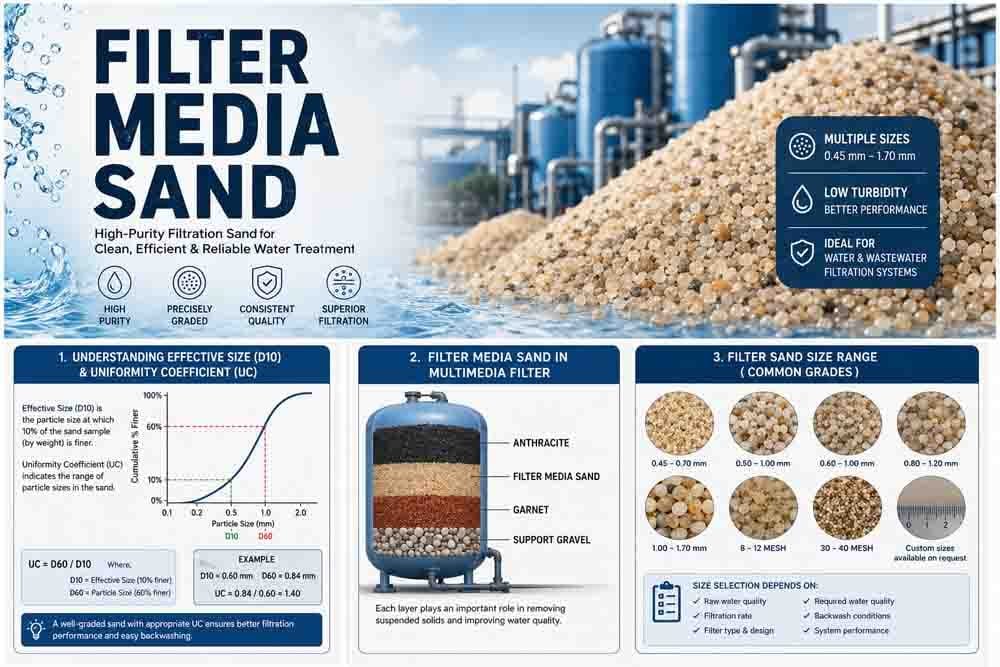
Filter media sand is one of the most widely used filtration materials for removing suspended solids and turbidity from water. It is commonly used in pressure sand filters, rapid gravity filters, multimedia filters, industrial water treatment plants, RO pretreatment systems, swimming pools, and wastewater treatment systems.
However, filter media sand is not simply ordinary sand placed inside a filter.
For reliable filtration, the sand must be properly washed, graded and selected according to particle size distribution, effective size (D10), uniformity coefficient (UC), purity and the requirements of the filtration system.
Choosing the wrong sand grading can result in poor filtration, excessive pressure drop, media loss during backwashing, short filter runs and increased downstream loading.
This guide explains what filter media sand is, how it works, the commonly available sizes, important specifications, and how engineers should select the correct grade for a water filtration system.
What Is Filter Media Sand?
Filter media sand is a carefully processed and graded granular material, typically silica or quartz based, used as the filtration bed inside water treatment filters.
As water passes through the filter bed, suspended particles are retained within and between the media grains.
Unlike ordinary construction sand, filtration-grade sand is selected for controlled properties such as:
- Particle size distribution
- Effective size (D10)
- Uniformity coefficient (UC)
- Silica content
- Specific gravity
- Cleanliness
- Acid solubility
- Grain characteristics
- Oversize and undersize percentage
These properties influence how efficiently the filter operates.
How Does Filter Media Sand Work?
A sand filter contains a bed of carefully graded filter media through which water is passed.
Suspended particles are removed through a combination of physical mechanisms within the media bed.
As filtration continues, retained contaminants gradually increase resistance to water flow. The filter therefore requires periodic backwashing, during which water is passed upward through the bed to expand and clean the media.
This is why selecting filter media solely on the basis of the words “silica sand” or a nominal size range can be misleading.
Two sands labelled 0.5–1.0 mm, for example, can have considerably different particle-size distributions and therefore behave differently inside a filter.
Typical Filter Media Sand Specifications
Actual specifications should always be selected according to the filtration system and project requirements.
| Parameter | Typical Description |
|---|---|
| Material | Silica / Quartz Sand |
| Appearance | Natural granular material |
| SiO₂ | Typically ≥97–98% for high-purity grades |
| Bulk Density | Approx. 1450–1600 kg/m³ |
| Effective Size (D10) | Grade / project dependent |
| Uniformity Coefficient | Typically controlled according to specification |
| Specific Gravity | Typically around 2.5–2.65 |
| Particle Size | Multiple grades available |
| Application | Water & wastewater filtration |
| Packaging | Bags / Jumbo Bags / project-specific packing |
Important: A filter media specification should not be selected from a generic table alone. Required effective size, UC, grading and bed configuration depend on the filter design and application.
Common Filter Media Sand Sizes
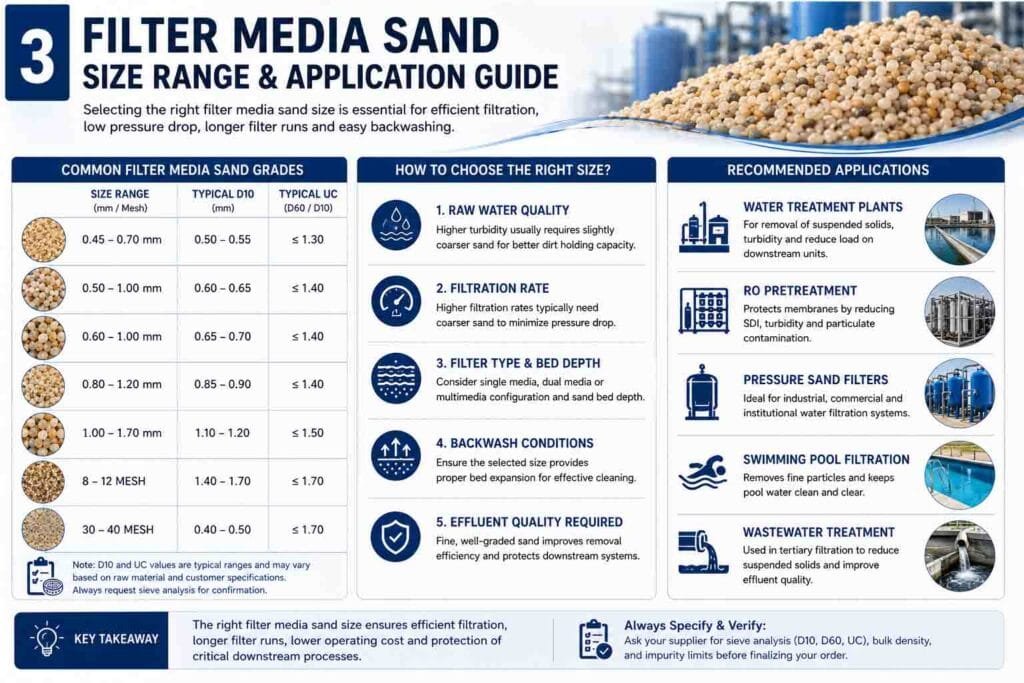
Filter media sand can be supplied in different particle-size ranges depending on the filtration requirement.
Commonly requested grades include:
- 0.45–0.70 mm
- 0.50–1.00 mm
- 0.60–1.00 mm
- 0.80–1.20 mm
- 1.00–1.70 mm
- 8–12 mesh
- 30–40 mesh
Custom gradings may also be produced or selected against project specifications.
The correct size should be determined from the required filtration performance rather than simply choosing the finest available sand.
What Is Effective Size (D10) in Filter Media Sand?
One of the most important parameters when specifying filter media sand is its Effective Size, commonly called ES or D10.
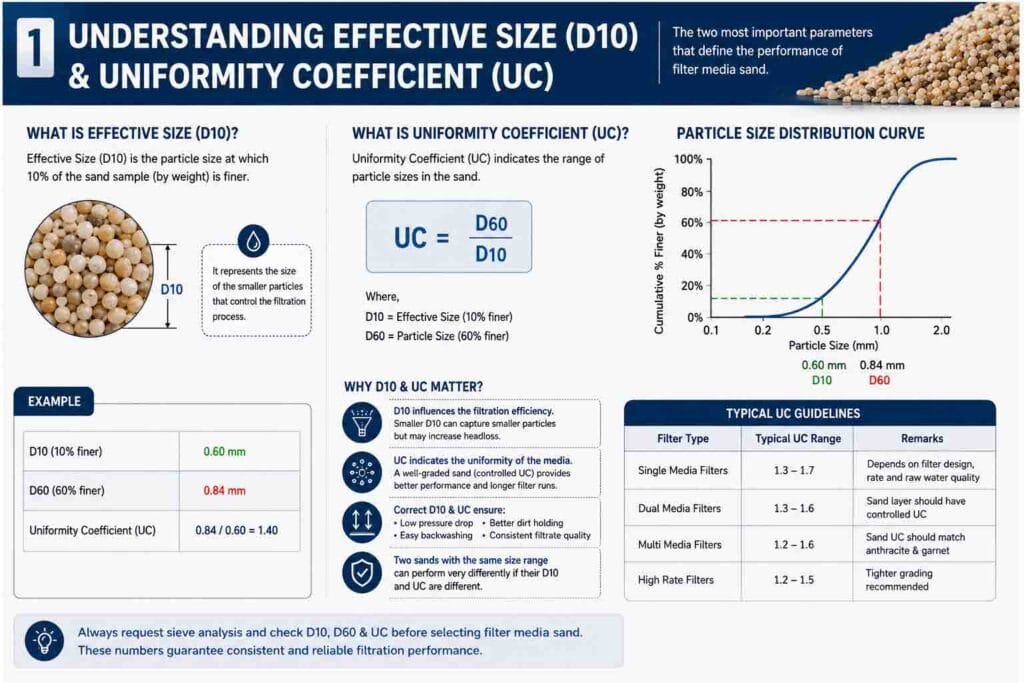
D10 represents the particle diameter at which approximately 10% of the sample by weight is finer.
For example, a filter sand with:
D10 = 0.60 mm
means that approximately 10% of the sample is finer than 0.60 mm according to the particle-size distribution.
Effective size is important because it helps characterize how the filter bed will behave hydraulically and how effectively it can retain particles.
A nominal size such as 0.5–1.0 mm alone does not provide the complete picture.
Engineers should therefore evaluate the actual particle-size distribution.
What Is Uniformity Coefficient (UC)?
Uniformity Coefficient describes how closely the particle sizes within the filter media are distributed.
It is calculated as:
UC = D60 ÷ D10
Where:
D10 = particle size at which 10% is finer
D60 = particle size at which 60% is finer
A lower UC generally indicates a more uniformly graded media.
For example:
D10 = 0.60 mm
D60 = 0.84 mm
Therefore:
UC = 0.84 ÷ 0.60 = 1.40
UC is an important filter-media parameter because two materials having the same nominal size range can still have significantly different distributions within that range.
That difference can affect filtration and backwashing behaviour.
Why Particle Size Distribution Matters
Consider two suppliers offering:
Filter Media Sand: 0.5–1.0 mm
At first glance, both products appear identical.
But Supplier A’s material may be concentrated around 0.60–0.80 mm.
Supplier B’s material may contain considerably more material close to 0.50 mm and 1.00 mm.
Both may technically fall within the stated nominal range.
Yet their:
- D10
- D60
- UC
- hydraulic behaviour
- filtration characteristics
- backwash behaviour
may be different.
This is why experienced water-treatment engineers look beyond the nominal size printed on a quotation.
The sieve analysis tells the real story.
Filter Media Sand Sieve Analysis
Sieve analysis is one of the most important quality-control tests for filter media sand.
A representative sample is passed through a series of standard test sieves. The amount retained on each sieve is measured to determine the particle-size distribution.
A typical report may show:
| Test Sieve | % Retained |
| 1.18 mm | — |
| 1.00 mm | — |
| 0.85 mm | — |
| 0.71 mm | — |
| 0.60 mm | — |
| 0.50 mm | — |
| Pan | — |
The actual percentages depend on the specified grade.
From the resulting distribution curve, parameters such as D10, D60 and UC can be determined.
For large projects, representative sampling and batch-wise QC become particularly important.
A small approved sample is useful but the bulk shipment must also maintain the required grading.
Filter Media Sand vs Ordinary Sand
One of the most common misconceptions is:
“Sand is sand. Why can’t ordinary silica sand be used in a water filter?”
The difference is primarily in selection, processing and grading control.
| Ordinary Sand | Filter Media Sand |
| May have broad particle distribution | Controlled particle distribution |
| Fines may be present | Fines are controlled |
| ES may not be specified | ES/D10 can be specified |
| UC may not be controlled | UC can be controlled |
| General-purpose material | Selected for filtration |
| Limited filtration QC | Sieve analysis and QC can be provided |
For filtration applications, the cheapest sand per kilogram is therefore not necessarily the lowest-cost media over the life of the filter.
How to Select the Correct Filter Media Sand
There is no single sand size that is correct for every water-treatment filter.
Before selecting a grade, consider:
1. Raw Water Quality
Understand the incoming:
- Turbidity
- Suspended solids
- Particle distribution
- Organic loading
- Iron and manganese
- Other contaminants
2. Required Filtrate Quality
What does the downstream process require?
Pretreatment before RO, for example, may have different objectives from a swimming pool or conventional water-treatment filter.
3. Filtration Rate
The hydraulic loading rate affects the selection and performance of the media.
4. Filter Configuration
Determine whether the filter is:
- Single-media
- Dual-media
- Multimedia
- Pressure filter
- Gravity filter
5. Effective Size
Specify the required D10 rather than relying solely on the nominal size range.
6. Uniformity Coefficient
Specify the acceptable UC to control the particle-size distribution.
7. Backwash Conditions
Available backwash flow and expected bed expansion should be considered when selecting media.
Filter Media Sand for Pressure Sand Filters
Pressure sand filters are widely used in industrial and commercial water treatment.
Water passes through the sand bed under pressure, allowing suspended matter to be retained within the filtration bed.
Filter sand used in these systems should have controlled grading because inappropriate media selection can contribute to:
- Excessive pressure drop
- Short filter runs
- Poor filtrate quality
- Uneven backwashing
- Media carryover
- Channeling
The correct media should therefore be selected alongside the filter’s hydraulic design.
Filter Media Sand in Multimedia Filters
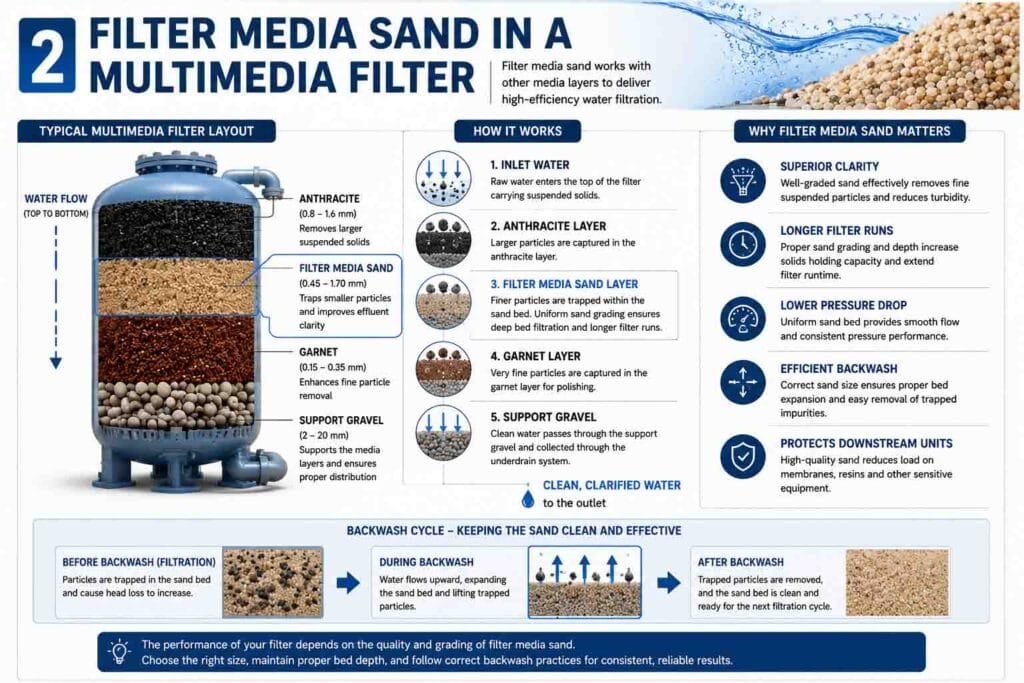
Sand is also commonly used as one layer of a multimedia filtration system.
A typical multimedia arrangement may contain:
↓
↓
↓
The exact configuration varies according to filter design.
Different media densities and particle sizes allow the bed to provide depth filtration while maintaining an appropriate hydraulic profile.
This is another reason why sand should not be selected independently of the other filter layers.
Filter Media Sand for RO Pretreatment
Pretreatment plays an important role in protecting downstream reverse osmosis systems.
Filter media sand may form part of a pressure sand or multimedia filtration stage designed to reduce suspended matter before downstream treatment.
However, sand filtration alone should not automatically be assumed to solve every RO pretreatment problem.
Engineers should consider parameters such as:
- Feed-water turbidity
- Suspended solids
- SDI
- Organic loading
- Filtration rate
- Coagulation requirements
- Media configuration
- Downstream cartridge filtration
The complete pretreatment train should be designed according to the feed-water characteristics and RO requirements.
Where Is Filter Media Sand Used?
Filter media sand is commonly used in:
Municipal Water Treatment
For filtration of treated surface or groundwater.
Industrial Water Treatment
For process-water and utility-water filtration.
RO Pretreatment
As part of pressure sand and multimedia filtration systems.
Wastewater Treatment
For tertiary filtration and suspended-solids reduction where appropriately designed.
ETP & STP Systems
As part of polishing and filtration stages.
Swimming Pool Filtration
For removal of suspended particles from recirculating pool water.
Commercial Water Treatment
In pressure vessels and filtration systems across hotels, institutions and commercial facilities.
Filter Media Sand Standards
Depending on the country, customer and application, filtration media may be specified against standards or project-specific requirements.
Commonly referenced standards include:
- AWWA B100
- EN 12904
- IS 8419
- Relevant ASTM sieve-analysis methods
The applicable standard should always be confirmed against the specific project.
Compliance should be evaluated against the actual supplied grade and test requirements rather than assumed simply because the material is silica sand.
What Should You Ask a Filter Media Sand Supplier?
Before approving filter media for a project, ask for more than just the price per kilogram.
Request:
- Particle-size range
- Sieve analysis
- Effective Size / D10
- D60
- Uniformity Coefficient
- Silica content
- Bulk density
- Specific gravity, where required
- Applicable standard/compliance
- Representative sample
- Packaging details
- Batch traceability for large projects
For engineered water-treatment applications, these parameters provide far more useful information than appearance alone.
How Much Filter Media Sand Is Required?
Filter media quantity depends primarily on:
Filter diameter × required bed depth × bulk density
First calculate the cross-sectional area of the vessel.
Then:
Media Volume = Filter Area × Bed Depth
Finally:
Media Weight = Media Volume × Bulk Density
For example, if the calculated filter-media volume is 1.0 m³ and the selected sand has a bulk density of approximately 1,500 kg/m³, the approximate media requirement would be:
1.0 × 1,500 = 1,500 kg
Allowances may be required depending on actual bulk density, vessel internals, specified bed depth and installation conditions.
Packaging & Bulk Supply
Filter media sand can be supplied in different packaging configurations depending on project quantity and logistics requirements.
Typical options include:
- Small bags
- 25 kg / 50 kg bags depending on requirement
- Jumbo bags
- Palletized packing
- Bulk project quantities
- Export packing
For large water-treatment projects, packaging should be planned alongside installation sequence and site handling requirements.
Frequently Asked Questions About Filter Media Sand
What is filter media sand?
Filter media sand is processed, washed and graded silica or quartz-based granular material used as a filtration bed for removing suspended particles from water.
Is filter media sand the same as ordinary silica sand?
Not necessarily. Filtration-grade sand requires controlled particle-size distribution and may need specified effective size, uniformity coefficient, purity and other properties.
What size sand is used for water filtration?
The required size depends on the filter design and application. Common grades can range from approximately 0.45–0.70 mm to 1.0–1.7 mm, with other custom sizes used for specific projects.
What is D10 in filter sand?
D10, also known as Effective Size, is the particle diameter at which approximately 10% of the material is finer by weight.
What is D60?
D60 is the particle diameter at which approximately 60% of the sample is finer.
What is the Uniformity Coefficient of filter sand?
Uniformity Coefficient is calculated as D60/D10. The required UC depends on the applicable filter and project specification.
Is a lower Uniformity Coefficient better?
A lower UC indicates a narrower particle-size distribution. However, the correct UC should be selected according to the filter design and applicable specification rather than assuming that the lowest possible value is always required.
Can filter media sand be used in multimedia filters?
Yes. Sand is commonly used together with media such as anthracite, garnet and support gravel in appropriately designed multimedia filtration systems.
Can filter media sand be used before RO?
Yes. Sand or multimedia filtration is commonly used as part of RO pretreatment, depending on the feed-water characteristics and overall pretreatment design.
How do I choose the correct filter media sand?
Start with the required particle size, D10, UC, filtration rate, raw-water characteristics, bed configuration and backwash conditions. For project specifications, evaluate the supplier’s sieve analysis rather than relying only on the nominal size.
Filter Media Sand: Specification Matters More Than the Name
Filter media sand may appear to be one of the simplest components in a water-treatment plant.
But its performance depends heavily on what cannot be determined merely by looking at the material.
Particle-size distribution, D10, D60, UC, purity, cleanliness and consistent batch grading all matter.
So when comparing filter sand quotations, don’t ask only:
“What is your price per kg?”
Also ask:
“Can you show me the sieve analysis?”
That one question can tell you considerably more about the media you are about to put inside your filtration system.
Need Help Selecting Filter Media Sand?
Starke Filter Media supplies graded filter media sand for industrial, municipal and commercial water-treatment applications in India and international markets.
Multiple particle sizes and project-specific gradings are available, along with technical documentation and bulk supply options.
For a project enquiry, send us:
- Required particle size
- Effective Size (D10), if specified
- Uniformity Coefficient, if specified
- Required quantity
- Application
- Project location
Our team can review the requirement and recommend a suitable grade.
Starke Filter Media
Website: www.starkefiltermedia.com
Email: sales@starkefiltermedia.com
Request a specification, sample or quotation for your filter media sand requirement.