
Selecting the correct filter media is one of the most critical decisions in any water or wastewater treatment system. Yet, it is also one of the most misunderstood.
Many filtration failures, poor water quality issues, and premature media replacement problems can be traced back to incorrect filter media selection, not poor operation or maintenance.
There is no universal filter media that removes all impurities efficiently. Each contaminant behaves differently in water, and therefore requires a specific filtration mechanism and media type.
This guide explains how to select the best filter media based on the type of impurity, helping engineers, EPC contractors, consultants, and plant operators design reliable and long-lasting filtration systems.
Why Filter Media Selection Matters
Filter media selection directly affects:
Filtration efficiency
Pressure drop and filter run time
Backwash frequency
Media lifespan
Overall operating cost
Using the wrong media often leads to:
Rapid clogging
Poor contaminant removal
Channeling or mud-ball formation
Frequent shutdowns
Correct selection ensures the system performs as designed throughout its service life.
Understanding Impurities in Water
Before selecting filter media, it is essential to understand the nature of the impurity:
Is it physical, chemical, or biological?
Is it dissolved or suspended?
Is it light, heavy, organic, or inorganic?
Each impurity category requires a different removal mechanism, such as straining, adsorption, ion exchange, or catalytic oxidation.
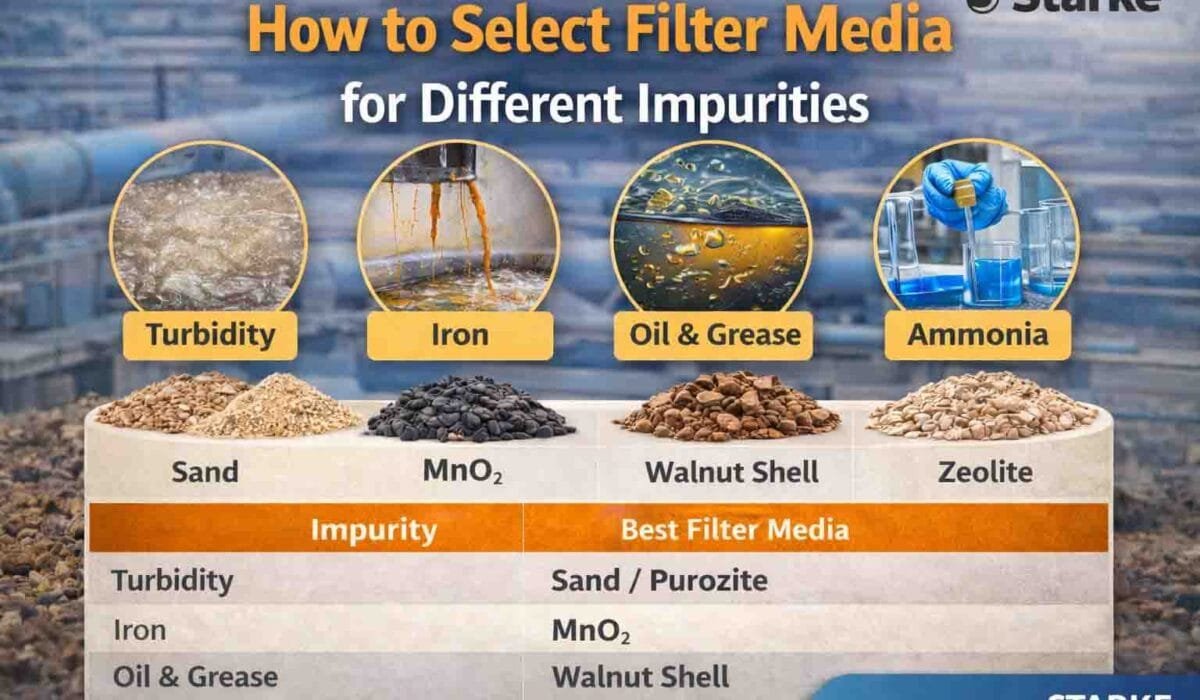
Impurity-to-Filter Media Selection Overview
| Impurity | Best Filter Media |
|---|---|
| Turbidity | Sand / Purozite |
| Iron | Manganese Dioxide (MnO₂) |
| Oil & Grease | Walnut Shell |
| Ammonia | Zeolite |
Let’s break this down in detail.
1. Turbidity Removal – Sand and Purozite
What Is Turbidity?
Turbidity is caused by suspended particles such as:
Silt
Clay
Fine organic matter
Colloidal solids
These particles scatter light and give water a cloudy appearance.
Best Filter Media for Turbidity
Silica Sand
Silica sand is the most widely used filter media for turbidity removal in:
Drinking water treatment
Municipal filtration plants
Industrial pre-treatment systems
Why sand works:
Effective mechanical straining
Stable physical structure
Proven performance over decades
Sand works best when:
Particle size is properly graded
Uniformity coefficient (UC) is within limits
Backwash is correctly designed
Purozite (Advanced Zeolite-Based Media)
Purozite is a high-performance alternative to conventional sand.
Why Purozite performs better:
Higher porosity than sand
Better dirt-holding capacity
Finer effective filtration
Longer filter runs
Purozite is ideal where:
Space is limited
High turbidity spikes occur
Longer backwash intervals are required
When to Choose Sand vs Purozite
Use sand for conventional, cost-sensitive applications
Use Purozite for high-performance or compact systems
2. Iron Removal – Manganese Dioxide (MnO₂)
Understanding Iron in Water
Iron typically appears as:
Dissolved ferrous iron (Fe²⁺)
Oxidized ferric iron (Fe³⁺)
Iron causes:
Brown staining
Metallic taste
Filter clogging
Distribution system fouling
Why MnO₂ Is the Best Media for Iron Removal
Manganese dioxide (MnO₂) filter media removes iron through catalytic oxidation.
Key advantages:
Converts dissolved iron into insoluble particles
Removes iron without continuous chemical regeneration
Handles higher iron loading than sand
MnO₂ media is suitable for:
Groundwater treatment
Iron-rich borewell water
Municipal and industrial plants
Important Design Considerations
Adequate oxidation (air or chlorine)
Correct pH range
Proper backwash velocity
Using sand alone for iron removal often leads to rapid clogging and early failure.
3. Oil & Grease Removal – Walnut Shell Filter Media
Why Oil Is Difficult to Remove
Oil and grease behave differently from solid particles:
Lower density than water
Tendency to float
Sticky and hydrophobic nature
Traditional sand filters perform poorly in oily water applications.
Why Walnut Shell Is Ideal for Oil Removal
Walnut shell filter media is specifically designed for:
Oil & grease removal
Hydrocarbon filtration
Industrial wastewater treatment
Key benefits:
Low density (oil-selective behavior)
High resistance to attrition
Easy oil release during backwash
Walnut shell media is widely used in:
Refineries
Petrochemical plants
Produced water treatment
Effluent treatment plants (ETPs)
Why Sand Fails in Oil Applications
Oil coats sand grains
Backwashing becomes ineffective
Media cements and channels
Selecting walnut shell instead of sand dramatically increases system reliability and media life.
4. Ammonia Removal – Zeolite (Clinoptilolite)
Understanding Ammonia in Water
Ammonia is a dissolved contaminant, commonly found in:
Groundwater
Aquaculture systems
Municipal wastewater
Ammonia is harmful because it:
Is toxic to aquatic life
Interferes with disinfection
Causes taste and odor problems
Why Zeolite Is Best for Ammonia Removal
Natural clinoptilolite zeolite removes ammonia through ion exchange.
Why zeolite works:
Strong affinity for ammonium ions (NH₄⁺)
High cation exchange capacity
Effective without complex equipment
Zeolite is ideal for:
Drinking water pre-treatment
Aquaculture systems
Industrial water reuse
Design Notes
Requires periodic regeneration or replacement
Performance depends on competing ions
Flow rates must be controlled
Sand cannot remove dissolved ammonia effectively media chemistry matters.
Common Mistakes in Filter Media Selection
Even experienced engineers make these mistakes:
Selecting media based only on price
Using sand for every application
Ignoring impurity chemistry
Overlooking media density and backwash design
Not planning for contaminant variation
These mistakes almost always result in short media life and operational issues.
How to Build a Proper Filter Media Selection Strategy
Analyze raw water quality
Identify dominant impurities
Select media based on removal mechanism
Verify design flow and loading rates
Confirm backwash compatibility
Plan for long-term operation, not just startup
Correct selection reduces lifecycle cost, not just capital cost.
Why This Selection Guide Matters
The best filter media for water treatment is not universal.
It depends entirely on what you are trying to remove.
Matching the right media to the right impurity:
Improves water quality
Extends media life
Reduces maintenance cost
Prevents system failure
Smart filtration starts with informed selection.
Final Thoughts
Filter media selection is not about choosing what is most commonly used it is about choosing what is technically correct.
Whether dealing with turbidity, iron, oil, or ammonia, understanding impurity behavior and filtration mechanisms ensures stable, long-term system performance.
A well-designed filtration system always begins with the right media.
Filter Media Reference Guide (PDF): A detailed comparison of filtration media characteristics, functions, and applications for water and wastewater treatment