
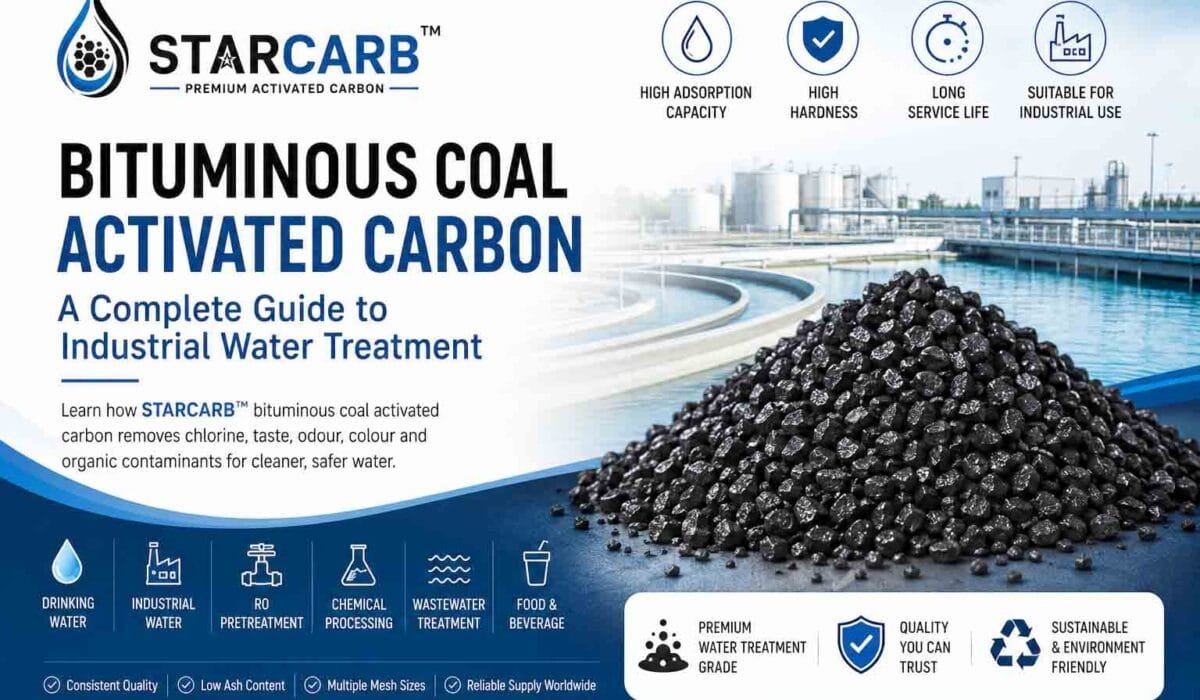
Bituminous Coal Activated Carbon: A Complete Guide to Industrial Water TreatmentClean water is essential for industries, municipalities, and commercial facilities. Whether treating drinking water, process water, or wastewater, selecting the right filtration media plays a critical role in achieving consistent water quality. Among the most trusted adsorption media available today, bituminous coal activated carbon is widely recognized for its exceptional ability to remove chlorine, taste, odour, colour, and a broad range of dissolved organic contaminants.
Unlike ordinary coal, activated carbon undergoes a carefully controlled activation process that develops millions of microscopic pores. These pores create an enormous internal surface area, allowing contaminants to be captured through adsorption rather than simple filtration. As a result, bituminous coal activated carbon has become a preferred choice for industrial water treatment systems, municipal plants, food and beverage industries, pharmaceutical facilities, and many other applications where high-quality water is essential.
What Is Bituminous Coal Activated Carbon?
Bituminous coal activated carbon is a granular adsorption media manufactured from selected grades of bituminous coal. The raw coal is processed at high temperatures using steam activation, which develops a highly porous internal structure without compromising the material’s mechanical strength.
The activation process significantly increases the surface area available for adsorption, enabling the carbon to capture dissolved organic compounds, chlorine, odour-causing substances, and various chemical impurities present in water.
Unlike conventional filter media that primarily remove suspended particles, activated carbon is specifically designed to remove dissolved contaminants that cannot be effectively eliminated by sand or multimedia filters alone.
How Does Activated Carbon Work?
The primary mechanism behind activated carbon is adsorption. During adsorption, dissolved contaminants are attracted to and held on the internal surface of the carbon’s microscopic pores.
As water passes through the carbon bed:
- Chlorine reacts with the carbon surface.
- Organic molecules become trapped within the pore structure.
- Taste and odour compounds are adsorbed.
- Colour-causing substances are reduced.
- Many synthetic organic chemicals are removed.
The effectiveness of adsorption depends on several factors, including contact time, contaminant concentration, water temperature, pH, and the quality of the activated carbon itself.
Advantages of Bituminous Coal Activated Carbon
Bituminous coal activated carbon offers several performance advantages that make it suitable for demanding industrial applications.
High Mechanical Strength
Its excellent hardness helps reduce particle breakdown during transportation, installation, and repeated backwashing cycles.
Excellent Adsorption Capacity
The well-developed pore structure provides efficient removal of chlorine, organic compounds, colour, and odour while maintaining consistent performance.
Long Service Life
When properly designed and operated, bituminous coal activated carbon provides reliable performance over extended operating periods before replacement or regeneration becomes necessary.
Low Attrition Loss
The material generates minimal fines during operation, helping maintain water clarity and reducing maintenance requirements.
Suitable for Pressure Filters
Its high density and strength make it ideal for industrial pressure vessels operating under continuous service conditions.
Typical Applications
Bituminous coal activated carbon is used across a wide range of industries where water quality is critical.
Common applications include:
- Municipal drinking water treatment
- Industrial process water treatment
- Reverse osmosis pretreatment
- Food and beverage manufacturing
- Pharmaceutical water systems
- Swimming pool filtration
- Groundwater treatment
- Wastewater polishing
- Cooling water treatment
- Chemical processing plants
Its versatility makes it one of the most widely specified activated carbon media for both new installations and retrofit projects.
Bituminous Coal Activated Carbon vs. Ordinary Filter Media
Many people assume activated carbon functions like silica sand or anthracite. In reality, each media serves a different purpose.
| Filter Media | Primary Function |
|---|---|
| Silica Sand | Removes suspended solids |
| Anthracite | Improves depth filtration |
| Activated Carbon | Removes dissolved chemicals through adsorption |
For many water treatment systems, these media are used together, with activated carbon positioned after particulate filtration to maximise adsorption efficiency.
Important Selection Parameters
Choosing the correct activated carbon involves more than selecting the lowest-cost product. Engineers typically evaluate several important characteristics.
These include:
- Iodine number
- Particle size
- Effective size
- Uniformity coefficient
- Hardness
- Moisture content
- Ash content
- Apparent density
- Surface area
- Adsorption performance
Selecting a carbon grade that matches the specific water quality and operating conditions helps achieve optimal performance and service life.
Maintenance and Replacement
Activated carbon does not last indefinitely. As adsorption sites become occupied, the media gradually loses its ability to remove contaminants.
Common signs that replacement may be required include:
- Chlorine breakthrough
- Unpleasant taste or odour returning
- Increased organic content in treated water
- Reduced adsorption performance
- Laboratory testing indicating media exhaustion
Rather than replacing carbon based solely on time, regular water quality monitoring provides a more accurate indication of remaining media life.
Best Practices for Optimum Performance
To maximise the life and efficiency of activated carbon:
- Install effective pre-filtration to remove suspended solids.
- Operate within the recommended flow rate.
- Provide sufficient Empty Bed Contact Time (EBCT).
- Perform regular backwashing where applicable.
- Monitor chlorine breakthrough and treated water quality.
- Replace exhausted media before performance declines significantly.
Following these practices helps maintain stable operation while reducing operating costs.
Why Choose STARCARB™
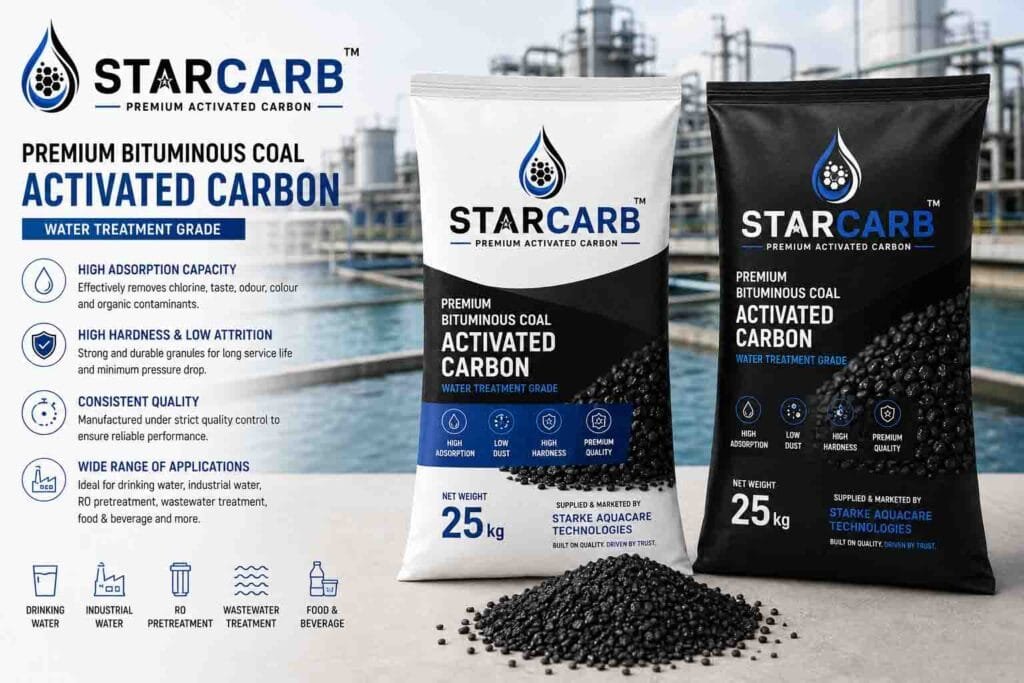
STARCARB™ Bituminous Coal Activated Carbon is developed to meet the requirements of industrial and municipal water treatment applications where consistent performance and dependable supply are essential.
STARCARB™ offers:
- High-quality bituminous coal activated carbon
- Excellent adsorption performance
- Strong mechanical hardness
- Low attrition characteristics
- Multiple particle size options
- Suitable for pressure filter applications
- Reliable packaging for domestic and international supply
- Technical guidance for media selection and application
Whether used in industrial process water, municipal treatment plants, or commercial filtration systems, STARCARB™ is designed to deliver dependable adsorption performance and long-term operational value.
Frequently Asked Questions
Does activated carbon remove TDS?
No. Activated carbon primarily removes chlorine, taste, odour, and many dissolved organic compounds. It does not significantly reduce Total Dissolved Solids (TDS).
Does activated carbon remove iron?
Activated carbon is generally not intended as the primary media for iron removal. Dedicated iron removal media are typically recommended where dissolved iron concentrations are significant.
How long does activated carbon last?
Service life varies depending on water quality, contaminant loading, operating conditions, and system design. Monitoring treated water quality is the most reliable method for determining replacement intervals.
Can activated carbon be regenerated?
Certain grades of activated carbon can be thermally regenerated under specialised industrial processes. However, many installations replace exhausted media depending on operational and economic considerations.
Conclusion
Bituminous coal activated carbon remains one of the most effective adsorption media available for modern water treatment. Its combination of high adsorption capacity, mechanical strength, long service life, and versatility makes it suitable for a broad range of industrial and municipal applications.
When properly selected, installed, and maintained, activated carbon helps improve water quality by reducing chlorine, organic contaminants, taste, odour, and colour, contributing to more reliable treatment performance and downstream process protection.
For organizations seeking dependable adsorption media, STARCARB™ Bituminous Coal Activated Carbon provides a practical solution backed by consistent quality and technical support for diverse water treatment requirements.