
Granular Activated Carbon for Water Treatment: The Complete Industrial Buyer’s Guide
Water quality has become one of the most important concerns for industries, municipalities, commercial facilities, and water treatment professionals across the world. Whether the objective is producing safe drinking water, improving industrial process water, polishing wastewater, or protecting expensive reverse osmosis membranes, selecting the right granular activated carbon for water treatment plays a significant role in system performance.
Among the different filtration media available today, bituminous coal based granular activated carbon (GAC) has earned a strong reputation for its excellent adsorption capacity, durability, long operating life, and cost-effectiveness. Industries handling large water volumes increasingly rely on activated carbon filter media because it removes contaminants that conventional filtration cannot.
This guide explains everything industrial buyers should know about granular activated carbon, how it works, where it is used, how to select the correct grade, and why STARCARB™ by Starke has become a preferred solution for demanding water treatment applications.
What is Granular Activated Carbon?
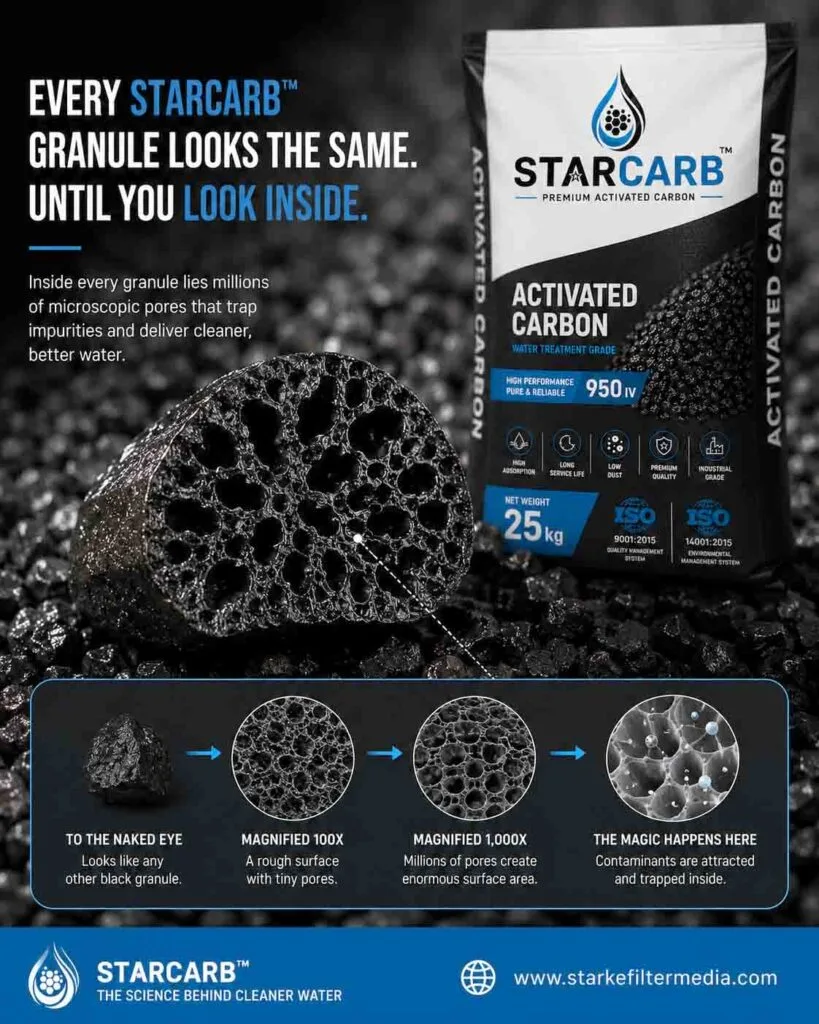
Granular Activated Carbon (GAC) is a highly porous filtration media manufactured by activating carbon-rich raw materials under carefully controlled conditions. The activation process develops millions of microscopic pores, creating an enormous internal surface area capable of adsorbing dissolved contaminants from water.
Unlike ordinary carbon, activated carbon contains an interconnected network of micro, meso and macro pores that trap unwanted molecules through physical adsorption. Because of this unique structure, activated carbon media is widely used in industrial water treatment, municipal water treatment, drinking water purification, wastewater polishing, beverage production, pharmaceutical manufacturing, food processing and numerous other industries.
Why Bituminous Coal Activated Carbon?
Although activated carbon can be produced from several raw materials, bituminous coal activated carbon offers an outstanding balance between adsorption performance, mechanical strength, durability and economics.
For industrial applications where large flow rates and long service cycles are required, coal based activated carbon often provides excellent value while maintaining high contaminant removal efficiency.
Its advantages include:
- High adsorption capacity
- Excellent mechanical hardness
- Low pressure loss
- Longer operating life
- Better resistance to abrasion
- Uniform particle distribution
- Suitable for large pressure filters
- Cost-effective compared to many premium carbon grades
For industrial buyers evaluating lifecycle costs rather than only purchase price, these characteristics often translate into lower replacement frequency and reduced operating costs.
How Does Activated Carbon Remove Contaminants?
Unlike sand or multimedia filters that remove suspended particles primarily by mechanical filtration, granular activated carbon removes dissolved contaminants through adsorption.
As water passes through the carbon bed, contaminants migrate into the extensive pore structure where they are retained by attractive surface forces. The extremely high internal surface area enables activated carbon to capture a wide range of dissolved organic compounds.
Properly selected activated carbon filter media can effectively reduce:
- Free chlorine
- Taste and odor compounds
- Volatile Organic Compounds (VOCs)
- Organic contaminants
- Color-causing substances
- Pesticide residues
- Industrial chemicals
- Disinfection by-products
- Trace hydrocarbons
- Certain PFAS compounds depending on design and operating conditions
This adsorption capability makes water treatment activated carbon an essential polishing stage in many treatment systems.
Applications of Granular Activated Carbon
The versatility of industrial activated carbon allows it to serve numerous industries.
Drinking Water Treatment
Municipal and private water treatment plants use activated carbon for drinking water to improve taste, odor and consumer confidence while reducing chlorine and organic contaminants.
Industrial Water Treatment
Manufacturing facilities require consistent water quality to protect production equipment and ensure product quality. Activated carbon is commonly installed before reverse osmosis systems, demineralization plants and process water systems.
Wastewater Treatment
Many industries use activated carbon for wastewater treatment as a polishing stage after biological or chemical treatment to reduce residual organic compounds before discharge or reuse.
RO Pretreatment
Reverse osmosis membranes are highly sensitive to oxidizing agents like chlorine. Activated carbon effectively removes free chlorine, helping protect membrane life and reduce replacement costs.
Food and Beverage Industry
Food manufacturers, breweries, soft drink producers and bottled water plants depend on activated carbon to improve product consistency and remove unwanted taste and odor compounds.
Pharmaceutical Industry
High-purity water systems often incorporate activated carbon media to reduce organic contaminants before further purification.
How to Choose the Right Activated Carbon
Selecting the correct granular activated carbon involves more than simply choosing the lowest price.
Industrial buyers should evaluate:
Raw Material
Coal based activated carbon provides excellent strength and adsorption for industrial water treatment.
Iodine Value
Higher iodine values generally indicate greater adsorption capacity for small organic molecules.
Particle Size
Common grades include 8×16, 8×30 and 12×40 mesh. The selected mesh affects flow characteristics, adsorption kinetics and pressure loss.
Hardness
Higher hardness improves durability during backwashing and minimizes carbon loss.
Ash Content
Lower ash content is generally preferred for high-quality filtration applications.
Bulk Density
Bulk density influences vessel loading calculations and shipping quantities.
Uniformity
Consistent particle size distribution ensures predictable hydraulic performance and efficient bed operation.
Benefits of Using STARCARB™
STARCARB™ by Starke has been developed for demanding industrial filtration applications where consistent quality and dependable performance are essential.
Key benefits include:
- High quality bituminous coal activated carbon
- Excellent adsorption efficiency
- Strong mechanical hardness
- Low attrition losses
- Uniform particle sizing
- Reliable hydraulic performance
- Suitable for pressure filtration systems
- Ideal for industrial and municipal water treatment
- Available for domestic and export markets
- Backed by technical support from experienced filtration specialists
Rather than focusing solely on product supply, Starke works closely with OEMs, EPC contractors, industrial users and water treatment professionals to recommend suitable filtration media for specific applications.
Why Activated Carbon is Essential in Modern Water Treatment
As water quality regulations continue becoming stricter, industries must remove increasingly complex contaminants.
Modern treatment systems frequently combine:
- Multimedia filtration
- Activated carbon filtration
- Ion exchange
- Reverse osmosis
- UV disinfection
- Advanced oxidation
Within this treatment train, granular activated carbon acts as a highly effective polishing stage, improving overall water quality while protecting downstream equipment.
Common Industries Using Activated Carbon
Industrial buyers searching for activated carbon supplier India commonly come from sectors such as:
- Power generation
- Food processing
- Beverage production
- Pharmaceuticals
- Chemical manufacturing
- Electronics
- Textile processing
- Municipal corporations
- Hotels and commercial buildings
- Swimming pools
- Aquaculture
- Refineries
- Petrochemical industries
- Engineering companies
- Water treatment OEMs
Best Practices for Longer Carbon Life
The performance of activated carbon depends not only on product quality but also on proper system operation.
To maximize service life:
- Maintain recommended flow rates.
- Ensure proper backwashing.
- Prevent excessive suspended solids from reaching the carbon bed.
- Replace exhausted media based on water quality monitoring instead of fixed time intervals.
- Protect the bed from oil fouling where applicable.
- Follow manufacturer recommendations for vessel design and operating conditions.
Proper operation can significantly extend carbon life and reduce overall operating costs.
Why Industrial Buyers Choose Reliable Suppliers
When selecting an activated carbon manufacturer or activated carbon supplier India, buyers should evaluate more than just product pricing.
Consider:
- Consistent product quality
- Reliable supply chain
- Technical documentation
- Particle size consistency
- Quality control procedures
- Export capability
- Packaging quality
- Technical assistance
- Industry experience
- Long-term partnership potential
A dependable supplier contributes directly to stable plant performance and lower lifecycle costs.
Conclusion
Granular Activated Carbon continues to be one of the most effective and versatile filtration media available for modern water treatment. Whether the objective is chlorine removal, taste and odor improvement, VOC reduction, organic contaminant adsorption, RO pretreatment or industrial process water polishing, selecting the correct coal based activated carbon can significantly improve treatment efficiency and reduce operating costs.
For industrial buyers, engineers and water treatment professionals, choosing high-quality activated carbon filter media means evaluating adsorption performance, hardness, particle size, consistency and supplier reliability—not simply comparing prices.
STARCARB™ by Starke combines the performance expected from premium bituminous coal granular activated carbon with dependable quality, technical support and application expertise for industrial, commercial and municipal water treatment projects. As industries continue demanding cleaner water and more efficient treatment systems, high-quality granular activated carbon for water treatment will remain one of the most valuable filtration media available.
Frequently Asked Questions
What is granular activated carbon used for?
Granular activated carbon is used to remove chlorine, taste, odor, VOCs, dissolved organic compounds and many industrial contaminants from water.
Is bituminous coal activated carbon suitable for industrial water treatment?
Yes. It offers high adsorption capacity, excellent mechanical strength and long operating life, making it ideal for industrial filtration systems.
Can activated carbon protect RO membranes?
Yes. Activated carbon removes free chlorine before reverse osmosis systems, helping protect membrane performance and extend membrane life.
Which industries use activated carbon?
Municipal water treatment, food and beverage, pharmaceuticals, power plants, chemical processing, textile manufacturing, aquaculture, hospitality and wastewater treatment all use activated carbon extensively.
How do I choose the right activated carbon?
Consider the raw material, iodine value, mesh size, hardness, ash content, bulk density, hydraulic performance and the specific contaminants that need to be removed.