
What Is Zeolite Powder?
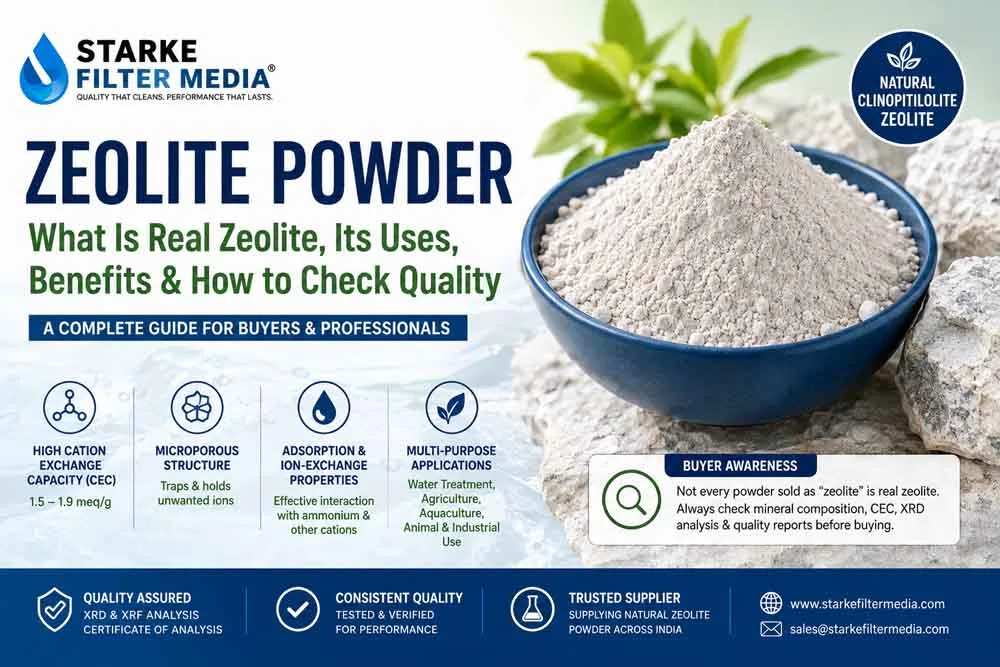
Zeolite powder is much more than an ordinary mineral powder.
Natural zeolites are crystalline, hydrated aluminosilicate minerals with a highly porous three-dimensional structure. Among the naturally occurring zeolites, clinoptilolite zeolite is one of the most widely used for commercial, agricultural and environmental applications.
The value of natural zeolite powder comes primarily from its unique mineral structure, adsorption characteristics and ability to exchange positively charged ions.
This is why genuine clinoptilolite zeolite powder is used in applications ranging from agriculture and aquaculture to water and wastewater treatment.
But there is an important issue buyers need to understand:
Not every powder being sold as “zeolite powder” necessarily has the same mineral composition, purity or functional properties.
Two mineral powders may look almost identical while performing very differently.
That is why buyers should understand what they are purchasing before comparing products only on price.
What Is Real Natural Zeolite Powder?
Real natural clinoptilolite zeolite is a naturally occurring microporous mineral.
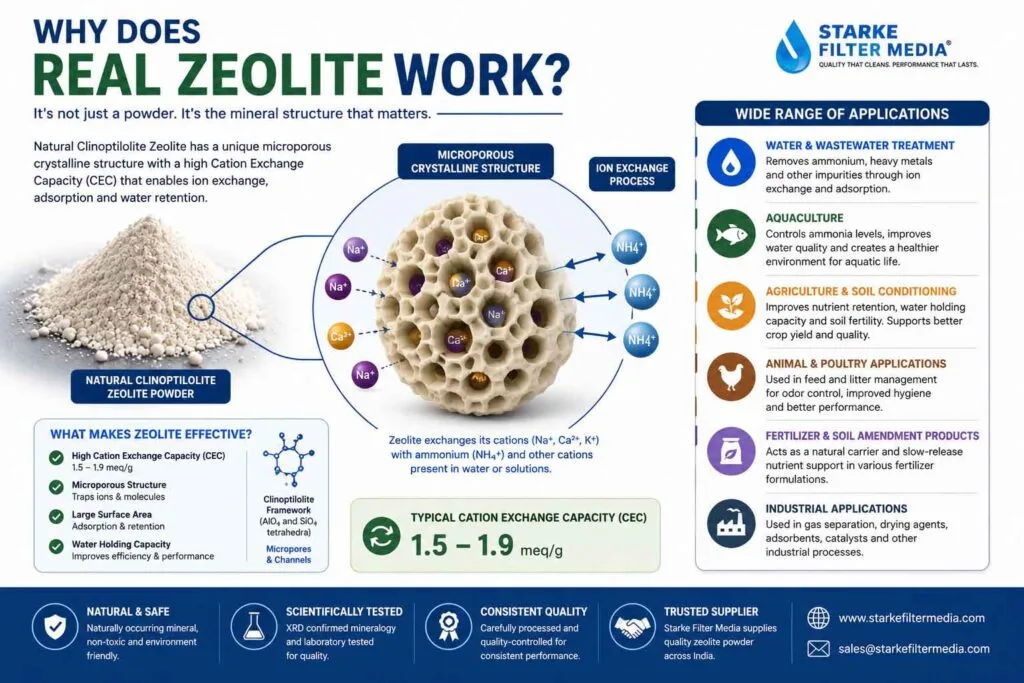
Its crystalline framework contains interconnected microscopic channels and cavities. Within this structure are exchangeable cations, which give zeolite its characteristic ion-exchange and adsorption properties.
In simple terms, zeolite is valuable because its structure can interact with water, ammonium and various positively charged ions.
This combination of:
- Microporosity
- Cation Exchange Capacity (CEC)
- Ion-exchange characteristics
- Adsorption properties
- Water-holding ability
makes natural zeolite a functional mineral rather than simply a filler powder.
Why Is Clinoptilolite Zeolite Important?
There are many naturally occurring zeolite minerals, but clinoptilolite is among the most commercially important.
Its porous structure and ion-exchange characteristics make it useful across multiple industries.
Scientific literature has extensively investigated natural clinoptilolite for environmental remediation, wastewater treatment, agriculture and other applications.
For buyers searching for pure natural zeolite powder or high purity clinoptilolite zeolite, however, the important consideration is not simply whether the word “zeolite” appears on a quotation.
The actual mineralogical composition matters.
What Makes Zeolite Powder Different from Ordinary Mineral Powder?
This is where buyer awareness becomes particularly important.
Many naturally occurring minerals can be:
- White
- Ivory
- Cream
- Grey
- Fine powdered
- Similar in texture
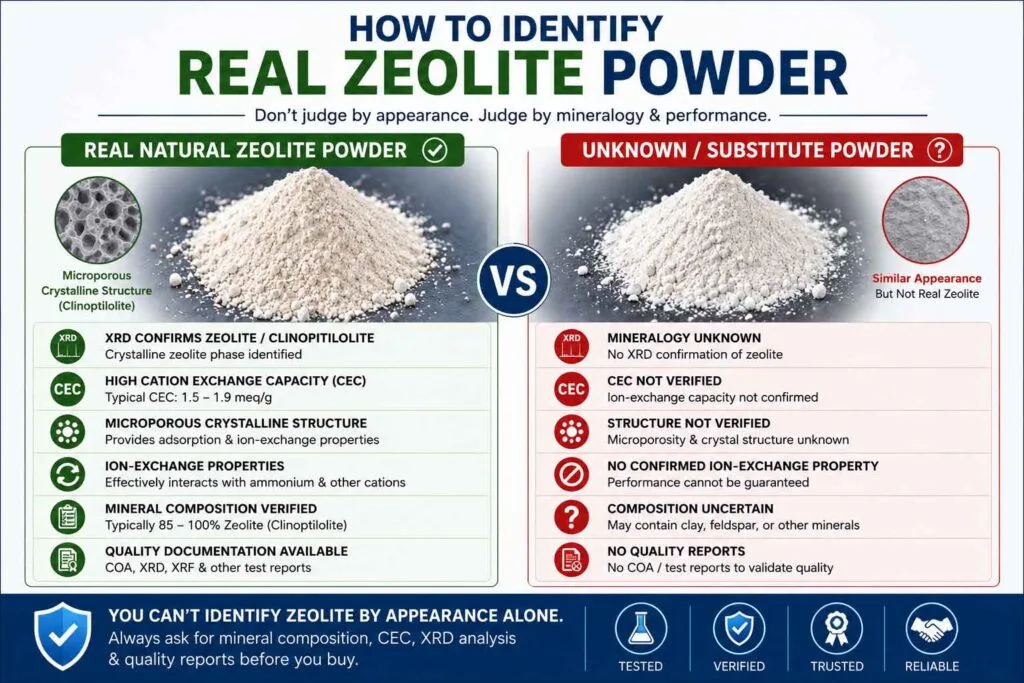
Therefore, appearance alone cannot confirm that a powder is genuine zeolite.
The functionality of natural zeolite originates from its crystalline mineral structure.
An inexpensive mineral powder may visually resemble zeolite but may not possess comparable:
CEC + microporosity + mineral composition + ion-exchange behaviour.
Therefore: Don’t judge zeolite powder by colour or appearance alone. Judge it by mineralogy and performance.
What Is Cation Exchange Capacity (CEC) in Zeolite?
One of the most important zeolite powder specifications is its Cation Exchange Capacity, commonly abbreviated as CEC.
CEC indicates a material’s ability to hold and exchange positively charged ions, or cations.
For natural clinoptilolite, this property is particularly important because of its affinity toward ions including ammonium (NH₄⁺).
This explains why searches such as:
zeolite for ammonia removal
ammonia removal zeolite
high CEC zeolite
are closely associated with natural clinoptilolite applications.
For the natural zeolite powder supplied by Starke Filter Media, the typical total CEC specification is:
CEC: 1.5–1.9 meq/g
However, CEC should always be evaluated together with mineral composition and the intended application.
How Do You Identify Real Zeolite Powder?
If you are wondering how to identify real zeolite, do not rely solely on visual inspection.
Ask your zeolite powder supplier for supporting technical information.
1. Check the Mineral Composition
The first question should be:
What percentage of the material actually consists of zeolitic mineral?
A genuine natural zeolite product should have supporting mineralogical information.
For Starke’s supplied material, typical mineral composition is:
Zeolite: 85–100%
Other Clays: 0–5%
The semi-quantitative whole-rock mineralogical analysis is performed using powder X-Ray Diffraction (XRD).
2. Ask for XRD Analysis
Zeolite XRD analysis is one of the most valuable tools for determining the crystalline phases present in a mineral sample.
X-Ray Diffraction can be used to identify clinoptilolite and other crystalline mineral phases.
This makes XRD particularly useful when investigating:
How to test zeolite powder
How to check zeolite quality
Real zeolite powder
Clinoptilolite purity
Instead of asking only:
“Is this zeolite?”
ask:
“Can you provide the XRD mineralogical analysis?”
That is a much more meaningful technical question.
XRD vs XRF: Don’t Confuse the Two
Buyers frequently see XRD and XRF reports and assume they provide the same information.
They don’t.
XRD – X-Ray Diffraction
XRD is primarily used to identify crystalline mineral phases.
It can help determine whether clinoptilolite or other minerals are present.
XRF – X-Ray Fluorescence
XRF is used to determine the elemental/chemical composition of the material.
A typical chemical analysis of Starke’s natural zeolite powder includes:
| Parameter | Typical Range |
|---|---|
| SiO₂ | 65–72% |
| Al₂O₃ | 10–12% |
| CaO | 2.4–3.7% |
| K₂O | 2.3–3.8% |
| Fe₂O₃ | 0.7–1.9% |
| MgO | 0.9–1.2% |
| Na₂O | 0.1–0.65% |
| LOI | 9–14% |
Therefore, for a more complete understanding of zeolite mineral composition, XRD and chemical analysis can complement each other.
Physical Properties of Natural Zeolite Powder
Typical physical characteristics of the natural zeolite supplied by Starke include:
| Property | Typical Value |
| Appearance | Ivory White |
| Smell | None |
| Porosity | 45–50% |
| Hardness | 2–3 Mohs |
| Water Absorption | 42–50% |
| Single Point Surface | 39 m²/g |
| Micropore Area | 11 m²/g |
| Mesopore Area | 29 m²/g |
| Effective Pore Diameter | Approx. 4 Å |
| Solubility | None |
| Bulk Density | 650–850 kg/m³ |
| pH | 7.0–8.0 |
| CEC | 1.5–1.9 meq/g |
Actual characteristics can vary according to the natural mineral source and processing.
What Are the Main Zeolite Powder Uses?
The combination of porosity, adsorption and ion exchange creates a wide range of zeolite powder uses.
Common application areas include:
1. Water & Wastewater Treatment
2. Agriculture & Soil Conditioning
3. Aquaculture
4. Fertilizer & Soil Amendment Products
5. Animal & Poultry Applications
6. Industrial Applications
Let’s understand these applications individually.
Zeolite Powder for Water Treatment
Zeolite for water treatment is one of the most technically interesting applications of natural clinoptilolite.
Clinoptilolite has been extensively studied for the removal of ammonium from water through ion exchange.
Depending upon water chemistry and operating conditions, natural zeolite can be used in applications involving:
- Ammonium management
- Wastewater treatment
- Ion exchange
- Adsorption
- Certain heavy-metal ions
- Environmental remediation
Therefore, buyers searching for zeolite powder for water treatment, zeolite for wastewater treatment, zeolite for ammonia removal or natural zeolite filter media should pay particular attention to CEC and mineral composition.
It is also important to remember that performance depends on factors such as water chemistry, competing ions, contact time, particle size and zeolite quality.
Zeolite Powder for Ammonia Removal
One reason clinoptilolite has attracted considerable interest is its affinity toward ammonium ions.
Its ion-exchange properties can allow NH₄⁺ ions in water to exchange with cations present within the zeolite structure.
This makes ammonia removal zeolite relevant to applications such as:
- Wastewater treatment
- Aquaculture
- Fish culture
- Certain industrial effluents
However, zeolite should not be treated as a universal ammonia-removal solution.
Capacity and efficiency depend strongly on operating conditions.
Zeolite Powder for Aquaculture
Another important application is zeolite powder for aquaculture.
Ammonia accumulation is an important water-quality concern in fish and shrimp culture.
Natural zeolites have historically been investigated and used for ammonium management in aquaculture systems.
This is why commercial searches often include:
Aquaculture zeolite powder
Zeolite for fish pond
Zeolite powder for fish pond
Zeolite for shrimp pond
The effectiveness of zeolite can vary considerably between freshwater and saline environments because other ions compete for exchange sites.
Therefore, the correct product and application rate should be selected according to actual water conditions rather than applying a universal dosage.
Zeolite Powder for Agriculture
Zeolite for agriculture is another major application area.
Natural clinoptilolite can act as a soil amendment because of its:
- Cation exchange capacity
- Water-holding characteristics
- Nutrient retention
- Porous structure
Research has investigated natural zeolite for improving soil properties, nutrient management and water-use efficiency.
Consequently, zeolite powder for agriculture may be incorporated into soil-conditioning and fertilizer systems.
Zeolite as a Soil Conditioner
A zeolite soil conditioner can help retain water and certain nutrients within the soil environment.
The ion-exchange characteristics of zeolite can be particularly useful for retaining cations such as ammonium and potassium.
Instead of nutrients being immediately lost through leaching, zeolite can form part of a nutrient-management system.
This is why terms such as:
zeolite powder for soil
agricultural zeolite
zeolite soil amendment
have become increasingly important in sustainable agriculture.
Zeolite for Fertilizer and Soil Amendment Products
Natural zeolite can also be incorporated into fertilizer and soil-amendment formulations.
Potential functions include:
- Mineral carrier
- Nutrient retention
- Soil conditioning
- Water retention
- Slow-release nutrient systems
Therefore, zeolite for fertilizer and zeolite fertilizer additive applications are closely linked with agriculture.
The actual formulation should always be designed according to crop, soil, nutrient and agronomic requirements.
Zeolite Powder for Animal & Poultry Applications
Natural clinoptilolite has also been studied for livestock and animal applications.
Depending upon applicable regulations and the required grade, zeolite may be considered for uses involving:
- Mineral/feed formulations
- Moisture management
- Odour management
- Bedding applications
- Agricultural environments
Buyers looking for zeolite for poultry, zeolite powder for poultry or zeolite animal feed additive should ensure that the offered grade is suitable and compliant for the intended application.
Industrial-grade zeolite should never automatically be assumed to be feed grade.
Zeolite for Heavy Metal Removal
Another area of research involves the interaction of natural zeolites with metal ions.
The porous structure and ion-exchange properties of clinoptilolite have led to extensive investigation in environmental remediation.
Consequently, searches for zeolite for heavy metal removal are common.
However, removal capacity varies according to:
- Target metal
- Initial concentration
- pH
- Competing ions
- Zeolite mineralogy
- Contact time
- Particle size
- Surface modification, where applicable
Testing should therefore be conducted for critical treatment applications.
Real Zeolite Powder vs Substitute Mineral Powder
This is perhaps the most important section for buyers.
There is strong price competition in the mineral-powder market.
A customer may receive quotations for apparently similar “zeolite powder” at significantly different prices.
The natural reaction is:
“Why should I pay more when both powders look the same?”
But appearance is not the correct comparison.
Compare:
| Check | Genuine Zeolite Evaluation |
| Colour | Not sufficient |
| Appearance | Not sufficient |
| Price/kg | Commercial comparison only |
| Mineral Composition | Very important |
| XRD Analysis | Very important |
| CEC Value | Very important |
| Source | Important |
| Application Performance | Essential |
A low-cost substitute may still be useful for another purpose.
The problem occurs when an ordinary mineral is represented as genuine natural zeolite despite lacking the mineralogical and ion-exchange characteristics expected from zeolite.
How to Check Zeolite Quality Before Buying
Before placing a bulk order with a natural zeolite supplier in India, ask these questions:
1. What is the mineral composition?
Ask for actual zeolite/clinoptilolite content.
2. Is an XRD report available?
This helps establish the crystalline mineral phases.
3. What is the CEC?
A zeolite CEC value provides important information about its ion-exchange capability.
4. What is the chemical composition?
Ask for parameters such as SiO₂, Al₂O₃, CaO, K₂O, MgO, Fe₂O₃ and Na₂O.
5. What is the particle size?
The correct zeolite powder mesh size depends upon the application.
6. What is the bulk density?
Zeolite powder bulk density affects packaging, transportation and volumetric calculations.
7. What is the intended application?
Zeolite suitable for agriculture may not automatically be the correct grade for every water-treatment, feed or industrial application.
8. Is a Certificate of Analysis available?
A proper zeolite powder Certificate of Analysis gives buyers much more confidence than appearance alone.
Zeolite Powder Price in India: Why ₹/kg Shouldn’t Be Your Only Comparison
One of the most common commercial searches is zeolite powder price in India.
Price is obviously important.
But comparing zeolite solely on ₹/kg can be misleading.
Imagine:
Product A: Lower price, but very low functional zeolite content.
Product B: Higher price, but confirmed clinoptilolite-rich mineral with appropriate CEC and documented mineralogy.
Which one is actually cheaper?
The answer depends on the required performance.
If the objective is simply to purchase tonnes of powder, Product A may appear cheaper.
If the objective is to obtain the functional characteristics of natural zeolite, the calculation changes.
Cost per kilogram and value per kilogram are not necessarily the same thing.
Buying Bulk Zeolite Powder in India
Industrial customers frequently require:
bulk zeolite powder
zeolite powder wholesale
zeolite powder bulk supplier
zeolite powder 25 kg
zeolite powder 50 kg
Before purchasing bulk material, specifications should preferably be agreed before dispatch.
Important parameters can include:
- Mineral composition
- CEC
- Particle size
- Moisture
- Bulk density
- Chemical composition
- Packaging
- Quantity
- Intended application
For recurring industrial requirements, maintaining specification consistency between batches is particularly important.
Natural Zeolite vs Synthetic Zeolite
Another common source of confusion is natural zeolite vs synthetic zeolite.
They are not necessarily interchangeable.
Natural Zeolite
Natural zeolites occur geologically and are mined, processed and graded.
Clinoptilolite is a commonly used natural zeolite.
Synthetic Zeolite
Synthetic zeolites are engineered materials produced under controlled manufacturing conditions to achieve specific structures and characteristics.
Each category has its own applications.
Therefore, buyers should not assume that “zeolite” refers to one universal product.
For applications requiring natural clinoptilolite, specifically request natural clinoptilolite zeolite.
Why Particle Size Matters
Zeolite is available in different particle sizes ranging from fine powder to granular zeolite filter media.
The correct size depends upon the application.
Fine zeolite mineral powder may be appropriate for:
- Soil formulations
- Fertilizer blends
- Powdered industrial formulations
- Selected agricultural applications
Granular zeolite may be more appropriate for:
- Fixed-bed water treatment
- Filtration
- Ion-exchange columns
- Certain aquaculture treatment systems
Always specify the required particle size instead of purchasing simply by product name.
Benefits of Real Natural Zeolite Powder
When correctly selected for the application, the potential zeolite powder benefits include:
✔ High Cation Exchange Capacity
✔ Microporous structure
✔ Ion-exchange capability
✔ Adsorption characteristics
✔ Ammonium affinity
✔ Water-holding capacity
✔ Nutrient-retention applications
✔ Soil-conditioning applications
✔ Water and wastewater treatment applications
✔ Aquaculture applications
✔ Multiple industrial uses
These characteristics explain why natural clinoptilolite continues to attract attention across environmental, agricultural and industrial sectors.
Zeolite Powder Supplier in India – What Should Buyers Look For?
Choosing a zeolite powder supplier in India should involve more than asking for the lowest quotation.
A technically responsible supplier should be able to discuss:
- Mineral composition
- CEC
- XRD analysis
- Chemical composition
- Particle size
- Bulk density
- Application suitability
- Packaging
- Quality documentation
The objective should be to purchase the right mineral for the application, rather than simply purchasing a product carrying the word “zeolite.”
Natural Zeolite Powder from Starke Filter Media
Starke Filter Media supplies natural zeolite powder in India for suitable agricultural, aquaculture, water-treatment and industrial applications.
Typical characteristics of the supplied material include:
Zeolite Mineral Composition: 85–100%
Other Clays: 0–5%
CEC: 1.5–1.9 meq/g
Appearance: Ivory White
Porosity: 45–50%
Water Absorption: 42–50%
Bulk Density: 650–850 kg/m³
pH: 7.0–8.0
Mineralogical analysis is supported by XRD testing, while chemical composition can be evaluated using XRF analysis.
For bulk requirements, buyers can request the relevant technical specifications and available quality documentation before ordering.
Website: www.starkefiltermedia.com
Frequently Asked Questions About Zeolite Powder
What is zeolite powder?
Zeolite powder is finely processed zeolitic mineral material. Natural clinoptilolite zeolite has a microporous crystalline structure that provides adsorption and ion-exchange properties.
What is natural clinoptilolite zeolite?
Clinoptilolite is a naturally occurring zeolite mineral widely studied and used in agriculture, environmental remediation, wastewater treatment and other applications.
How can I identify real zeolite powder?
Do not rely on appearance alone. Check the mineral composition, CEC, XRD mineralogical analysis, chemical composition and Certificate of Analysis.
What is CEC in zeolite?
CEC stands for Cation Exchange Capacity. It represents the ability of a material to hold and exchange positively charged ions.
Can zeolite remove ammonia?
Natural clinoptilolite has an affinity for ammonium ions and has been extensively studied for ammonium removal through ion exchange. Actual performance depends on water chemistry and operating conditions.
Is zeolite useful in agriculture?
Yes. Natural zeolite is used as a soil conditioner and nutrient-retention mineral because of its cation-exchange and water-holding characteristics.
Is zeolite powder used in aquaculture?
Natural zeolite is used and studied in aquaculture, particularly in relation to ammonium management. Performance can differ significantly between freshwater and saline systems.
Is every white mineral powder zeolite?
No. Colour and appearance cannot establish whether a mineral is zeolite. Mineralogical analysis such as XRD is a much more reliable way to identify crystalline zeolite phases.
What should I check before buying zeolite powder?
Check mineral composition, CEC, XRD analysis, particle size, chemical composition, bulk density, source and application suitability.
Where can I buy natural zeolite powder in India?
Starke Filter Media supplies natural zeolite powder for bulk requirements across India. Buyers can request technical specifications and quality documentation according to their application.
Final Takeaway: Don’t Buy the Name – Buy the Mineral
The biggest misconception surrounding zeolite powder is that anything looking like a fine white or ivory mineral powder will perform like natural zeolite.
It won’t necessarily.
Real natural zeolite derives its functionality from its crystalline structure, mineral composition, porosity and cation exchange capacity.
So, before comparing only the zeolite powder price, compare the material itself.
Ask for:
Mineralogy.
XRD.
CEC.
Specifications.
Application suitability.
Because when you need the properties of zeolite, buying an inexpensive substitute can ultimately be far more expensive than buying the correct material.
Starke Filter Media – Supplying Natural Zeolite Powder Across India